Marine Ich Fallow Period Calculator
Plan fishless display dates, selected fallow windows, temperature planning notes, and aquarium equipment placeholders with date math only.
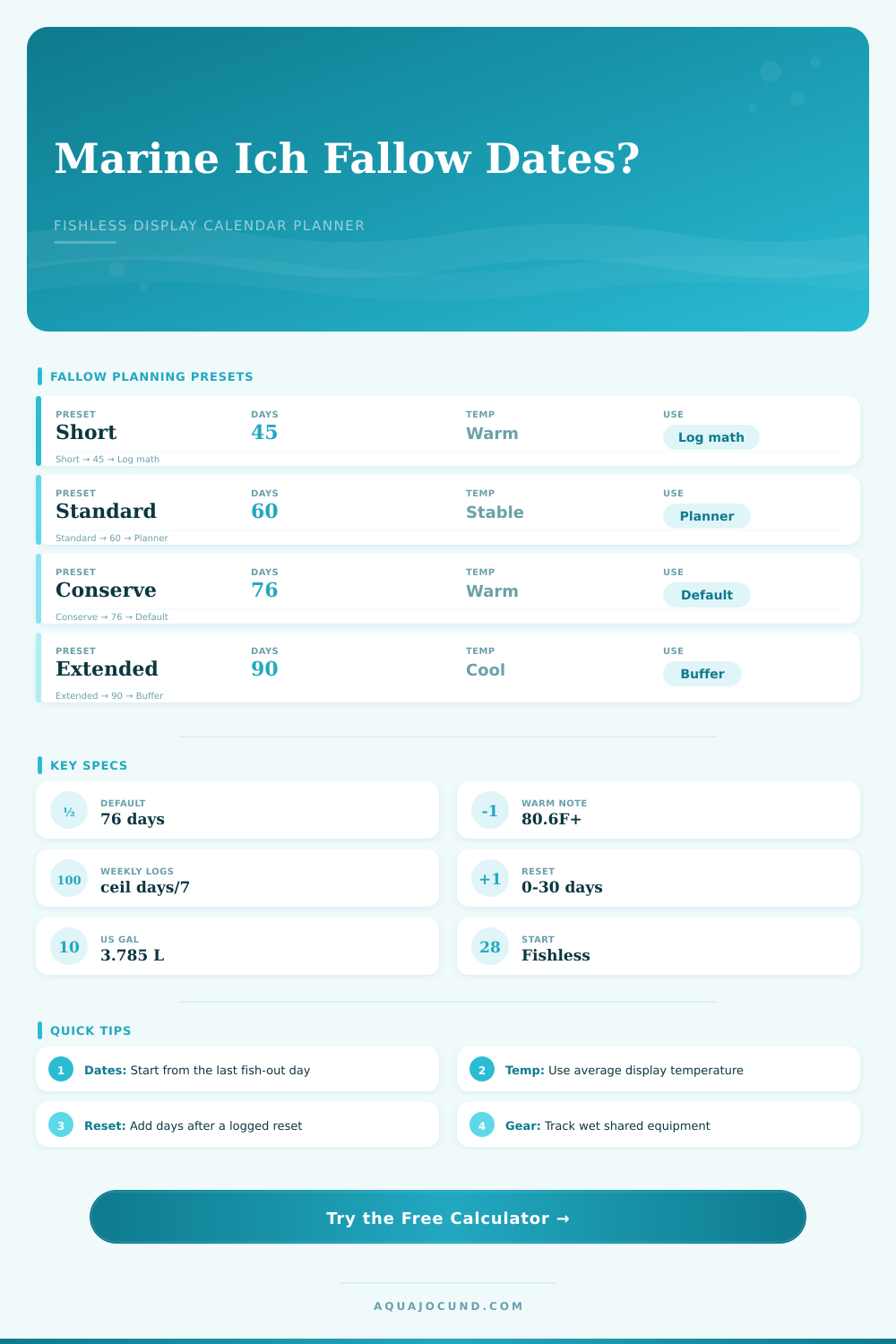
| Planning preset | Days added | Date math purpose | Temperature note |
|---|---|---|---|
| 45-day short log | 45 days | Creates a compact calendar window for records that use a shorter selected protocol. | Warm, stable displays usually receive the fewest planning-buffer notes. |
| 60-day standard plan | 60 days | Builds a two-month fishless display calendar with weekly checkpoints. | Moderate temperatures may justify extra review days in the calculator. |
| 76-day conservative default | 76 days | Common conservative fishless-display planning duration used for date arithmetic. | Temperature field creates notes only; it does not prescribe adjustment. |
| 90-day extended buffer | 90 days | Useful when the calendar needs more slack for cooler systems or uncertain logs. | Cooler averages display a higher planning-buffer note. |
| 120-day archive window | 120 days | Long form planning for records, shared equipment logs, or deliberately extended windows. | Best for conservative paperwork, not a care recommendation. |
| Average display range | Calculator buffer | Milestone effect | Note wording |
|---|---|---|---|
| 80.6°F+ / 27.0°C+ | 0 days in auto mode | Base selected date window remains unchanged. | Warm-average note, verify against your own protocol. |
| 78.0-80.5°F / 25.6-26.9°C | 7 days in auto mode | Completion date moves one week later. | Stable midrange note, calendar buffer added. |
| 75.0-77.9°F / 23.9-25.5°C | 14 days in auto mode | Completion date moves two weeks later. | Cooler-average note, larger planning buffer added. |
| Below 75.0°F / 23.9°C | 21 days in auto mode | Completion date moves three weeks later. | Cool log note, use a conservative calendar review. |
| System | Dimensions | Nominal volume | Example fallow calendar |
|---|---|---|---|
| 20 long nano reef | 30 × 12 × 12 in / 76 × 30 × 30 cm | 20 gal / 76 L | 76 base days plus any selected buffer days. |
| 40 breeder reef | 36 × 18 × 16 in / 91 × 46 × 41 cm | 40 gal / 151 L | Weekly milestones give about eleven review entries. |
| 75 gallon display | 48 × 18 × 21 in / 122 × 46 × 53 cm | 75 gal / 284 L | 90-day preset lands about three months after start. |
| 125 gallon reef | 72 × 18 × 21 in / 183 × 46 × 53 cm | 125 gal / 473 L | Connected wet zones can be tracked in one calendar. |
| 300 L metric display | 120 × 50 × 50 cm / 47 × 20 × 20 in | 79 gal / 300 L | Metric presets keep the same date math. |
| Placeholder type | Wet zones counted | Volume-factor hint | Calendar focus |
|---|---|---|---|
| Display tank only | 1 zone | 90-95% of nominal display | Start date, completion date, and final review entry. |
| Display plus sump | 2 zones | 95-115% when sump water is included | Shared water loop and sump equipment notes. |
| Connected refugium | 3 zones | 100-120% with refugium water online | Extra wet zone milestone and light-cycle notation. |
| Rock-heavy aquascape | 1-2 zones | 75-88% after displacement | Volume math and uncertainty-buffer entry. |
| Shared wet tools | Variable | Volume unchanged | Reset buffer and equipment log placeholders. |
For example, you’ve invested three years in a beautiful reef. Water parameters is dialed-in and the coral colonies has grown. You notice a small white spot on your clownfish and realize you need to go through a fallow period… so what’s the duration? That’s where this marine ich fallow period calculator come in handy, it takes away the guessing and replaces it with a specific timeframe on your calendar, turning waiting into an anxiety-free experience.
It’s basic biology, Cryptocaryon irritans need a fish host to reproduce. How long it survive in the free swimming stage depends completely of water temperature. For warm water, the life cycle is shortened; for cool water, it will slow way down. You’ve got to know when to start and exactly when to stop. Knowing exact timing for your own set up is important. Most hobbyists knows the standard benchmarks, but applying them to your specific tank setup require precision.
How the Fallow Calculator Helps You
Next, enter your start date, which is day the last fish left the system. There’s no wiggle room here; If you remove one fish on Tuesday, your clock begin ticking on Tuesday. You’ll then pick a duration preset based off what the calculator tells you from that anchor point; how long till your completion date? Aggressive is 45 days, common when quarantining in a hot tank. Conservative is 90 days, common as a buffer for cooler displays or when you want to be absolutly sure. The calendar day gives you something concrete to aim for.
It is less stressful than expected. While volume doesn’t change the fallow time, it help you visualize the scale of your system and plan your maintenance. That’s why it doesn’t show up as an input in the calculator. You can adjust the volume of the sump or how much displacement is caused by rocks (for those larger systems). This allows you to see what the scope of the job will be. It doesn’t alter the fallow time because a big tank with all that volume isn’t as much real water as its stated capacity implies. But at least if you know net volume you can plan out your maintenance schedule and water changes for the silent period.
Where most folks trip up is equipment tracking, there are field in the calculator for that. Why? Because anything wet, such as skimmer socks or nets, can carries ich. So the tool allows you to record contamination events when you dip a common tool into the following display, resetting the clock. The tool provide buffer days if it thinks you may have been exposed to keep the timeline accurate, since perfection is impossible.
The calculator doesn’t tell you what temperatures you should of kept, it just flags if your average display temperature suggest a shorter or longer wait. If the tank’s cool it will factor an additional day onto the schedule. So, rather than rushing a cool tank because you think 60 days have passed, it will remind you that you still has some days ahead. That’s because the parasite move slower at cooler temps. It won’t make you turn the heater down but it will remind you that biology play out differently in the real world.
Weekly check points and milestones help make the fallow period more bearable as well. Breaking it up helps with the long wait. Instead of staring at an empty tank for three months, you now have smaller goal. You have something to work toward. This gives you structure and a sense of progress. You’re able to go in there and check the equipment, check the rockwork, etc., to ensure your life support systems is running well and working right. It keeps things from drifting like they do if there’s nothing changing over a long period of time.
At the end of the day, there’s no treatment for a fallow period except patience, nothing in biology respond to being rushed. But the calculator provides a framework for your patience, taking a vague idea of “wait until things get better” and making it a set time on the calendar. You know when you’re going to be able to restock. You know when the risk is almost gone.
Yes, you waited for your reef to grow up. Now you wait for the parasite to die off. The calendar makes sure you wait long enough, but not one second more.