🐟 Medicated Food Mixing Calculator
Convert fish biomass, feed ration percent, label-entered active ingredient target, product strength, binder volume, and batch length into measured mixing amounts.
Mixing measurement sheet
Review label and veterinarian instructions before using any result.
| Feed form | Density guide | Binder guide | Mixing note |
|---|---|---|---|
| Micro pellet / crumble | 0.45-0.60 g/mL | 35 mL/kg | Small batches need precise scales and even dusting. |
| Flake or thin wafer pieces | 0.12-0.25 g/mL | 45 mL/kg | Low density makes volume measures less reliable. |
| Small floating pellet | 0.50-0.65 g/mL | 65 mL/kg | Use gradual coating to avoid clumping. |
| Sinking pellet | 0.58-0.75 g/mL | 85 mL/kg | Often accepts a little more carrier liquid. |
| Koi pellet | 0.40-0.55 g/mL | 75 mL/kg | Large pellets may need longer tumbling. |
| Gel food cubes | 0.85-1.05 g/mL | 140 mL/kg | Count the liquid already inside the gel mix. |
| Paste or mash feed | 0.75-1.00 g/mL | 180 mL/kg | Wet carriers are measured as part of final feed. |
| Thawed frozen blend | 0.80-1.05 g/mL | 120 mL/kg | Drain excess water before weighing if required. |
| Strength format | Entered value | Calculator conversion | Verify before use |
|---|---|---|---|
| Percent active powder | % active | product g = active mg / (% / 100) / 1000 | Label strength |
| mg active per gram | mg/g | product g = active mg / mg per g | Premix label |
| Capsule or tablet | mg each | units = active mg / mg per unit | Rounding check |
| Liquid product | mg/mL | mL = active mg / mg per mL | Volume check |
| Stock slurry | mg/mL optional | slurry mL = active mg / stock mg per mL | Separate record |
| Scenario | Biomass | Daily ration | Batch feed | At 500 mg/kg feed |
|---|---|---|---|---|
| Nano pellet check | 0.05 kg / 0.11 lb | 1.5% | 3.9 g for 5 days | 2.0 mg active |
| Community batch | 0.20 kg / 0.44 lb | 1.5% | 15.8 g for 5 days | 7.9 mg active |
| Goldfish pellets | 0.90 kg / 1.98 lb | 1.0% | 47.3 g for 5 days | 23.6 mg active |
| Koi small pond | 18 kg / 39.7 lb | 1.2% | 1.59 kg for 7 days | 793.8 mg active |
| Tilapia growout | 25 kg / 55.1 lb | 1.8% | 3.31 kg for 7 days | 1,653.8 mg active |
| Direct small batch | not used | not used | 10 g entered feed | 5.0 mg active |
| Record item | Why it matters | Example entry | Calculator field |
|---|---|---|---|
| Fish biomass basis | Shows how feed weight was derived | 24 fish x 8 g = 192 g | Count, average, or direct biomass |
| Finished feed target | Keeps the active concentration traceable | 500 mg/kg feed | Target active ingredient |
| Product strength | Prevents confusing total product with active ingredient | 100 mg active/g premix | Strength format and value |
| Binder volume | Documents coating liquid and slurry volume | 1.0 mL for 15.8 g feed | Binder mode and mL/kg |
| Review source | Ties the math to label or written instructions | Label lot or vet note ID | Label or instruction ID |
If you’ve mixed your own medication in your fish food, you know that you’re dealing with some exacting math. You have an idea how much medication you need, but figuring out exact amounts for mixing isn’t always a sure thing. Either they don’t take it or the medication doesn’t stay on when you try to give it.
In most cases, it’s not about the medication. It’s about the math. The math involve figuring out ratio of active ingredient, binder volume, feed ration volume, and the biomass of the tank you’re treating. That sounds easy enough on paper but in practice rarely is.
How to Mix Fish Medicine
When you plug-in information about your tank (weight of fish) and medication (concentration), the calculator do the heavy lifting for you.
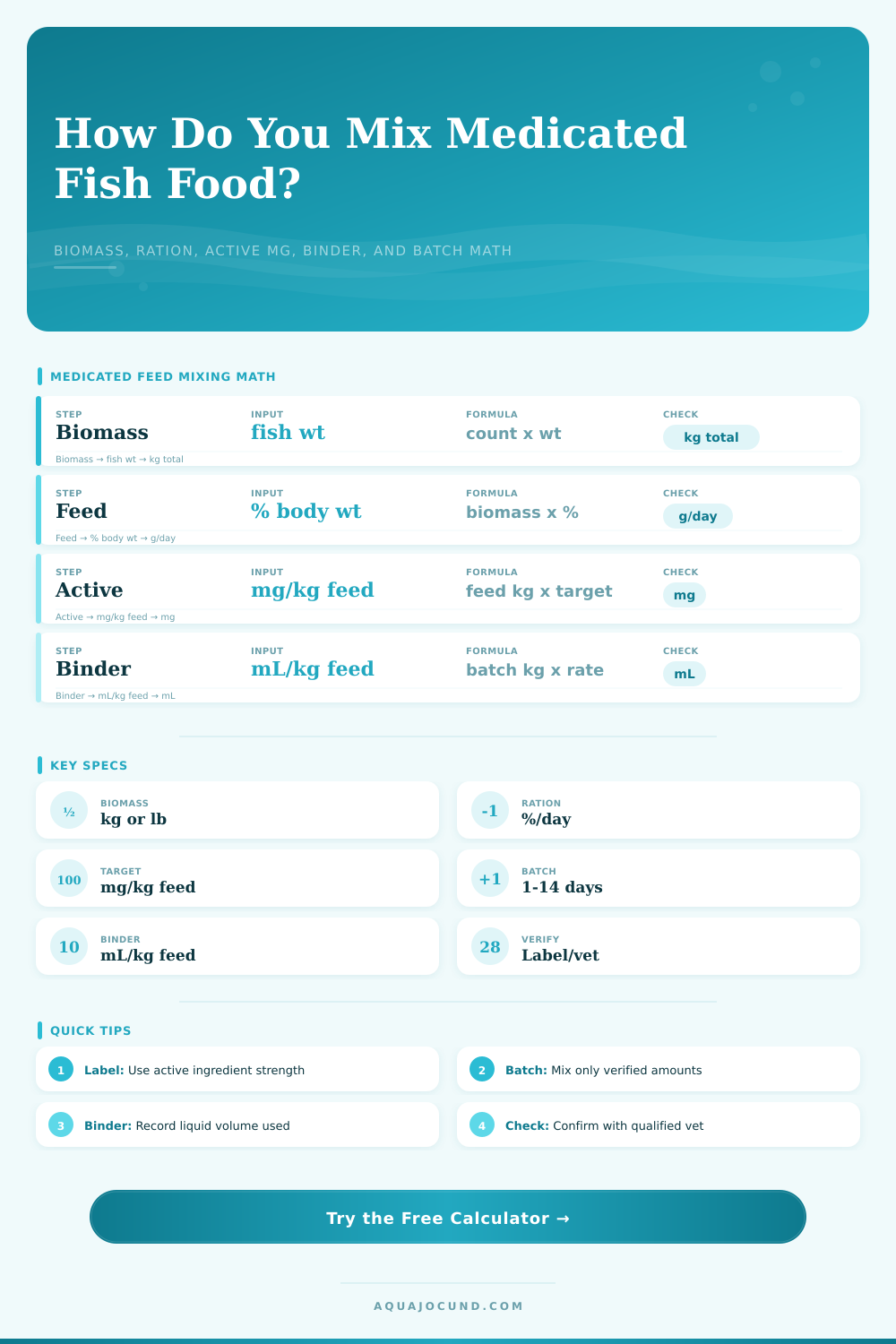
Most hobbyists begin with total biomass… The total weight of all the fishes in the system. You can use an actual weight, provided you have a sufficiently large scale. Alternatively, you can simply guess at it using an average weight times the number of fish.
Why does that matter? Because we’re guessing here, there’s variance to your estimate. Guessing wrong by 10% will cause you to be 10% out on the feed ration, that will affect each following number calculated.
After that, we have the feed ration, typically stated as %body weight/day. Here’s where biology meets logistics. Feed requirements may be half or less of body weight/day if your fish are tropical versus coldwater; and zero, nada, nothing if they’re stressed out.
With this tool, you can account for batch size. I.e., prepare one mix for a week instead of every single day. That reduces labor but increases importance of getting it right. Because you’re essentially pre-dosing the week’s worth of nutrition for your fish, precision is a must.
Most people make their mistakes in the “active ingredient” section. They will enter wrong value into the box thinking it represents total product weight. For example, if your powder contain just 10% active medication, you will need ten times as much product as pure powder to get the same result.
The calculator separates the product strength (how much medicine you’re using) from target dose (how many milligrams per kilogram of feed you want). This removes any confusion and tells you exactly how many milliliters or grams of actual product to measure. This means you can avoid most common error of under dosing due to use of a weak premix.
The last variable is Binder volume. This is what most people overlook. Medication doesn’t adhere to dry pellets…well not well anyway. It requires some sort of liquid carrier like boiled water with methylcellulose or a gel binder to put around the food.
How much? That all has to do with form of the food. Wet gel cubes holds more liquid than sinking pellets, and sinking pellets hold more than small floating pellets. The chart on the page breaks it down for you. It shows that paste feed can hold as much as one hundred eighty milliliters, while micro pellets may require only thirty five per kilo.
Not enough binder and medication comes off in water. Too much binder and your food dissolves before fish can consume it.
At the end of the day, adding medicine to food mixtures is as much about recording details as it is about guessing. The tool prompts you to write down the following: 1) Label ID, 2) Batch Date and 3) the precise quantity of each ingredient used. This isn’t just bureaucratic busywork. If the treatment doesn’t work, you would of wanted to know if it was because of the wrong dose. Was it the wrong ratio? It could be a wrong binder.
Get your math right and all you’ve got left is the fishs response. And that, too, is a variable to be recorded.
Always check with your veterinarian, then also compare results to product label before mixing. This is a precision tool, not a diagnosis tool. You input the information and make the judgment. If the math is correct, it forms into a feed, the fish eat it and the medication works.