💊 Chloroquine Phosphate Dose Calculator
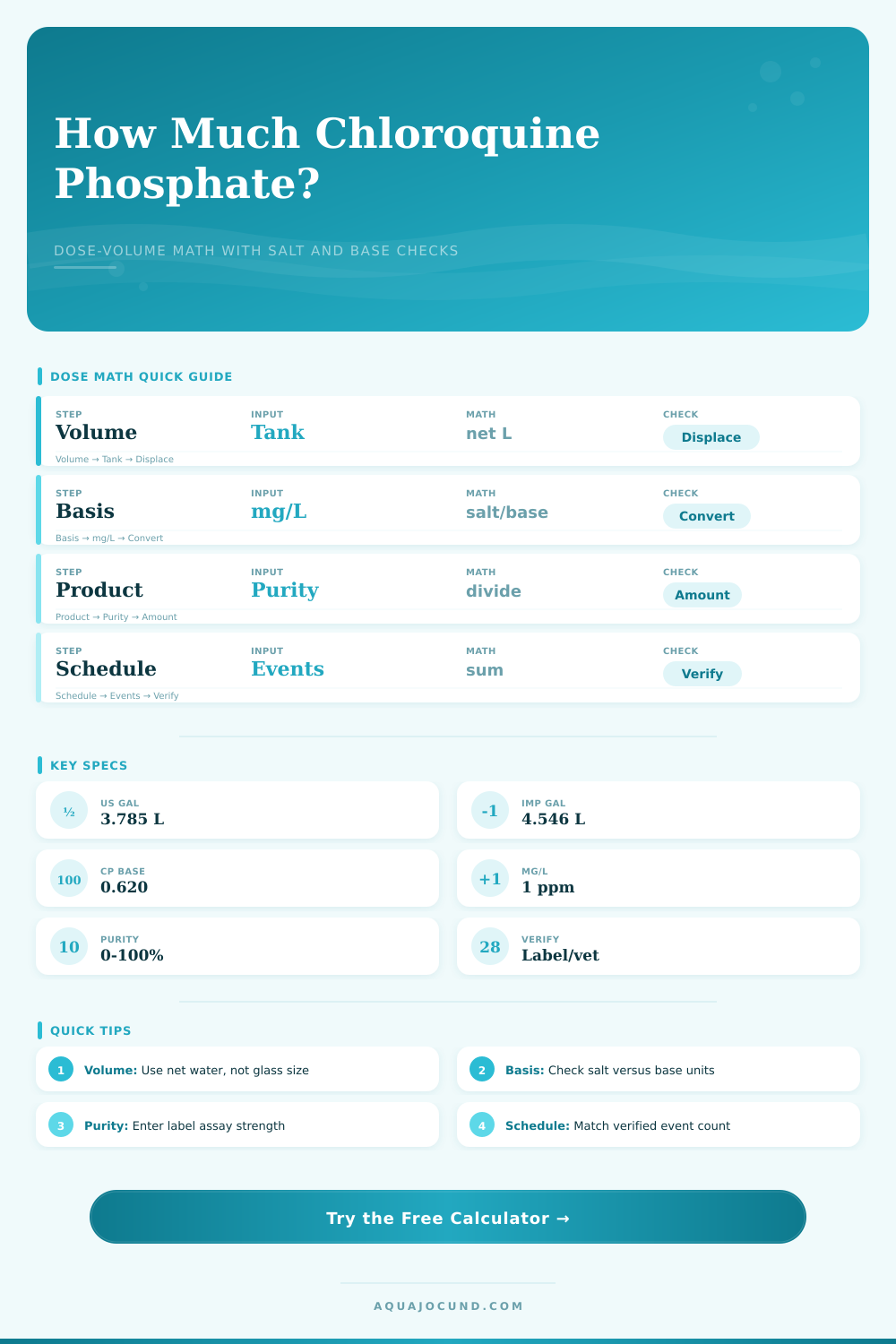
Convert net aquarium water volume, mg/L target basis, chloroquine phosphate purity, displacement, and repeat events into dose-volume arithmetic.
| Input Basis | Calculator Conversion | Example | Verification Point |
|---|---|---|---|
| CP salt mg/L | CP mg = mg/L target × net liters | 10 mg/L in 100 L = 1000 mg CP | Confirm the label states chloroquine phosphate, not base equivalent. |
| Base equivalent mg/L | CP mg = base mg/L × liters / 0.620 | 6.2 mg/L base in 100 L = about 1000 mg CP | Check whether the source lists active chloroquine base. |
| Purity adjusted | Product amount = CP mg / effective strength | 1000 mg CP at 95% = 1.053 g powder | Use the assay, potency, or certificate value when available. |
| Repeat schedule | Total = first amount + repeat amount × remaining events | Four events use one first amount and three repeats | Match only a verified schedule; the calculator does not create one. |
| Product Format | Strength Field Means | Product Output | Formula Used |
|---|---|---|---|
| Dry powder percent CP | Percent chloroquine phosphate by weight | grams | CP mg / fraction / 1000 |
| Dry blend mg CP per gram | Milligrams of CP in each gram of product | grams | CP mg / mg per gram |
| Stock solution mg CP per mL | Milligrams of CP in each mL of liquid | mL | CP mg / mg per mL |
| Tablet, capsule, or packet | Milligrams of CP in each whole unit | units | CP mg / mg per unit |
| Common Aquarium Size | Inside Dimensions | Nominal Volume | CP mg at 1 mg/L Before Displacement |
|---|---|---|---|
| 5 gallon | 16 in × 8 in × 10 in / 41 cm × 20 cm × 25 cm | 5 gal / 18.9 L | 18.9 mg CP |
| 10 gallon | 20 in × 10 in × 12 in / 51 cm × 25 cm × 30 cm | 10 gal / 37.9 L | 37.9 mg CP |
| 20 long | 30 in × 12 in × 12 in / 76 cm × 30 cm × 30 cm | 20 gal / 75.7 L | 75.7 mg CP |
| 40 breeder | 36 in × 18 in × 16 in / 91 cm × 46 cm × 41 cm | 40 gal / 151.4 L | 151.4 mg CP |
| 75 gallon | 48 in × 18 in × 21 in / 122 cm × 46 cm × 53 cm | 75 gal / 283.9 L | 283.9 mg CP |
| 125 gallon | 72 in × 18 in × 21 in / 183 cm × 46 cm × 53 cm | 125 gal / 473.2 L | 473.2 mg CP |
| Schedule Field | What It Changes | Neutral Math Example | Label/Vet Check |
|---|---|---|---|
| Dose events | How many arithmetic entries are added | 1 event = first amount only | Do not infer event count from this tool. |
| Full target repeat | Repeats the full target amount | Repeat CP = target mg/L × net L | Use only if the verified instructions say so. |
| Replacement-only repeat | Calculates amount for water changed | 25% changed = 25% of net-volume CP amount | Confirm whether replacement water is handled separately. |
| Custom repeat factor | Uses a percent of first amount | 50% factor halves the repeat amount | Enter only a verified arithmetic factor. |
Most aquarists’ woes begin with misreading their water volume. They purchase a 20g tank but the volume of water in that tank isn’t 20 gallons. Why? This is because equipment, filter media, rock work, and sand all displaces water. Fewer gallon equals fewer gallons to maintain.
Chloroquine phosphate is very effective, so you don’t want to overdose it. That’s why the calculator subtracts volume of hardscapes to prevent an overdose based off the tank’s nominal size.
How to Measure Your Aquarium Water Correctly
Math turns guesswork into a calculation but it only works if you know what those numbers mean for your fish. A common mistake involves confusing the base and the salt. The active ingredient is chloroquine base, but this salt also contains chloroquine phosphate. These aren’t interchangeable on weight-for-weight basis. For example, there’s about a 0.62 conversion factor between two forms. That is, to achieve a certain amount of active ingredient, the salt version weigh more then the base version. So if you’re trying to administer a dose in terms of base equivalent and you weigh out pure phosphate salt instead, you’ll come up short.
You can use the tool to choose the basis on which you want to work; this way the math lines up with whatever instruction you follow. It sounds like a tiny detail but it makes all the difference between success and failure.
But there’s more: how about product purity? Some formulas is weaker. Some powders aren’t 100% active. Without paying attention to the assay value, it’s a guess as to what your dose is. Enter the strength of particular product you’re buying, and the calculator will adjust for correct dose required to reach your desired concentration. That way you avoid the trap of thinking all powders are created equally. Because they aren’t. Your purchase isn’t generic; it’s a particular product at a particular potency. The math accounts for that fact so you get proper amount of chemical instead of only the proper amount of powder.
If you redose with every water change, your schedule gets complicated. The calculator models several approaches, ranging from full dosing to re-dosing everything after a water change (or replacing just the dose that was lost). If you changed 25% of the water, then you’ve lost 25% of the drug, so you need to replace that to maintain consistent concentration. That keeps pressure on the parasite consistently. By setting number of events (water changes) and their frequency, the tool will calculate how much you need to add back to get consistant concentration throughout your treatment course.
Now we need to measure out the water. For most aquariums, filling a bucket up and pouring it into the tank will be far more precise than simply going by outside measurements. Bows are even worse. It has options for calculating shapes but you should of verify things in the real world. Pour a full bucket of water into the tank, mark where it comes to on the inside walls, then do this again. This way you can determine exact amount of water in there. If you don’t have this starting point then all your other calculations won’t mean anything. Use a bucket, not what’s on the side of the tank. Common tank dimensions are referenced in conversion charts, which give an estimate of gallons/liters/milligrams. Your tank isn’t one of these though, so trust what’s in your bucket, not the box.
You plug the numbers into it and get exact amount of the product you need in milliliters or grams. That takes the guesswork out of it and eliminates the stress of not knowing how much to put in.
But again: never take anyone’s word on anything (including mine) on medical matters without checking with the label and/or vet. They can tell you what they suggest you try and when to use it. The tool gives you the precision. But it’s up to you to give that number some context.
After you’ve got the proper amount, then you just wait until the water works its magic. You did all the work.