🧪 Tetracycline Aquarium Dose Calculator
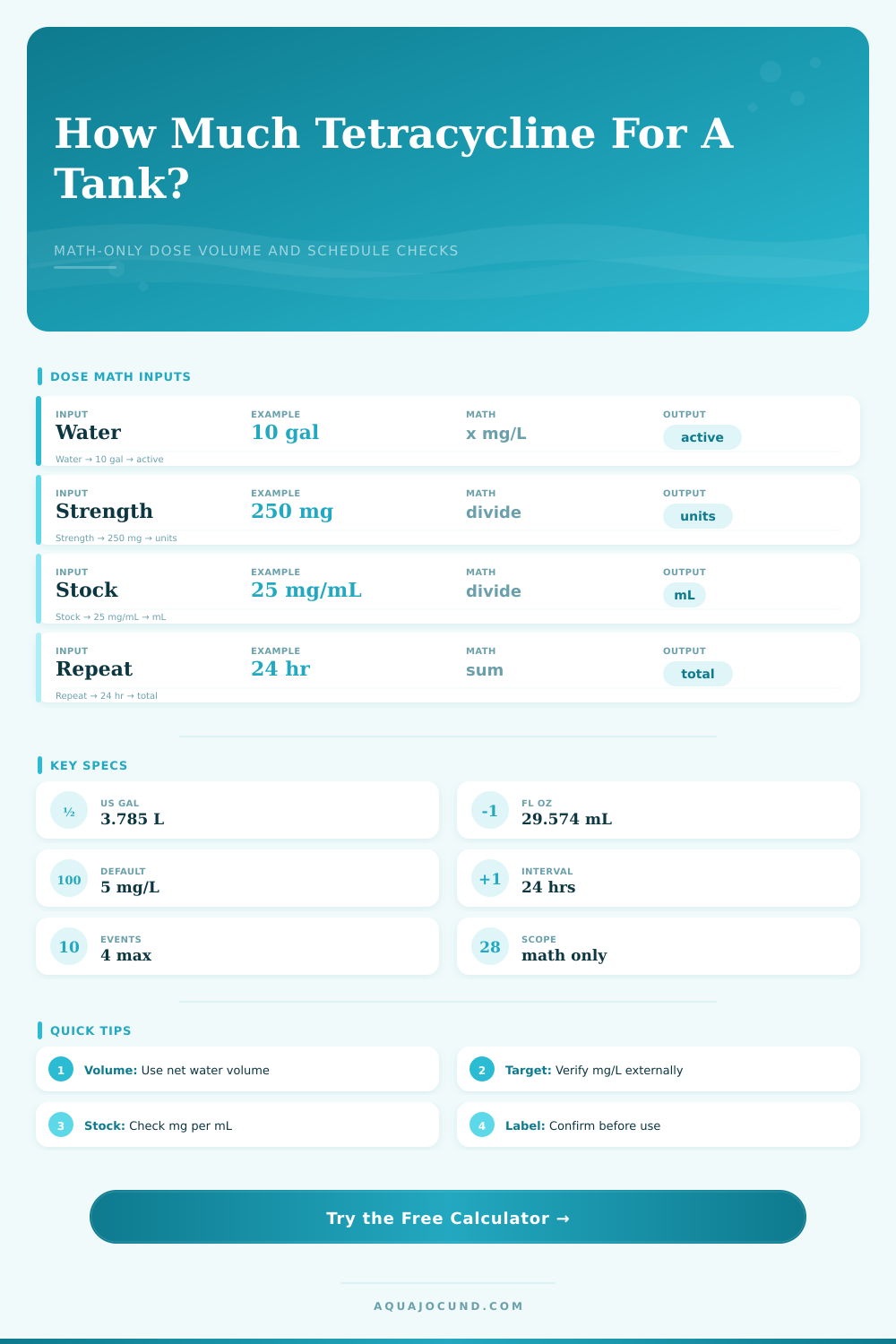
Convert verified target concentration, net aquarium water volume, active strength, stock solution strength, dose amount, repeat interval, and carbon or UV pause windows into arithmetic.
Calculated Dose Math
| Format | Calculator Input | Amount Formula | Verification Wording |
|---|---|---|---|
| Dry unit | Active mg per capsule, tablet, scoop, or packet | Product units = active mg needed / mg per unit | Confirm the active tetracycline value on the specific label. |
| Percent powder | Active percent by weight | Product grams = active mg / percent active / 1000 | Use the active ingredient percentage, not total package weight. |
| mg/g powder | Active mg per gram of dry blend | Product grams = active mg needed / mg per gram | Verify whether the entry is tetracycline base or salt equivalent. |
| Stock liquid | Active mg per mL | Stock mL = active mg needed / mg per mL | Use a freshly verified stock concentration and label source. |
| Tank | Nominal Dimensions | Gross Volume | Active Mg At 5 mg/L Before Displacement |
|---|---|---|---|
| 5 gal rectangle | 16 x 8 x 10 in / 40.6 x 20.3 x 25.4 cm | 5.5 gal / 20.8 L by dimensions | 104 mg active |
| 10 gal rectangle | 20 x 10 x 12 in / 50.8 x 25.4 x 30.5 cm | 10.4 gal / 39.4 L by dimensions | 197 mg active |
| 20 long rectangle | 30 x 12 x 12 in / 76.2 x 30.5 x 30.5 cm | 18.7 gal / 70.8 L by dimensions | 354 mg active |
| 40 breeder rectangle | 36 x 18 x 16 in / 91.4 x 45.7 x 40.6 cm | 44.9 gal / 170.0 L by dimensions | 850 mg active |
| 75 gal rectangle | 48 x 18 x 21 in / 121.9 x 45.7 x 53.3 cm | 78.5 gal / 297.2 L by dimensions | 1486 mg active |
| Model | Repeat Active Mg Formula | Schedule Total Formula | Use In Calculator |
|---|---|---|---|
| Same amount | Target mg/L x net L | First active + repeat active x later events | Arithmetic for equal event amounts. |
| Water-change replacement | Target mg/L x net L x water-change percent | First active + replacement active x later events | Arithmetic for replacing a changed water fraction. |
| Custom percent | First active x custom repeat percent | First active + custom repeat active x later events | Arithmetic for externally supplied repeat percentages. |
| New-water premix | Target mg/L x net L x new-water percent | First active + premix active x later events | Arithmetic for mixing replacement water to target. |
| Conversion | Factor | Formula Direction | Calculator Use |
|---|---|---|---|
| US gallons to liters | 1 gal = 3.785411784 L | gal x 3.785411784 = L | Converts tank volume to mg/L dose math. |
| Cubic inches to US gallons | 1 in3 = 0.00432900433 gal | L x W x H x factor = gal | Converts inside dimensions into water volume. |
| Cubic centimeters to liters | 1000 cm3 = 1 L | L x W x H / 1000 = L | Converts metric dimensions into water volume. |
| US fluid ounce to milliliters | 1 fl oz = 29.5735296 mL | mL / 29.5735296 = fl oz | Shows stock solution volume equivalents. |
It’s late, your fish are sick, the water looks suspicious, and you want to get things fixed before you do any further damage. This isn’t something that can be addressed with instinct; treating disease in an aquarium is as much about chemistry as it is about medicine. And you don’t need to mess around with unit conversions either… The calculator does the work for you once you plug-in the volume of your tank and desired treatment concentration.
But what do all those numbers represents for your tank? The second common mistake is volume. Most folks think if they have a 10g tank then there are ten gallons of water in their tank. Nope, most often not. There’s filter(s) taking up space, substrate, rocks, driftwood, etc., so maybe you only have seven gallons of actualy water. If you dose for ten gallons when you really have seven, you’ve overdosed by thirty percent. You can enter the % displacement into the tool to make up for this non-water space. Why? Because high concentration = stress on your livestock. And you want to deliver the right amount in the water…not just in the container.
How to Use the Dose Calculator
The other variable is product strength. Different capsules has different strengths; some have 250 mg, others 500 mg. Similarly, powder can be pure or dilute. To make things harder, not every capsule, liquid, or powder contains same concentration of active ingredients. So you have to identify the actual quantity of active ingredients in your product. Instead of dumping a scoop without reading the label, you actually have to read it. If you’re using a stock solution, then you should also knows the milligram/milliliter content. That will give you an exact measure rather than a vague guess.
All this make sense once you see how various formats alter the final math in the reference tables. Tetracycline’s rate of degradation in your water determine the treatment schedule. Generally speaking, it won’t last indefinitely; you’ll have to give it again if you want to keep therapeutic levels. To model this behavior, the tool supports various repeat scenarios (e.g., top off after water change vs. This includes full replacement. It also calculates cumulative total; i.e., how much product do I need for the whole course? This ensures that you don’t run out midway through and helps you better budget for the medication.
The tetracycline doesn’t have enough time in the water to cure the infection, the carbon and UV lights strip it out first. You’ll want to suspend those filters while using the system and there’s a space on the calculator for stopping and resuming them. It seems obvious, but I’ve seen too many people forget about it after medication is filtered out; now your good water system is working against the treatment.
The beauty of this system is consistency. Once you confirm all your inputs, the math stays consistent. You won’t have to guess at dose each day, and you will know exactly what you should of be doing. Allowing time for healing is key here and the correct dose are critical to getting the fish there.