Kanamycin Aquarium Dose Calculator
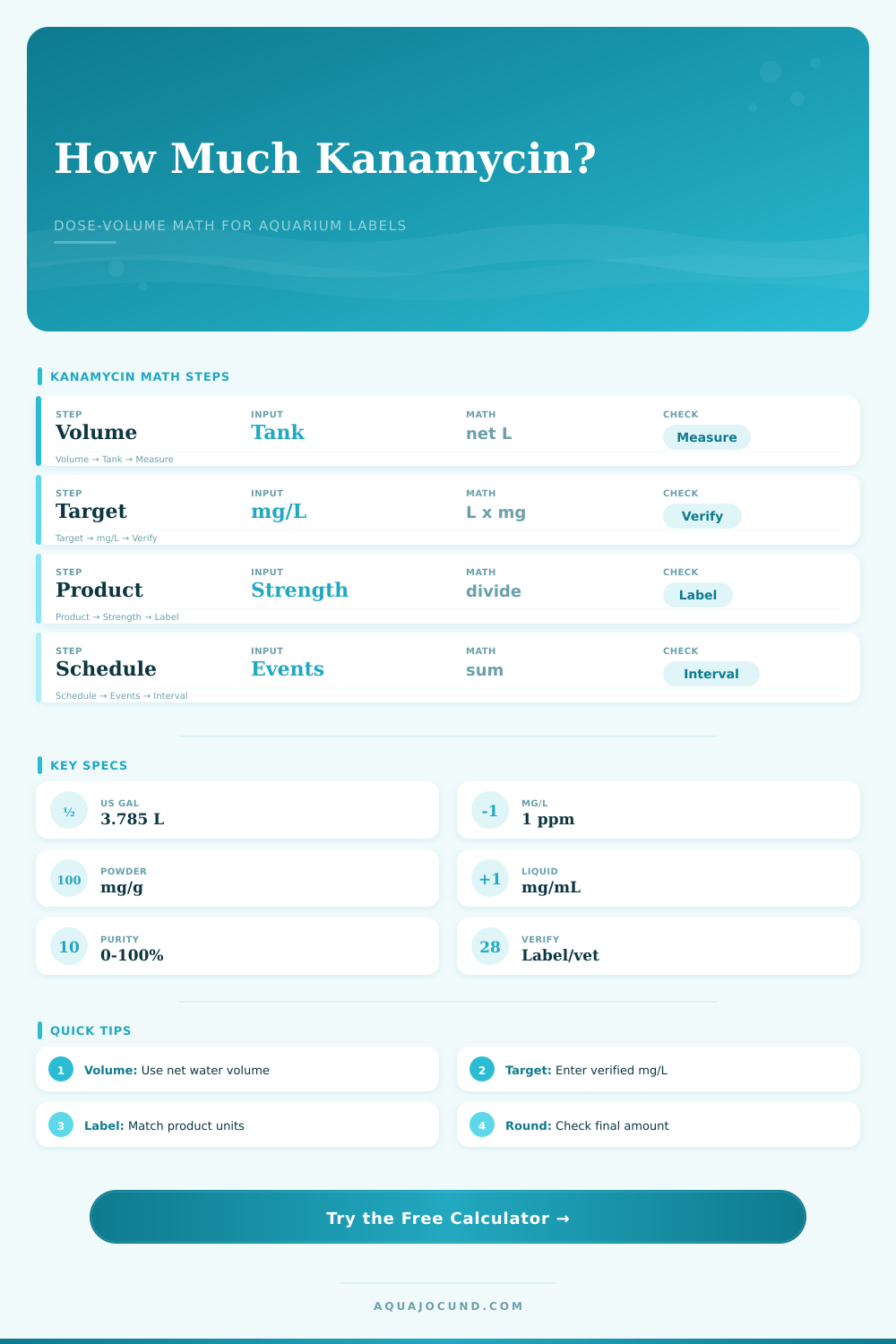
Math-only dose-volume calculator for net water volume, displacement, product strength, purity, and verified schedule inputs.
Powder mg/g
Uses active milligrams per gram of powder, then applies the purity or assay percent.
Liquid mg/mL
Uses active milligrams per milliliter and returns milliliters per event.
Net volume
Subtracts displacement unless the measured custom volume is already net water.
Schedule math
Sums first and repeat events from the selected repeat model and interval.
| Conversion | Formula | Use in calculator | Verification point |
|---|---|---|---|
| US gallons to liters | gallons x 3.785411784 | Converts tank water to liters for mg/L arithmetic. | Use actual filled volume when known. |
| Cubic inches to gallons | cubic inches / 231 | Calculates rectangular and cube tank volume. | Outside dimensions can overstate real water volume. |
| mg/L target to active mg | net liters x mg/L | Returns active kanamycin amount for the event. | Target mg/L must come from the label or veterinarian. |
| Powder product amount | active mg / adjusted mg per g | Returns grams of powder. | Check whether the label says active mg/g or total blend mg/g. |
| Liquid product amount | active mg / adjusted mg per mL | Returns milliliters of liquid. | Check concentration units and dilution basis. |
| Product entry type | Strength field means | Output unit | Math note |
|---|---|---|---|
| Powder - 1000 mg/g | Pure active arithmetic basis | grams | 1 g entered strength equals 1000 active mg before purity adjustment. |
| Powder - 900 mg/g | Assayed active per gram | grams | Useful when a certificate or label lists less than full active content. |
| Powder blends | Active mg in each gram of blend | grams | The calculator divides by the active fraction, not by total filler weight. |
| Liquid stock | Active mg in each milliliter | mL | Use the concentration after any dilution, not before dilution. |
| Custom strength | User-entered mg/g or mg/mL | grams or mL | Best for label formats not included in the preset list. |
| Common aquarium size | Typical dimensions | Gross volume | Example active mg at 5 mg/L after 10% displacement |
|---|---|---|---|
| 5.5 gal small tank | 16 x 8 x 10 in / 41 x 20 x 25 cm | 5.5 gal / 20.8 L | 93.7 mg active, example only |
| 10 gal standard | 20 x 10 x 12 in / 51 x 25 x 30 cm | 10.4 gal / 39.4 L by dimensions | 177.2 mg active, example only |
| 20 long | 30 x 12 x 12 in / 76 x 30 x 30 cm | 18.7 gal / 70.8 L by dimensions | 318.6 mg active, example only |
| 40 breeder | 36 x 18 x 16 in / 91 x 46 x 41 cm | 44.9 gal / 169.9 L by dimensions | 764.4 mg active, example only |
| 75 gal display | 48 x 18 x 21 in / 122 x 46 x 53 cm | 78.5 gal / 297.1 L by dimensions | 1337.0 mg active, example only |
| Schedule mode | Repeat event formula | Total schedule formula | Use only when verified |
|---|---|---|---|
| Same target amount each event | net L x target mg/L | first amount + repeat amount x remaining events | When the verified schedule calls for equal arithmetic entries. |
| Replacement volume only | net L x water change percent x target mg/L | first amount plus top-up math for repeat events | When only changed water is being matched to a verified target. |
| Custom percent of first amount | first amount x custom repeat percent | first amount plus custom repeats | When a label, veterinarian, or lab sheet gives a repeat fraction. |
| Interval span | (events - 1) x hours between events | reports elapsed time from first to final event | Confirms timing arithmetic; it does not choose timing. |
Anyone who has had fish with an internal bacterial infection knows how to tell when something isn’t right: loss of appetite, lethargy, or slowed down gill movement. You’re thinking that it’s a pathogen somewhere deep in their tissues or gut. That’s where drugs such as kanamycin would of used. But here’s the thing, you aren’t giving a pill to a human; instead, you are dosing a living animal in a continuously changing volume of water. Getting this wrong doesn’t just result in wasting medication. It also results in creating conditions that allow for survival of bacteria and adaptation to the drug.
And there’s the heart of it all: Aquariums aren’t idealized perfect cubes of water. There’s rockwork (or other decoration), substrate on the floor, media and sponge in filters, usually an air gap between the water surface and the tank’s edge… If you buy a twenty-gallon tank, you don’t actualy have twenty gallons of water; you might only have fifteen or sixteen, assuming heavy plant coverage. So when you dose for the full twenty gallons, you’re actually under-dosing what’s in the tank, creating a reservoir of un-eradicated infection that won’t go away. On the flip side, you can overestimate the tank size and overdose, which will strip out beneficial bacteria from your filter. That creates a spike in ammonia that kills your fish even more quick than whatever caused the infection.
How to Dose Your Tank Correctly
Let’s get real: most of the stuff we treat our tanks with works through the magic of displacement (it’s an unknown variable). But there’s no need for us to worry about that. All we have to do is enter the tank size and a guesstimate of what % of the tank contains anything other than water (including rocks, substrate, wood, plants, etc) and it calculate the net volume for you. That’s the amount that really counts. Next, it uses whatever concentration the vet says or the label recommends. This matters because the form of the product makes a big difference. Is it pure powder, a premixed solution, or something with a filler? Those all has different levels of activity per unit mass.
Finally, it divides the total required milligrams of active ingredient based off how strong yours is. It will account for purity, unless you don’t know the assay and it’s not 100%. Most hobbyists who do this at home get tripped up on how much active ingredient is actualy in what they buy compared to amount of the overall product. For example, a gram of kanamycin isn’t necessarily a gram of kanamycin. There may be 800 mg of inert carrier (powder) for every 200 mg of active drug. Dosing accordingly will result in severe underdosing if you base your dose on whole weight.
The tool separates those factors so that the outputted milliliters/grams reflect the actual therapeutic concentration needed in the water. Plus, since kanamycin is typically pulsed, this help structure out when to repeat the events. Typically, there are water changes after the pulse treatments. These manage the half life of drug in the tank and prevent resistance from developing. Because of the repeat event logic in the tool, you can calculate whether you need to treat all the water or top up only the water that got changed.
First of all, keep in mind, this is arithmetic, not medicine. While the calculator will spit out a number to X decimal places based off your input, it won’t tell you what’s wrong with the fish. Nor will it tell you whether kanamycin is the right treatment for the specific pathogen involved. For that, you’ll need to observe and typically consult a pro. What the calculator does do is ensure an accurate delivery mechanism when you’ve reached a diagnosis and determined that kanamycin is indeed indicated. No more guessing at scale or syringe size.
All this is to say that treatment is also about precision; small doses in large volumes, and those doses influenced by factors beyond your control. To be clear you want to give just as much as needed to disrupt the infection but not so much then throw off the already delicate tank balance. So you verify the net volume and know the active strength and then bring the treatment into line with reality. There is no more guesswork or guessing, only treating. And that’s what turns failure into success, moving from a stressful situation to one where you have taken back control and made it a treatable condition.