🧮 Erythromycin Aquarium Dose Calculator
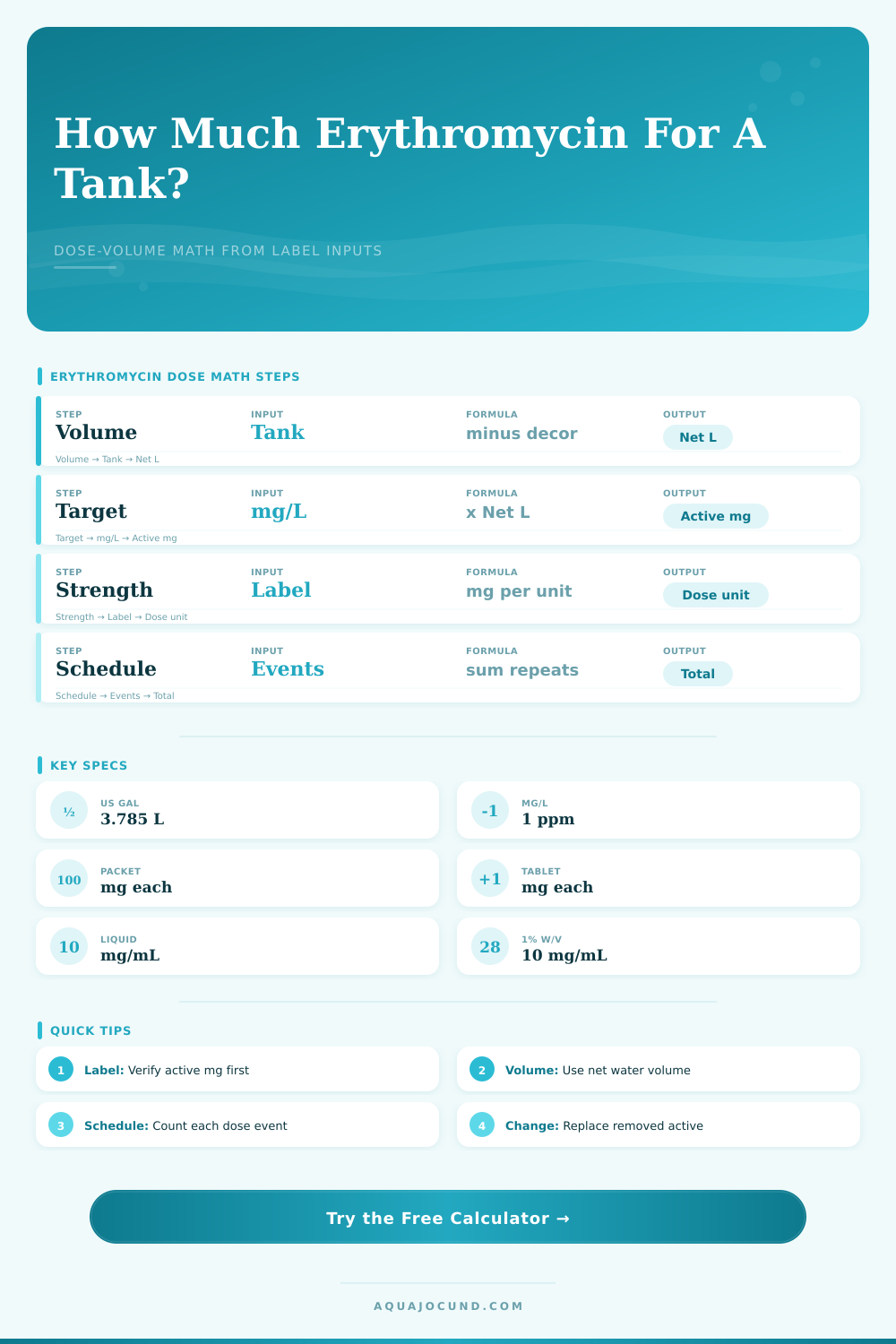
Convert net aquarium water volume, a user-entered mg/L target, label strength, dose format, timing, and water-change fields into neutral arithmetic.
| Calculator Step | Formula Used | Input Source | Output |
|---|---|---|---|
| Net liters | gross liters x fill factor x (1 - displacement) | Tank measurements or direct volume | Water volume used in dose math |
| Target active mg | (target mg/L - starting mg/L) x net liters | Verified label or vet number | Active erythromycin for first event |
| Product amount | active mg divided by active strength | Packet, tablet, liquid, or powder field | mL, grams, tablets, packets, or units |
| Water-change repeat | target mg/L x net liters x water-change percent | Water-change adjustment field | Replacement active amount |
| Format | Strength Field Means | Product Unit Shown | Conversion Note |
|---|---|---|---|
| Packet | active mg per packet or capsule | packets | Product amount = active mg / mg each |
| Tablet | active mg per tablet | tablets | Fractional result is arithmetic only |
| Liquid | active mg per mL | mL | Use the labeled active concentration |
| 1% w/v | 1 g active per 100 mL | mL | 1% w/v equals 10 mg/mL |
| Dry % | active percent by weight | grams | 100% means 1000 mg active per gram |
| Blend | active mg per gram | grams | Useful when a label lists mg/g |
| Tank Name | Typical Inside Math | Gross Volume | 90% Net Example |
|---|---|---|---|
| 5.5 gallon | 16 in x 8 in x 10 in | 5.5 US gal / 20.8 L | 5.0 gal / 18.7 L |
| 10 gallon | 20 in x 10 in x 12 in | 10 US gal / 37.9 L | 9.0 gal / 34.1 L |
| 20 long | 30 in x 12 in x 12 in | 20 US gal / 75.7 L | 18.0 gal / 68.1 L |
| 29 gallon | 30 in x 12 in x 18 in | 29 US gal / 109.8 L | 26.1 gal / 98.8 L |
| 40 breeder | 36 in x 18 in x 16 in | 40 US gal / 151.4 L | 36.0 gal / 136.3 L |
| 55 gallon | 48 in x 13 in x 21 in | 55 US gal / 208.2 L | 49.5 gal / 187.4 L |
| 75 gallon | 48 in x 18 in x 21 in | 75 US gal / 283.9 L | 67.5 gal / 255.5 L |
| 125 gallon | 72 in x 18 in x 21 in | 125 US gal / 473.2 L | 112.5 gal / 425.9 L |
| Schedule Model | Repeat Event Math | Best Input To Verify | Calculator Output |
|---|---|---|---|
| Single event | first event only | target mg/L and net liters | one product amount |
| Full repeat | same active mg as first event | event count and interval | total product across events |
| Water-change replacement | target x net liters x changed percent | water-change percentage | replacement amount per repeat |
| Custom percent | first event amount x custom percent | custom repeat percent | scaled repeat arithmetic |
| Conversion | Factor | Used For | Calculator Rule |
|---|---|---|---|
| US gallon to liter | 1 gal = 3.78541 L | Direct volume entry | Converted before mg/L math |
| Cubic inch to US gallon | 231 in³ = 1 gal | Dimension volume | Length x width x height / 231 |
| Cubic centimeter to liter | 1000 cm³ = 1 L | Metric dimensions | cm³ divided by 1000 |
| mg/L to ppm in water | 1 mg/L approx 1 ppm | Target concentration display | Numerically equal for this math |
Look at the bottle label, it has two numbers. According to the label, this stuff treats ten gallons per packet. So what do you do? Your tank is a twenty-nine gallon bowfront. It’s loaded with driftwood and heavy substrate. Do you treat based off the actual volume of water or the label’s full rated volume? For many hobbyists, this equation doesn’t add up.
Net water volume vs. The total tank volume makes the treatment less effective. What you believe to be correct dosing are really diluted medication due to displacement. This is where the math come into play.
How to Calculate Fish Medicine Doses
Enter the active milligrams, not the total weight of the gelatin shell or powder. Why? Because it isn’t that active material that cause any harm. Companies list the bulk weight to avoid liability, but only the active compound is what actualy fights the bacteria. Dosing by the bulk weight mean you’re probably massively under dosing!
That’s why the tool above does the math for you. Just input the active ingredient‘s strength and the concentration you want to achieve in milligrams per liter. The tool will convert those measurements into a real quantity of product.
Think about your tank’s shape. Obviously, a normal 20 gallon long will be straightforward. But what about a bowfront or even a round tub? That’s why there is a displacement correction field on the calculator. That’s because the decor, equipment, and especially the substrate takes up space where meds can’t go. Treating it as though it isn’t there mean you’re treating rock and air. It is not water. You can enter a percentage of that volume into the tool so it takes it out before calculating doses. In other words, you’ll get the concentration you desire in water around your fish.
Dosing is only part of the equation. Volume and timing are equally important. Erythromycin deteriorates with age, particularly in the presence of aquarium lighting. So it’s not a matter of dumping the full regimen all at one go. For repeat dosing, there’s a schedule option.
When you do a water change while medicating, you’re removing some of the dose. The calculator will calculate an estimate of the amount of active ingredient removed by the water change. Then it will recommend a new dose to bring it back to a level that works. This is key when treating bacterial infections where continuous exposure is necessary to collapse the infection. Otherwise, you risk not only non-recovery but developing resistance.
The mind-set changes from one format to another. With tablets, it’s simple to divide, but difficult to split exacty. For liquids, there is precision (milliliters), but you must be careful when measuring. Powders call for a weighing scale. Whichever format you have, the calculator accommodates that. The calculator converts the target active mass into the unit you carry. You do not need to remember conversion factors from grams to milliliters. Only knowing what your carrying.
You can use the reference tables that are included with this dosage calculator to check the size of your tank quickly. The table will then let you know if you’ve got your numbers entered correctly. It’ll alert you if your net volume seems off by 20%. This means you won’t overdose and kill all your fish! Overdosing is much worse then underdosing. Erythromycin kills good biofiltration bacteria. Overdosing too much could cause an ammonia spike. This will kill your fish much quicker than whatever killed them in the first place. Being accurate keeps you safe.
So where do we start? First measure your true water volume. Get a bucket out when doing a water change and fill it up with some of the tank water. That’s your true volume. Enter that into the direct volume field. Much better than eyeballing it. Next check the active strength on the bottle. Is it suspended or not? If it is a suspension, shake it well to ensure the concentration is uniform.
From there the calculator provides a starting point, but what happens next depends entirely on how your fish react. Are their gills clear? Are they feeding better? If not then maybe you need to adjust the concentration… but never outside of the safe range.
Dosage is a gamble. It’s medication, and you’re changing the chemical makeup of a complex environment for the purpose of combating a certain pathogen. Your hope is to throw a wrench into the gears while not disrupting what is working together to maintain clean water. This is where the tool helps. It takes away the guessing in the dosage step.
From there it’s about the biologicals, it’s up to you. It’s not just about adding chemicals, it’s about treating an illness. The medicine is supported by the math, but the fish is supported by your observation. Having a clear understanding of the amount present will allow you to watch with confidence, not angst. That peace of mind is why it’s important to take the time to do the math.