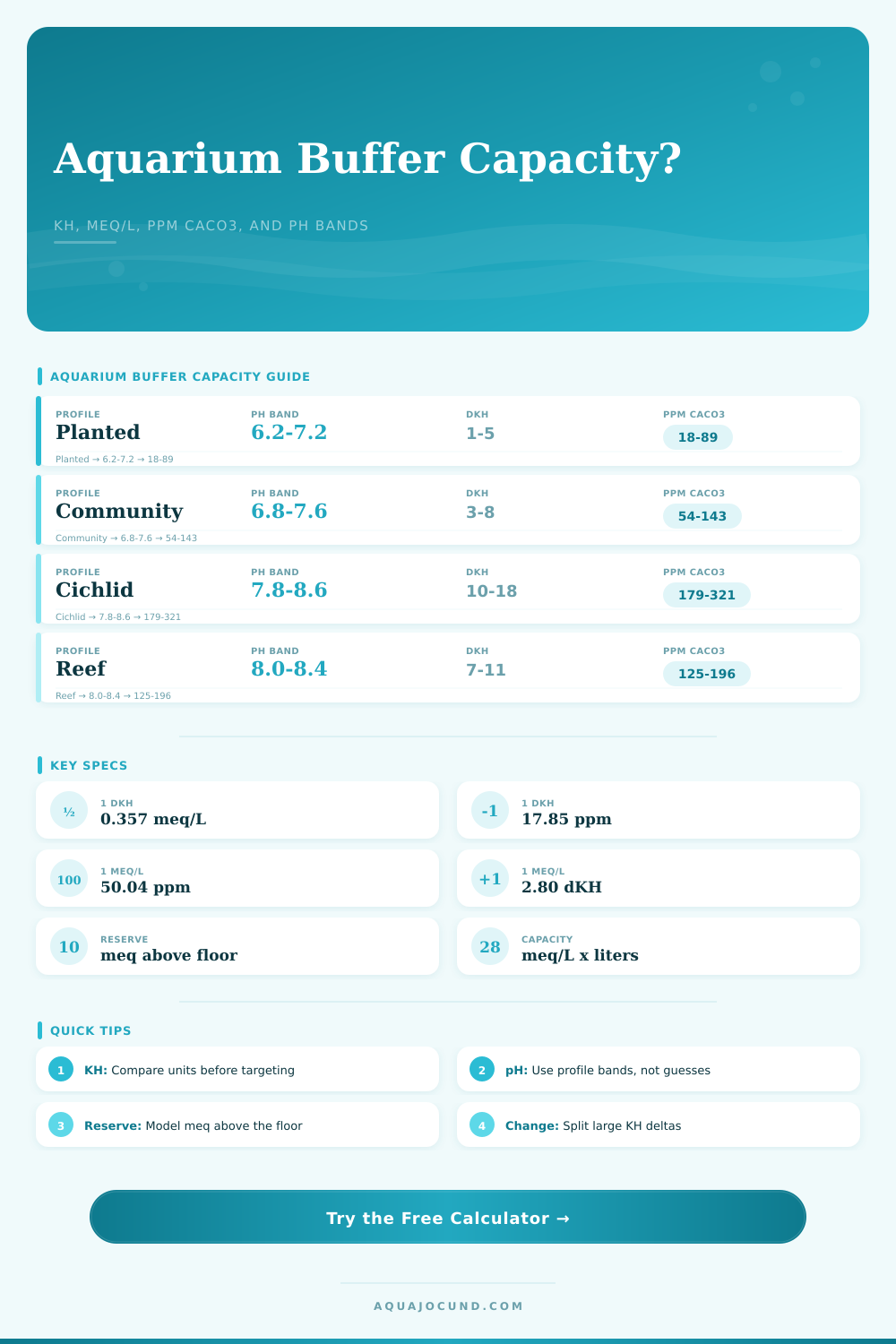
🧪 Buffer Capacity Calculator Aquarium
Convert alkalinity units, compare KH against pH target bands, and estimate acid-neutralizing reserve in meq for the actual water volume.
| dKH | meq/L | ppm as CaCO3 | Buffer Capacity Meaning |
|---|---|---|---|
| 1 | 0.36 | 17.85 | 0.36 meq/L of acid-neutralizing alkalinity |
| 3 | 1.07 | 53.54 | Low carbonate reserve |
| 6 | 2.14 | 107.09 | Moderate freshwater reserve |
| 8 | 2.86 | 142.78 | Common reef reference point |
| 11 | 3.93 | 196.33 | Upper mixed reef reference point |
| 15 | 5.36 | 267.72 | Hard alkaline water reference point |
| Profile | pH band | dKH band | meq/L band | ppm CaCO3 band |
|---|---|---|---|---|
| Soft acid freshwater | 5.8-6.8 | 0.5-3 | 0.18-1.07 | 9-54 |
| Planted freshwater | 6.2-7.2 | 1-5 | 0.36-1.79 | 18-89 |
| Freshwater community | 6.8-7.6 | 3-8 | 1.07-2.86 | 54-143 |
| Livebearer / hard freshwater | 7.2-8.2 | 5-12 | 1.79-4.29 | 89-214 |
| African cichlid | 7.8-8.6 | 10-18 | 3.57-6.43 | 179-321 |
| Marine fish only | 8.0-8.4 | 8-12 | 2.86-4.29 | 143-214 |
| Mixed reef | 8.0-8.4 | 7-11 | 2.50-3.93 | 125-196 |
| SPS reef | 8.1-8.4 | 7.5-9 | 2.68-3.21 | 134-161 |
| Material | Formula | Dry factor | Response | Companion ion |
|---|---|---|---|---|
| Sodium bicarbonate | NaHCO3 | 1.68 g per g CaCO3 equivalent | Fast | Na |
| Potassium bicarbonate | KHCO3 | 2.00 g per g CaCO3 equivalent | Fast | K |
| Sodium carbonate | Na2CO3 | 1.06 g per g CaCO3 equivalent | Fast, stronger pH push | Na |
| Potassium carbonate | K2CO3 | 1.38 g per g CaCO3 equivalent | Fast, stronger pH push | K |
| Calcium carbonate | CaCO3 | 1.00 g per g CaCO3 equivalent | Slow | Ca |
| Aragonite / crushed coral | CaCO3 mix | 1.00 g per g CaCO3 equivalent | Slow, pH-dependent | Ca |
| Calcium hydroxide | Ca(OH)2 | 0.74 g per g CaCO3 equivalent | Fast, high pH | Ca |
| Magnesium carbonate | MgCO3 | 0.84 g per g CaCO3 equivalent | Slow | Mg |
| Tank | Dimensions | Volume | Capacity of 1 dKH |
|---|---|---|---|
| Nano cube | 12 in x 12 in x 12 in | 30 cm x 30 cm x 30 cm | 7.5 gal | 28 L | 10 meq total reserve |
| 20 long | 30 in x 12 in x 12 in | 76 cm x 30 cm x 30 cm | 20 gal | 76 L | 27 meq total reserve |
| 40 breeder | 36 in x 18 in x 16 in | 91 cm x 46 cm x 41 cm | 40 gal | 151 L | 54 meq total reserve |
| Standard reef | 48 in x 18 in x 21 in | 122 cm x 46 cm x 53 cm | 75 gal | 284 L | 101 meq total reserve |
| Large display | 72 in x 24 in x 24 in | 183 cm x 61 cm x 61 cm | 180 gal | 681 L | 243 meq total reserve |
| Reserve above floor | dKH margin | meq/L margin | Calculation meaning |
|---|---|---|---|
| At or below floor | 0 | 0 | Profile floor has no measurable buffer margin left |
| Small margin | 0.5-1.0 | 0.18-0.36 | Reserve is close to test-kit resolution |
| Moderate margin | 1.1-3.0 | 0.39-1.07 | Usable target-band reserve above the lower edge |
| Large margin | 3.1+ | 1.11+ | High alkalinity reserve relative to the selected floor |
Stable pH isn’t just something you see when you look at your pH testing strips; it’s the consequence of constant chemical activity within the tank. Acid is being created by fish waste and other forms of decaying matter. Biological filtration attempt to reduce that acid but it cannot keep up with all of it. Unless there is some sort of reserve to counteract that acid, the chemistry crash.
That reserve is what we call carbonate hardness (or buffer capacity). Carbonate hardness are not a static number. Rather, it’s the amount of acid the water has available for absorption before the pH plummets. The calculator provide a real representation of this safety margin, expressed in terms you understand instead of abstract units.
Why Buffer Capacity Matters
The reason hobbyists get confused with conversion charts is because units used aren’t consistent. For example, you’ll see some charts list units like dKH (the German standard) or meq per liter (scientific standard). In the United States, you might see them listed in parts per million as calcium carbonate. All of these units describes the same thing, alkalinity, but on different scales.
One dKH equates to approximately 17.85 parts per million calcium carbonate. If you mix up units, you run the risk of overdosing accidentalaly. This reference table explains this conversion and shows you why eight dKH is commonly targeted in a reef tank. That’s equivalent to around 2.86 milliequivalents per liter. Make sure you know what units your dosing bottle contains so you don’t make mistakes different than what your test kit reports.
Now you have a way to track that so that you know what your reserve is. Your pH target band (say between 6.2 and 7.2 in a planted tank) is essentially your safety zone. You want your buffer capacity to be higher then the low end of that zone. When you reach bottom of the zone, there’s no more reserve left. Anything new that enters the water as acid will decrease the pH down into non-target range. The calculation provide an estimate for amount of milliequivalents of acid the water can absorbs before it reaches the floor.
Alkalinity serves as a fuel tank. How much capacity do you have before empty? Reserves also vary by environment. Alkaline, hard, buffered water is what African cichlids require. They frequently aim for 10 to 18 dKH to help stabilize the pH. Soft, acidic water with low alkalinity are ideal for apistogrammas in blackwater tanks. And that is the point, here the reserve is kept very small but deliberatly so.
That’s how you know when it’s okay or not for the type of fish you have. The calculator account for those types of profiles. It lets you know what’s okay or not for your fish given the existing conditions. Because sometimes you don’t want a high buffer in a tank where you really should of have soft, acidic water.
Speed of adjustment is another factor. If you raise your alkalinity too fast, it might shock your sensitive fish and corals. Setting the daily limit on the calculator will encourages you to split big changes across multiple days. This forces the discipline to slow down on adjustment. Biological systems has time to adjust slowly. This is why slow changes are safer.
Accuracy of tests matters too. Some kits are not accurate enough (e.g., only reading out to whole dKH). Small changes will be missed if you use a rough test. For example, a rough test doesn’t see a 0.2 dKH change but that’s meaningful to sensitive corals. Using a fine titration kit makes the data better. You cannot manage what you cannot measure precisely.
In the end, buffer capacity is all about stability. Is it going to crash your tank? Or keep it in balance? A buffer reserve estimate based off raw test numbers stops guessing. It lets you know exactly how much acid the water can take. And that gives you control. It is simple math, but it provides practical insight.