French Hardness to dKH Converter
Convert French degrees of hardness into aquarium dKH, ppm as CaCO3, meq/L, blended water-change KH, and target correction equivalents.
Converted aquarium hardness reading
Breakdown
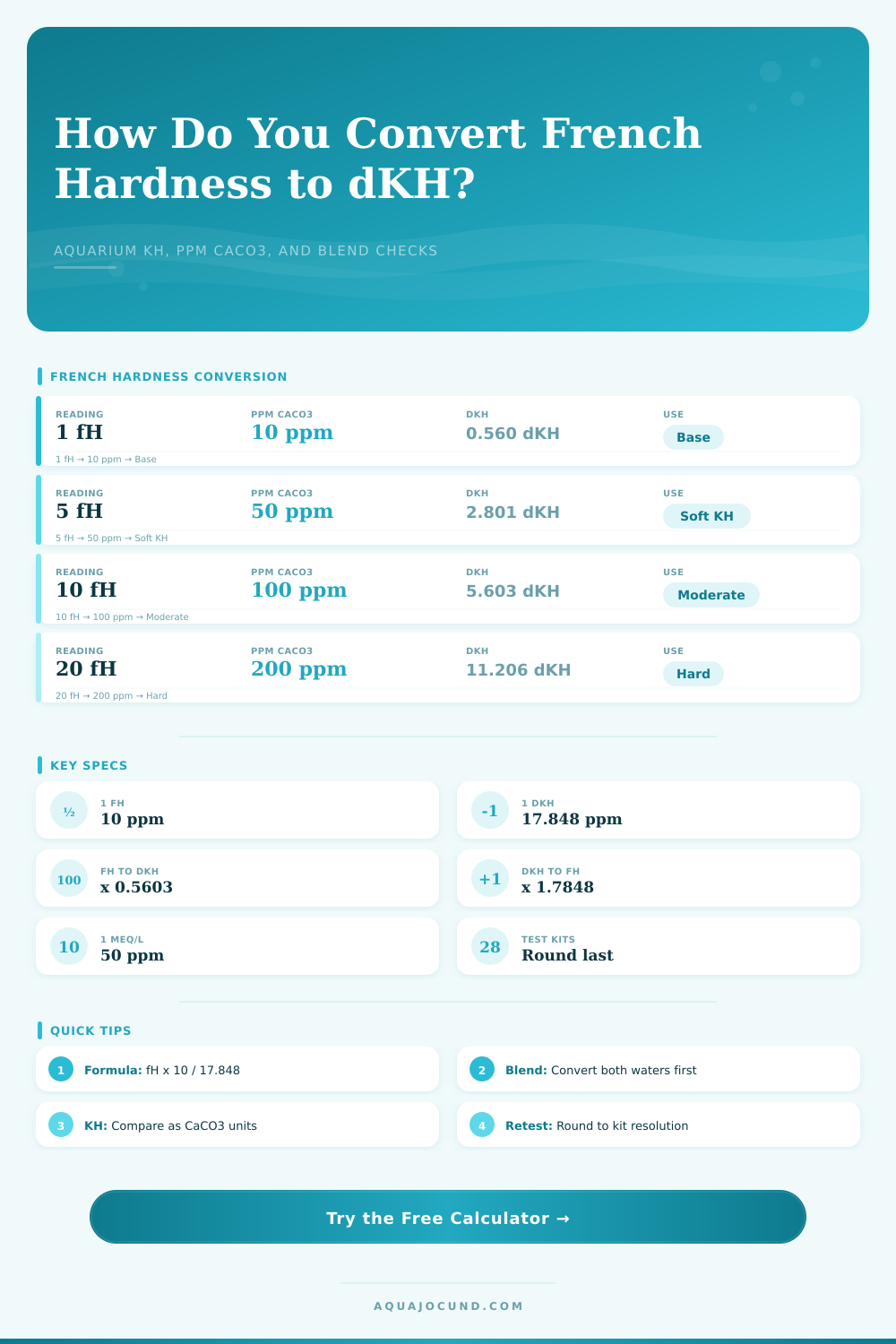
| French hardness | ppm as CaCO3 | dKH | meq/L equivalent |
|---|---|---|---|
| 1 °fH | 10 ppm | 0.560 dKH | 0.200 meq/L |
| 2 °fH | 20 ppm | 1.121 dKH | 0.400 meq/L |
| 5 °fH | 50 ppm | 2.801 dKH | 1.000 meq/L |
| 7 °fH | 70 ppm | 3.922 dKH | 1.400 meq/L |
| 10 °fH | 100 ppm | 5.603 dKH | 2.000 meq/L |
| 15 °fH | 150 ppm | 8.404 dKH | 3.000 meq/L |
| 20 °fH | 200 ppm | 11.206 dKH | 4.000 meq/L |
| 25 °fH | 250 ppm | 14.007 dKH | 5.000 meq/L |
| Profile | Common dKH window | French degree equivalent | Calculator note |
|---|---|---|---|
| RO/DI or very soft water | 0-1 dKH | 0-1.8 °fH | Small changes are large relative moves. |
| Blackwater softwater | 0.5-2 dKH | 0.9-3.6 °fH | Use finer rounding when readings are low. |
| Planted community | 3-6 dKH | 5.4-10.7 °fH | Compare KH tests on the same CaCO3 basis. |
| General community | 4-8 dKH | 7.1-14.3 °fH | Moderate test-kit resolution is usually enough. |
| Livebearer hardwater | 6-12 dKH | 10.7-21.4 °fH | Blending math helps predict water changes. |
| Rift lake cichlid | 8-16 dKH | 14.3-28.6 °fH | High alkalinity benefits from cross-checking ppm. |
| Reef alkalinity check | 7-11 dKH | 12.5-19.6 °fH | Reef kits usually report dKH directly. |
| Koi or garden pond | 4.5-10 dKH | 8.0-17.8 °fH | Use volume result for total CaCO3 equivalent. |
| Tank or batch | Dimensions | Volume | At 10 °fH |
|---|---|---|---|
| 10 gallon | 20 x 10 x 12 in / 51 x 25 x 30 cm | 10 gal / 37.9 L | 5.60 dKH, 3,785 mg CaCO3 equivalent |
| 20 long | 30 x 12 x 12 in / 76 x 30 x 30 cm | 20 gal / 75.7 L | 5.60 dKH, 7,571 mg CaCO3 equivalent |
| 29 gallon | 30 x 12 x 18 in / 76 x 30 x 46 cm | 29 gal / 109.8 L | 5.60 dKH, 10,977 mg CaCO3 equivalent |
| 40 breeder | 36 x 18 x 16 in / 91 x 46 x 41 cm | 40 gal / 151.4 L | 5.60 dKH, 15,142 mg CaCO3 equivalent |
| 55 gallon | 48 x 13 x 21 in / 122 x 33 x 53 cm | 55 gal / 208.2 L | 5.60 dKH, 20,820 mg CaCO3 equivalent |
| 75 gallon | 48 x 18 x 21 in / 122 x 46 x 53 cm | 75 gal / 283.9 L | 5.60 dKH, 28,391 mg CaCO3 equivalent |
| Current water | Replacement water | Water change | Blended dKH |
|---|---|---|---|
| 10 °fH | 0 °fH | 25% | 4.20 dKH |
| 10 °fH | 4 °fH | 25% | 4.76 dKH |
| 16 °fH | 8 °fH | 30% | 7.62 dKH |
| 7 °fH | 14 °fH | 20% | 4.71 dKH |
| 22 °fH | 18 °fH | 40% | 11.43 dKH |
| 2 °fH | 10 °fH | 10% | 1.57 dKH |
Getting into the water chemistry can be tricky until you understand that various units is measuring the same thing. For example, your fish care sheet may ask for a dKH measurement while a test kit in your tap water provide a result in French degrees of hardness. Both are measures of dissolved mineral content. The units are what confuse; not the water.
Ten parts per million of calcium carbonate are equivalent to one French degree of hardness. About 17.5 parts per million is one dKH. You’re comparing two methods of weighing the same buffer. After you put in your source reading, the calculator above do the math for you. You won’t have to guess about conversion factor or coefficients. You no longer have to memorize the division factor.
Understanding Water Hardness Units
All you have to know is why there’s a difference. Older test kits were manufactured by companies in Europe where French hardness is common. The English-speaking hobbyists mostly uses dKH. Both carbonate hardness. And that means it matters when you’re talking about pH stability. They aren’t measuring something differenter. They’re just counting it differently.
A common pitfall is when people assume that “higher” must equal “harder.” Don’t forget to look at what unit are being used. Two dKH might sound small but so does 20 French degrees. Yet 20 fH is actualy equivalent to approximately eleven dKH. Not correcting for units means overcorrecting your chemistry by a factor of ten. That’s a huge mistake. It’s disastrous if your livestock is sensitive. Always convert to some common baseline before acting.
Alkalinity is a buffer that catches the punch when your bioload introduces some swing in pH. A thin cushion = soft water. A thick one = hard water. This doesn’t mean one is good and one isn’t, it just means it depends on what you’re keeping.
If you have tetras and discus, they prefer soft, acidic water. If you have Rift Lake cichlids, they prefers hard, alkaline water. Use the calculator to determine where you are in relation to that. Enter your existing number and your goal. The calculator will tell you whether you’re close enough to not worry about it or if you should of do something about it.
Theory Where this all comes together is when you mix water. In reality, very few of us ever have water that perfectly matches our goal. Tap water. Reverse osmosis water. It might be a tank that falls somewhere in between. With the blend feature, you can see what will happen after a water change.
If you lose 25% of your tank water and add water that’s softer than what you currently have, how much harder will it be? Will it drop? Yes, but it won’t crash. It will shift. And once you know what that final hardness will be, you can minimize stress on your fish from sudden changes. More stability then perfection is better.
And then there’s volume. Adding a drop of conditioner to a five gallon betta bowl makes an immediate difference. Adding that same drop to a hundred gallon reef tank barely registers. There is simply more inertia in a bigger volume of water to resist any kind of chemical change. That’s one reason why small measurement differences makes such big differences in nano tanks. Be exacting.
When you’re on a big system, you have more wiggle room. It just doesn’t scale up. Don’t get hung up on the decimal places you don’t see with your own eyes. Most drop kits are working at 1/2 steps and whole numbers. A calculation of a result to 3 decimal places is an illusion of precision. The only number to round down to is the one your eyeballs will notice. Round to the nearest value your eyes can detect. If your kit shows six dKH, treat it as six dKH. It doesn’t change anything in the biology…only in the spreadsheet. Be practical.
What are you trying to do? Keep the water consistent. Consistent doesn’t mean chemically perfect water. It means keep the water the same. Fish adjusts to what you show them. Changing too quickly is hard on them. Set a baseline with the conversions. Then keep the water there.
The creatures who live in the water don’t care if its expressed in German degrees or French degrees. All they feel is the same thing. You want to know what it’s telling you. To do that, you have to speak the same language (test kit) that it does.