dGH to PPM Converter
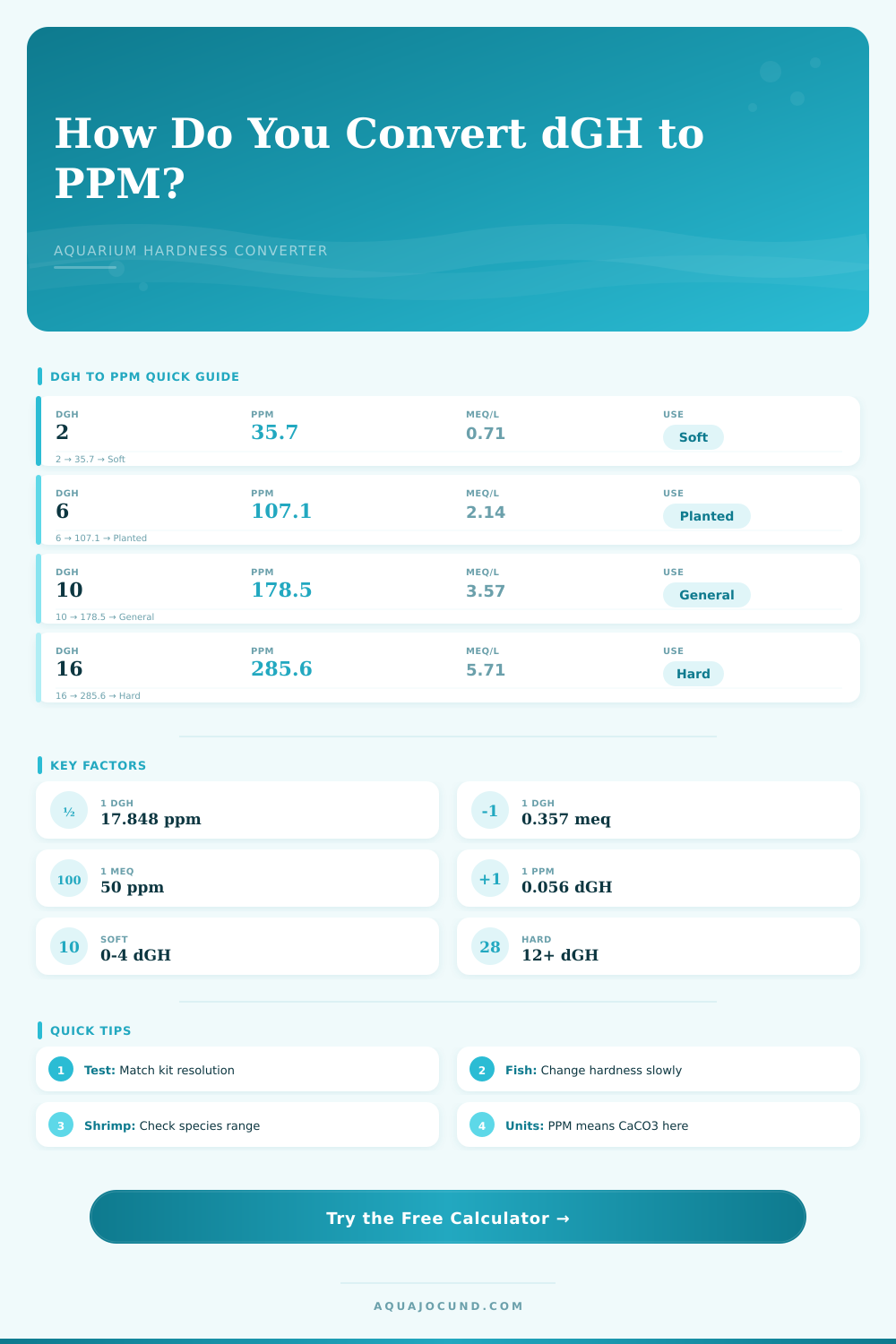
Convert general hardness between dGH, ppm as CaCO3, and meq/L, then compare the result with common freshwater aquarium ranges.
Conversion Breakdown
| dGH | ppm as CaCO3 | meq/L | Common aquarium reading |
|---|---|---|---|
| 1 dGH | 17.8 ppm | 0.36 meq/L | Very soft; often RO blend territory |
| 2 dGH | 35.7 ppm | 0.71 meq/L | Soft blackwater or specialty shrimp use |
| 4 dGH | 71.4 ppm | 1.43 meq/L | Soft community and many planted aquariums |
| 6 dGH | 107.1 ppm | 2.14 meq/L | Middle planted-community target |
| 8 dGH | 142.8 ppm | 2.86 meq/L | Neocaridina and hardy community range |
| 10 dGH | 178.5 ppm | 3.57 meq/L | Moderately hard general freshwater |
| 12 dGH | 214.2 ppm | 4.28 meq/L | Hard-water livebearer start |
| 16 dGH | 285.6 ppm | 5.71 meq/L | Hard cichlid or mineral-rich tap water |
| Aquarium use | Typical dGH | ppm as CaCO3 | Notes for conversion |
|---|---|---|---|
| Amazon blackwater fish | 1-4 dGH | 18-71 ppm | Often prepared with RO or rainwater plus careful minerals |
| Betta and soft community | 3-8 dGH | 54-143 ppm | Stable moderate values are usually easier than chasing very low GH |
| Planted community tank | 4-10 dGH | 71-178 ppm | Enough calcium and magnesium for plants and livestock |
| Caridina shrimp | 4-6 dGH | 71-107 ppm | Match species and mineral mix directions closely |
| Neocaridina shrimp | 6-10 dGH | 107-178 ppm | Comfortable general range for many cherry shrimp colonies |
| Livebearers | 10-20 dGH | 178-357 ppm | Guppies, mollies, and platies often prefer mineralized water |
| Rift lake cichlids | 12-22 dGH | 214-393 ppm | Also check KH and pH because GH is only one part of the profile |
| Unit | What it reports | Convert to dGH | Aquarium use |
|---|---|---|---|
| dGH | German degrees of general hardness | Already dGH | Most drop kits and fish profiles |
| ppm as CaCO3 | Mass equivalent as calcium carbonate | ppm ÷ 17.848 | Water reports and some digital meters |
| mg/L as CaCO3 | Same numeric value as ppm in freshwater | mg/L ÷ 17.848 | Municipal water quality reports |
| meq/L | Charge equivalent concentration | meq/L ÷ 0.357 | Chemistry references and advanced logs |
| TDS ppm | Total dissolved solids estimate | Not a GH conversion | Use alongside GH, not instead of GH |
| Tank volume | Change percent | Water affected | Why it matters |
|---|---|---|---|
| 10 gal / 38 L | 25% | 2.5 gal / 9.5 L | A small correction can move nano tanks quickly |
| 20 gal / 76 L | 30% | 6.0 gal / 22.7 L | Common planted-tank maintenance change |
| 40 breeder / 151 L | 25% | 10.0 gal / 37.9 L | Useful for steady community adjustments |
| 75 gal / 284 L | 20% | 15.0 gal / 56.8 L | Larger systems buffer small hardness swings |
| 125 gal / 473 L | 15% | 18.8 gal / 71.0 L | Slow changes are easier to control at scale |
So it starts with six, or maybe 12, a number on a test kit, and it’s called dGH, which is general hardness, according to the bottle. Except when you go to a municipal water report or order minerals online, those sources are probably talking about calcium carbonate in parts per million, otherwise known as ppm. These is two ways of describing the same physical thing. But one’s a number expressed in different units than the other.
The part most people overlook is you can’t have a source that wants ppm, but not dGH. That’s where the converter on this page come into play. This converter will bridge the gap between mg/L (ppm) and dGH without having to pull out your spreadsheet. It assumes that ppm are being used in reference to calcium carbonate, the typical way ppm is used when discussing aquarium chemistry.
How to Use the Water Hardness Calculator
You may have noticed ppm referenced without the qualifying terms “calcium carbonate.” That probably means the reading was generated using a TDS meter. A TDS meter measures all of ions in the water. Hardness, however, is specifically concerned with calcium and magnesium. Confusing TDS (ppm) with hardness can cause you to over-treat your water with unnecessary minerals. By focusing only on calcium carbonate equivalent, calculator keeps these differences clear and separates them for you.
Enter your existing hardness next. This can be in ppm, dGH, or milliequivalents per liter. Don’t panic if you’ve never heard of milliequivalents before, they’re simply how chemists measure electrical charge. A single dGH is approximately equivalent to 17.8 ppm, which also converts to around 0.36 milliequivalents. These conversions are consistent with the math, making things easy as pie.
Just remember which unit is reported by your test kit. Chances are, most drop tests report dGH, while digital meters will likely default to ppm. Your local water utility typically reports its water in mg per liter, which is the same thing as ppm for fresh water. Regardless of what unit you put into the tool, it normalizes this value so that you can easily compare against each other.
Having said that, target hardness is more important than being spot-on. There’s no one magic point of hardness. Shrimp, for example, have a range. So do fish. A 6 degree dGH doesn’t bother a betta as much as constantly fluctuating hardness. It just wants it stable.
The calculator also has some presets for common livestock. These aren’t hard-and-fast. These are starting points based off where those species evolved. Rift lake cichlids requires hard water. Amazon blackwater fish do well in soft water. Keep them in soft water, and you’ll be fighting the water all the time.
This is where planning collides with reality: The water change percentage input. Dumping in some minerals will not magically make everything better. You’re either concentrating what’s there (too much?) or diluting it (not enough?). After a certain water change, how hard is the tank likely to be? That’s what the calculator calculates.
No more shock. Stressful mineral content changes are sudden; they mess up salt balance and cause gill stress. This shows you the distance between where you are now and where you want to go. Then it helps show you how far you should of gone to get from here to there. Slow is smooth. Smooth is fast. Smoother changes are slow.
Beyond numbers, there’s hard water, moderate, and soft. Four or under is nearly pure soft water, but it lacks the buffering capacity of harder water. Organics will rapidly lower pH. Above 12 dGH is hard water which buffers against rapid swings in pH but can lead to scaling on glass and heaters. High nutrient levels plus hard water can also cause unsightly algae blooms.
The table on this page outlines the zones well, helping you determine whether what you want is feasible with your tap water. For instance, if your tap reads 15 dGH, you need reverse osmosis to get down to 4. If you have a 2 tap, all you need to do is add some minerals to get to 10. Your plan hinges on the direction of the shift.
Test kits should be used with enough resolution. False precision is created by underestimating the right resolution for a test kit. If you have a regular drop test, that’s a single increment of dGH. So saying your water is at 6.4 dGH after such a test are wrong. The calculator will round up/down to the appropriate resolution for whatever kit you’re using.
Why? Because this maintains realistic expectations. You don’t need to think your water is 5.92 if knowing it’s anywhere from five to seven dGH would suffice. There’s no such thing as precise water in a bucket of tap water. You don’t need to commit conversion factors to memory.
You just need to grasp how these parameters relates to mineral levels and animal health. You aim for consistent values that align with your fish biochemistry. When you understand the correlation between ppm and dGH, reading a test result or label makes sense. You no longer speculate on its significance. You take control of your water. You do it on purpose.
The arithmetic isn’t difficult. The science still is. And that’s how it should be.