🧪 meq/L to PPM Converter
Convert milliequivalents per liter to parts per million (mg/L) for any ion — and back again
| Ion | Formula | Valence | Mol. Wt (g/mol) | Eq. Wt (g/eq) | 1 meq/L = ppm |
|---|---|---|---|---|---|
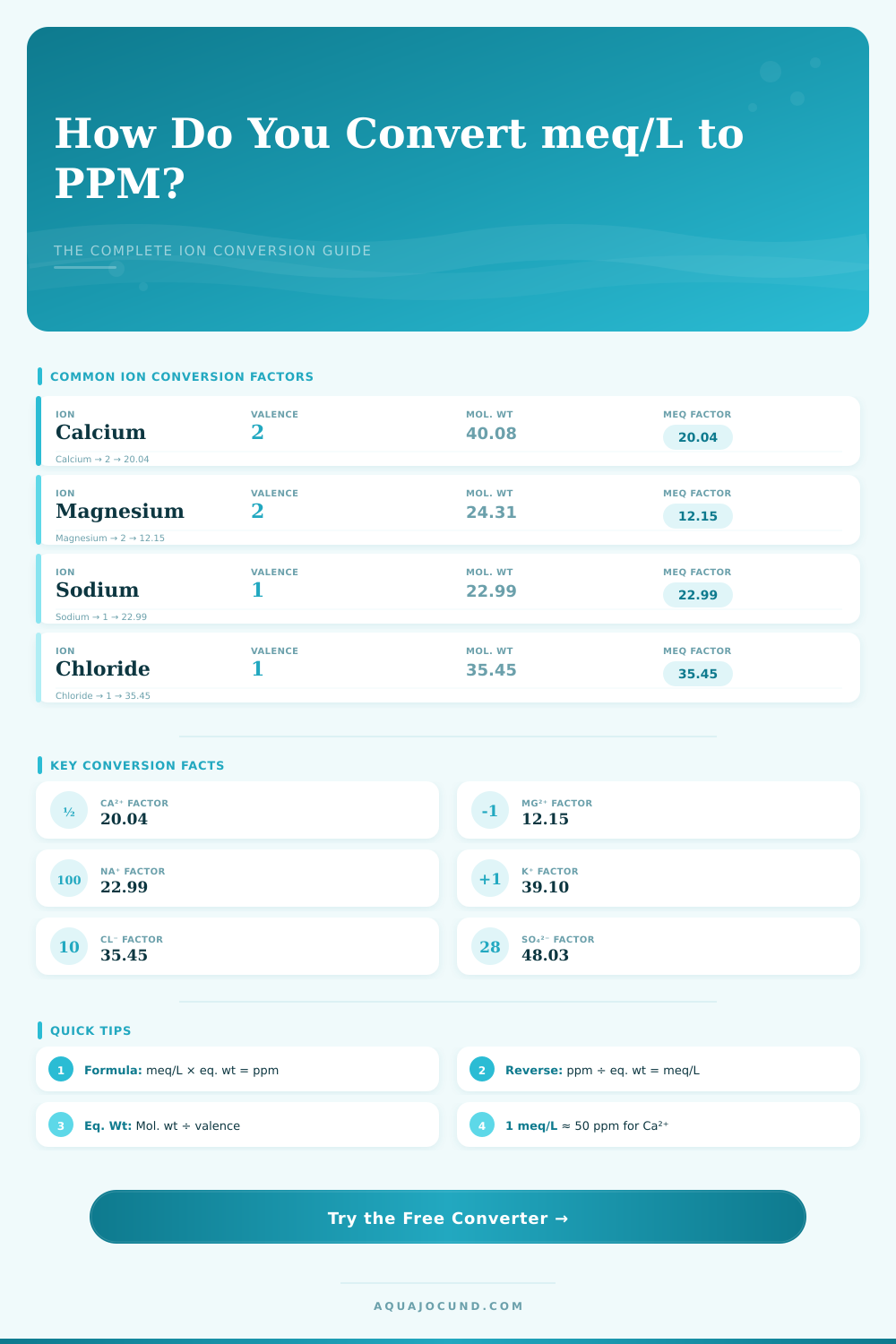
| Calcium | Ca²+ | 2 | 40.08 | 20.04 | 20.04 |
| Magnesium | Mg²+ | 2 | 24.31 | 12.15 | 12.15 |
| Sodium | Na+ | 1 | 22.99 | 22.99 | 22.99 |
| Potassium | K+ | 1 | 39.10 | 39.10 | 39.10 |
| Chloride | Cl− | 1 | 35.45 | 35.45 | 35.45 |
| Bicarbonate | HCO₃⁻ | 1 | 61.02 | 61.02 | 61.02 |
| Sulfate | SO₄²⁻ | 2 | 96.06 | 48.03 | 48.03 |
| Nitrate | NO₃⁻ | 1 | 62.00 | 62.00 | 62.00 |
| Phosphate | PO₄³⁻ | 3 | 94.97 | 31.66 | 31.66 |
| Ammonium | NH₄+ | 1 | 18.04 | 18.04 | 18.04 |
| Iron | Fe²+ | 2 | 55.85 | 27.92 | 27.92 |
| Carbonate | CO₃²⁻ | 2 | 60.01 | 30.00 | 30.00 |
| Water Type | Ca²+ (meq/L) | Mg²+ (meq/L) | Na+ (meq/L) | HCO₃⁻ (meq/L) | TDS (ppm) |
|---|---|---|---|---|---|
| Soft / Rainwater | 0.1 – 0.5 | 0.05 – 0.2 | 0.1 – 0.3 | 0.1 – 0.5 | <100 |
| Moderately Hard | 1.0 – 2.5 | 0.5 – 1.5 | 0.3 – 1.0 | 1.5 – 3.5 | 100–300 |
| Hard Water | 2.5 – 5.0 | 1.5 – 3.0 | 0.5 – 2.0 | 3.0 – 6.0 | 300–600 |
| Very Hard | 5.0 – 10.0 | 3.0 – 6.0 | 1.0 – 5.0 | 5.0 – 10.0 | 600–1200 |
| Brackish / SAR Risk | 1.0 – 3.0 | 0.5 – 1.5 | 10.0 – 40.0 | 2.0 – 5.0 | 1000–5000 |
| Drinking Water (WHO) | 0.5 – 2.5 | 0.3 – 2.0 | <8.7 | <6.5 | <500 |
| Irrigation Water (OK) | 0.5 – 4.0 | 0.5 – 3.0 | <4.0 | 1.0 – 5.0 | <700 |
| meq/L | Ca²+ ppm | Mg²+ ppm | Na+ ppm | Cl− ppm | HCO₃⁻ ppm |
|---|---|---|---|---|---|
| 0.5 | 10.0 | 6.1 | 11.5 | 17.7 | 30.5 |
| 1.0 | 20.0 | 12.2 | 23.0 | 35.5 | 61.0 |
| 2.0 | 40.1 | 24.3 | 46.0 | 70.9 | 122.0 |
| 3.0 | 60.1 | 36.5 | 69.0 | 106.4 | 183.1 |
| 5.0 | 100.2 | 60.8 | 115.0 | 177.3 | 305.1 |
| 10.0 | 200.4 | 121.5 | 229.9 | 354.5 | 610.2 |
| 20.0 | 400.8 | 243.1 | 459.8 | 709.0 | 1220.4 |
Now you get a water test back and there’s calcium listed at 200 ppm. You check out next sheet where it says 10 meq/L of calcium. Those numbers don’t even seem similar, but they’re both talking about the exact same water. That is the initial barrier to grasping what water chemistry are all about.
Parts per million is a measurement of actual mass. Milliequivalents per liter is a measure of chemical combining power. Converting one to the other is not just an exercise in algebra. It’s about knowing if you’re working with weight of the ion or its ability to react. That makes a difference when you deal with your water.
Why You Need to Know Both Units
Equivalent weight is nothing more than the molecular weight of the compound divided by its valence. Valence is the ions charge. For example, sodium has a one charge and therefore an equivalent weight that is nearly identical to its molecular weight. Calcium has a double positive charge, meaning it has an equivalent weight equal to about half its molecular weight.
Therefore, you can’t apply some sort of universal multiplier when doing this kind of thing with ions. Bicarbonate isn’t calcium; if you treat it as such, you’ll get wildly wrong answers. That’s where the calculator (above) come into play. Plug in the ion you’re concerned about and let machine do the math for you, all without having to guess what coefficient to apply to your scenario.
Let’s say you’re a home-owner and you’ve got hard water. Maybe you’re aware that anything above 100 ppm calcium carbonate is considered hard water. However, maybe you get a lab report back in meq/L, so what’s that? Well, one milliequivalent of calcium per liter equal roughly 20 ppm. Small sounding right, but it adds up fast. And once you know how to convert these abstract units of chemistry to something you can see and do something about, you realize that 5 meq/L isn’t very good at all. That’s a lot of minerals (and they will stain your fixtures and clog your pipes). Once you know the conversion factor, you’ll start seeing that 5 meq/L represent a pretty high number.
The consequences are just as serious (and specific) in an agricultural context. Sodium adsorption ratios matters a lot to farmers; they depend on ratio of calcium versus sodium. To assess how badly soil structure may be affected, you want to know the exact ppm of both. But if you fail to consider valence factor and assume that all sodium is equal, you could unwittingley throw extra gypsum onto your farm. That’s not only a financial loss, it can also be bad for your soil ecosystem. Get unit right and your amendments will be tailored to the true chemical requirement.
Confusion for most revolves around the reverse calculation. To go from ppm to meq/L you divide by the same equivalent weight. Yes, it’s the opposite process but the same principle applies. The mass doesn’t change, only the chemical activity changes. For example, a little bit of multi-charged ion such as magnesium have greater chemical clout than the same weight of single-charged ion. That’s why sometimes conductivity readings in water are a better measure of meq/L then raw mass. Charges (not just grams) drives the electricity.
One additional note: These conversions do not account for differences between temperatures or pressures. That won’t matter to the math. It matters when interpreting what is a “good” number. For example, acceptable water levels can vary depending on whether you are measuring for irrigation or boiler feed water. The numbers don’t care. Your application does.
Before running the numbers, always double check which ions were selected. By far the most frequent mistake is selecting the incorrect ion, making the precision of the calculator irrelevent.
Bottom line: Water chemistry isn’t about single measurements in isolation, it’s about the relationship among ions. Whether it’s maintaining a hydroponic garden, treating municipal water, or balancing a swimming pool, you’re working with a dynamic system. When you learn to communicate in both ppm and meq/L, you has control over the system. You begin to measure intentionally rather than guess. And yes, whether the label says ppm or meq/L, the water does the exact same thing; however, seeing both sides of the equation helps us understand more.