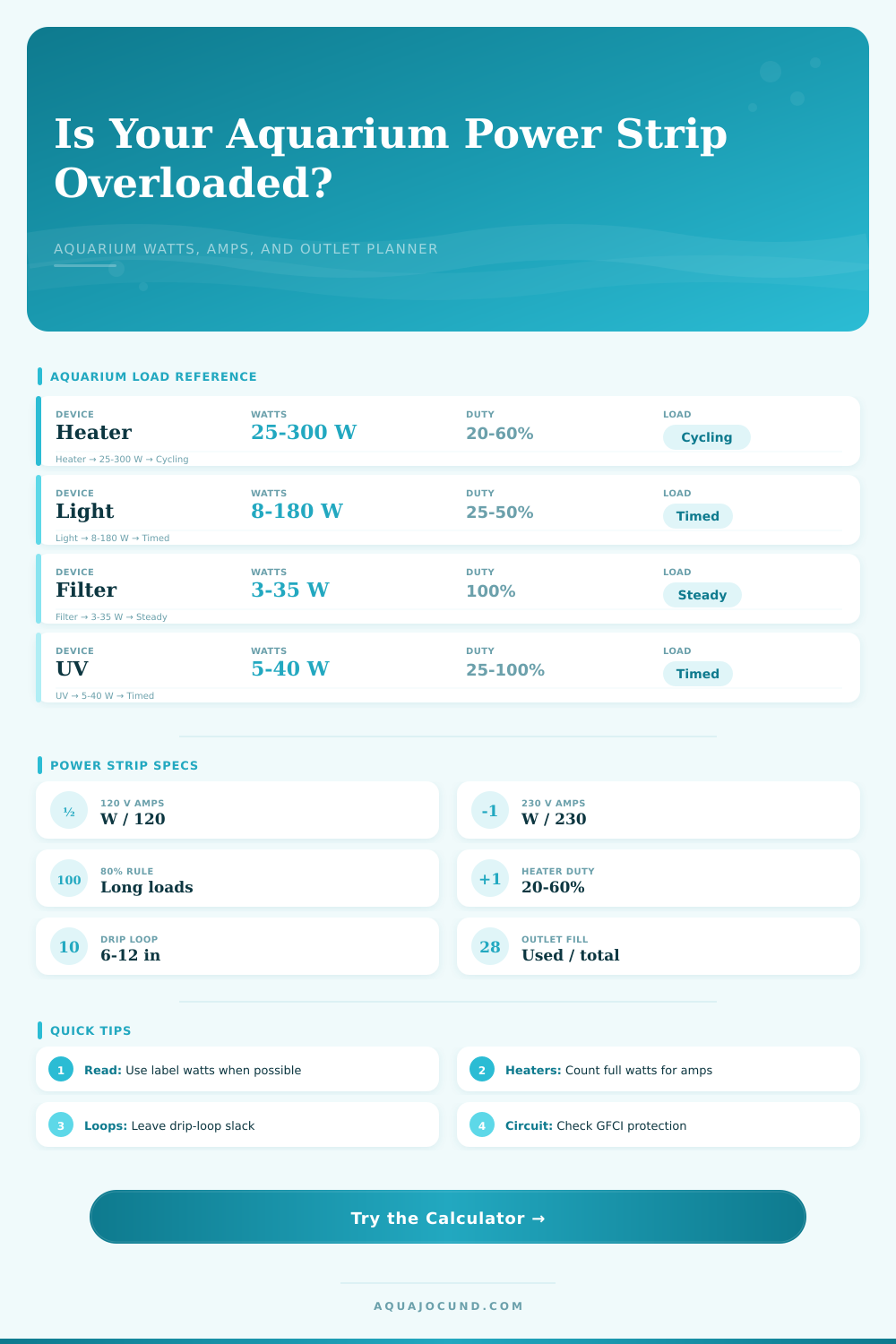
Aquarium Power Strip Load Calculator
Estimate heater, light, filter, pump, and accessory load against power-strip watts, circuit amps, outlet count, and drip-loop cord slack.
Power strip load results
| Strip profile | Typical rating | Outlet count | Planning limit | Best calculator use |
|---|---|---|---|---|
| Basic household strip | 10 A at 120 V or 230 V | 4 to 6 | 8 A at 80% | Small freshwater equipment with modest heaters |
| Standard 15 A strip | 15 A at 120 V | 6 to 8 | 12 A at 80% | Most medium tanks when wall circuit also supports it |
| Heavy-duty 20 A strip | 20 A at 120 V | 8 to 12 | 16 A at 80% | Larger systems where every part is rated for the load |
| GFCI aquarium strip | 15 A at 120 V | 6 to 8 | 12 A at 80% | Aquarium areas where water exposure is possible |
| Timer power bar | 12 A at 120 V | 4 to 8 | 9.6 A at 80% | Lights and timed accessories with limited heaters |
| Controller energy bar | 15 A total, outlet limits vary | 6 to 8 | Use lower printed limit | Reef systems with controlled outlets and dosing gear |
| Aquarium size | Dimensions | Volume | Typical connected watts | Outlet planning note |
|---|---|---|---|---|
| 5 gal desktop | 16 x 8 x 10 in / 41 x 20 x 25 cm | 5 gal / 19 L | 35 to 80 W | Heater, mini filter, compact light |
| 10 gal starter | 20 x 10 x 12 in / 51 x 25 x 30 cm | 10 gal / 38 L | 60 to 130 W | Three or four plugs are common |
| 20 gal long | 30 x 12 x 12 in / 76 x 30 x 30 cm | 20 gal / 76 L | 95 to 190 W | Light and heater dominate the load |
| 29 gal community | 30 x 12 x 18 in / 76 x 30 x 46 cm | 29 gal / 110 L | 130 to 260 W | Allow room for air pump or timer plug |
| 40 breeder reef | 36 x 18 x 16 in / 91 x 46 x 41 cm | 40 gal / 151 L | 180 to 420 W | Power bricks can block adjacent outlets |
| 55 gal display | 48 x 13 x 21 in / 122 x 33 x 53 cm | 55 gal / 208 L | 220 to 440 W | Check heater plus lighting nameplate amps |
| 75 gal display | 48 x 18 x 21 in / 122 x 46 x 53 cm | 75 gal / 284 L | 300 to 650 W | Large heaters may justify separate circuits |
| 125 gal system | 72 x 18 x 22 in / 183 x 46 x 56 cm | 125 gal / 473 L | 500 to 1100 W | Split load planning is often cleaner |
| Device | Common watts | Typical duty | Daily kWh example | Power strip note |
|---|---|---|---|---|
| Submersible heater | 25 to 300 W | 20 to 60% | 100 W at 35% = 0.84 kWh | Use full watts for connected amp checks |
| LED aquarium light | 8 to 180 W | 25 to 50% | 45 W for 8 h = 0.36 kWh | Power bricks may occupy extra outlet width |
| Hang-on-back filter | 3 to 15 W | 100% | 8 W continuous = 0.19 kWh | Usually a small steady load |
| Canister or return pump | 10 to 80 W | 100% | 35 W continuous = 0.84 kWh | Count every pump that runs all day |
| Protein skimmer | 8 to 35 W | 80 to 100% | 18 W at 90% = 0.39 kWh | Often paired with a return pump on reef tanks |
| UV sterilizer or doser | 5 to 40 W | 25 to 100% | 9 W at 50% = 0.11 kWh | Timer or controller settings matter |
| Formula | Expression | Example | Result |
|---|---|---|---|
| Connected watts | Sum of device nameplate watts | 200 + 45 + 12 + 5 | 262 W |
| Running amps | Watts / volts | 262 W / 120 V | 2.18 A |
| Buffered watts | Connected watts x margin | 262 W x 1.10 | 288 W |
| Daily kWh | Watts x duty hours / 1000 | 45 W x 8 h / 1000 | 0.36 kWh |
| Rect tank volume | L x W x H / 231 | 48 x 13 x 20 / 231 | 54.0 gal |
| Cord allowance | Distance plus drip loop | 24 in + 8 in | 32 in |
You’ve spent hours looking into tank layout/planting and fish compatibility. But did you just purchase the longest power strip you could find and plug them all in? That may work temporarally. But inevitably, the heater clicks on, the pump turns on, and the humidity increases too high… boom! Outlet trips, lights extinguished and you’re hoping your fish aren’t dead. Why?
Most keepers don’t understand what a power strip can or will handles regarding continuous loads. Even though a typical strip may have rating of fifteen amps, safety guidelines advise against ever exceeding eighty percent of that value continuously. It doesn’t happen immediately but heat accumulates within the plastic housing over time. You won’t see it and it’s too late once it fails.
How to Keep Your Aquarium Safe from Power Overload
After plugging in all of your equipment, the calculator here do the rest of the math, no more guesswork about whether or not you’re over the line with that extra power brick. Your filter runs continuously but your heater turns on and off so it takes that into account. Any electrical load calculation will include heaters as the largest variable. Heaters is tricky because they don’t operate constantly and therefore are hard to guess. They may run 20% to 60% of the day depending on conditions like your tank insulation and how stable your room temperature is. For your electricity bill, this can make a big difference… but it will make an even bigger difference to your breaker.
To calculate the breaker size needed, don’t look at average use. Look at the nameplate wattage (the maximum wattage). When the heater comes on, the breaker doesn’t give a hoot if you just turned it off an hour ago. It only cares about the spike. Plan for highest load, not the average load.
LED fixtures are now more energy efficient, however their power bricks is not. The brick that powers an LED fixture is inefficient and bulky. It produces heat that adds to total load on the strip, and it also uses more power than light draws. For example, if you are running a high output light in a reef set up or a high tech planted tank, you may also be running a heater, a protein skimmer, and return pump based off the same strip. Often, the physical space available on the strip will limit what you can do. Large power adapters can block adjacent outlets on the strip and force you to plug equipment into end of the strip where they may hang down near the water line.
So, use the calculator to check your electrical capacity prior to plugging in your gear. Tripping breakers isn’t the only concern, the issue is also one of electricity in the same room as water. To address this, Ground Fault Circuit Interrupter protection are mandatory (and there’s no negotiating). GFCIs either on an outlet strip or directly on an outlet will cut off power when they sense even a small amount of leaking current, keeping you from getting electrocuted. Even taking into account safety margins, the tool will tell you whether you’ll still have plenty of headroom. It compares how many devices you’re running to how many outlets you have so you don’t overload outlets or daisy-chain strips.
And even better, there are helpful reference tables on the page with common tank size standards. For example, a ten gallon tank is typically well under the danger zone while a seventy-five gallon display tank can quickly be overkill with caution. So it points out the balance between aesthetic appeal and safety concerns. Sure, you’d like to use a really long strip with lots of outlets, but if what you’re plugging into those outlets pulls too high of a current, go for something shorter and beefier instead.
It’ll take you ten minutes to plan it out on paper (or in this calculator). It’ll take you hours to replace a fried power strip and inspect your livestock for shock damage. Remember, you’re creating a buffer here. Leave a bit of wiggle room for future upgrades. Next year you might want to add a UV sterilizer. You might want to add a redundant heater for safety. If you plan your electrical load with future expansion in mind, you won’t have any nasty surprises and your fish will never know how close they came to disaster.
All they know is the water’s clear and warm. And that is all that matters.