Fish Room Heating Load Calculator
Estimate room heat load, tank heat demand, installed heater duty cycle, daily kWh, and reserve margin for aquarium rooms, breeding racks, and garage fish rooms.
Your fish room heating estimate
| Room profile | Model factor | Typical space | Best use |
|---|---|---|---|
| Tight insulated interior room | 18 W / 1000 cu ft / F | Finished fish room | Low air exchange, sealed door, stable walls |
| Insulated basement room | 28 W / 1000 cu ft / F | Basement rack area | Below-grade room with modest drafts |
| Average spare room | 42 W / 1000 cu ft / F | Bedroom or utility room | Normal door gaps and average wall exposure |
| Drafty garage | 65 W / 1000 cu ft / F | Garage fish rack | Large door seams, concrete slab, more air change |
| Lightly insulated outbuilding | 95 W / 1000 cu ft / F | Shed or shop | More surface exposure and colder walls |
| Leaky unconditioned space | 130 W / 1000 cu ft / F | Open utility area | Use only for rough planning and add reserve |
| Tank cover profile | Water factor | Typical tanks | Heat behavior |
|---|---|---|---|
| Mostly covered tanks | 3.0 W / 100 gal / F | Lidded breeder tanks | Lower evaporative heat loss |
| Glass lids with small gaps | 5.0 W / 100 gal / F | Community tanks | Good for mixed fish room layouts |
| Mixed lids and open sections | 7.5 W / 100 gal / F | Racks plus displays | Balanced default for planning |
| Open-top rack, gentle air | 10.5 W / 100 gal / F | Growout tanks | More water-air heat exchange |
| Open tops with strong aeration | 14.0 W / 100 gal / F | Fry and sponge filter racks | Aeration increases evaporation and cooling |
| Fish room scenario | Room volume | Water volume | Target air | Target water | Heater range |
|---|---|---|---|---|---|
| Nano shelf | 600 cu ft | 40 gal | 74 F | 76 F | 500 to 750 W |
| 10 gal breeding rack | 850 cu ft | 120 gal | 76 F | 78 F | 750 to 1500 W |
| Mixed basement room | 1200 cu ft | 240 gal | 74 F | 78 F | 1500 to 2500 W |
| Garage winter rack | 1800 cu ft | 320 gal | 72 F | 76 F | 2500 to 4000 W |
| Discus warm room | 1400 cu ft | 300 gal | 80 F | 84 F | 2500 to 5000 W |
| Outbuilding rack | 2000 cu ft | 500 gal | 74 F | 78 F | 4000 W plus |
| Output | Formula basis | Unit | Use it for |
|---|---|---|---|
| Room air load | Volume x air gap x room factor | W | How hard the room heater must work |
| Tank water load | Gallons x water-air gap x cover factor | W | Extra load from warm tanks in cooler air |
| Duty cycle | Required watts / installed watts | % | Whether installed wattage has enough reserve |
| Daily kWh | Installed watts x duty x 24 / 1000 | kWh/day | Electrical energy consumed in one day |
| Load margin | Installed watts minus required watts | W | Reserve available during cold swings |
With those values entered into the calculator (above), it do all the math for you based off your room sizes and tank volumes. No more guesswork, no more wondering if you will make it through a cold snap.
Remember, heating a fish room isn’t simply warming the water. There are two separate thermal systems in play and they is always competing with one another. The water in tanks wants to hold its heat but releases it to the air in the room, and the air then want to get cold. Overlooking air is the worst error of all. Many people think that purchasing a heater sufficient for volume of water means they’re covered. They don’t realize that air plays a major role here too. The heater inside the tank must fight the cold air around it, but the space heater must fight the heat coming from the tanks.
How to Use the Heater Calculator
That’s where the tool comes into play. It will divide these loads. It takes into consideration the insulation profile of the room (i.e. How well does this room retain heat? How many windows? How thick are walls?). Next it will consider the tank cover profile. Evaporative loss is huge when it comes to heat. An open top tank lose heat quickly because evaporation carries energy away with it. A tank under a lid retains heat better. Someone who has lidded breeding tanks doesn’t require nearly as much wattage as someone running open-top growout racks, even though both may have the same amount of water volume.
Duty cycle explains why it matter when purchasing heaters. No one wants a heater cycling on and off continuously throughout the entire day. This will lead to early death of the device. By using the calculator, you can see estimated duty cycle (i.e., what % of the time the heater should be on) needed to achieve the desired temp. If it’s higher than 90%, then perhaps you have undersized your heater? Ideally, you’d like some breathing room. Adding a buffer during expectedly cold periods can be done with the reserve margin option. A heater that maintains temperatures well, but doesn’t need to run constantly, will last much longer then one that runs at full speed and struggles to keep up.
Then there is the electricity bill. This is something many hobbyists don’t consider until their winter utility bill comes in the mail. Kilowatt-hours per day (the expected estimate) will provide a more realistic picture of your consumption. Sure, heaters are rated by wattage, but that’s only half the story. How long does it run? A high-wattage heater used for short periods might use less energy then a low-wattage heater that stays on all the time. The calculator links the real-world set up to the financial impact.
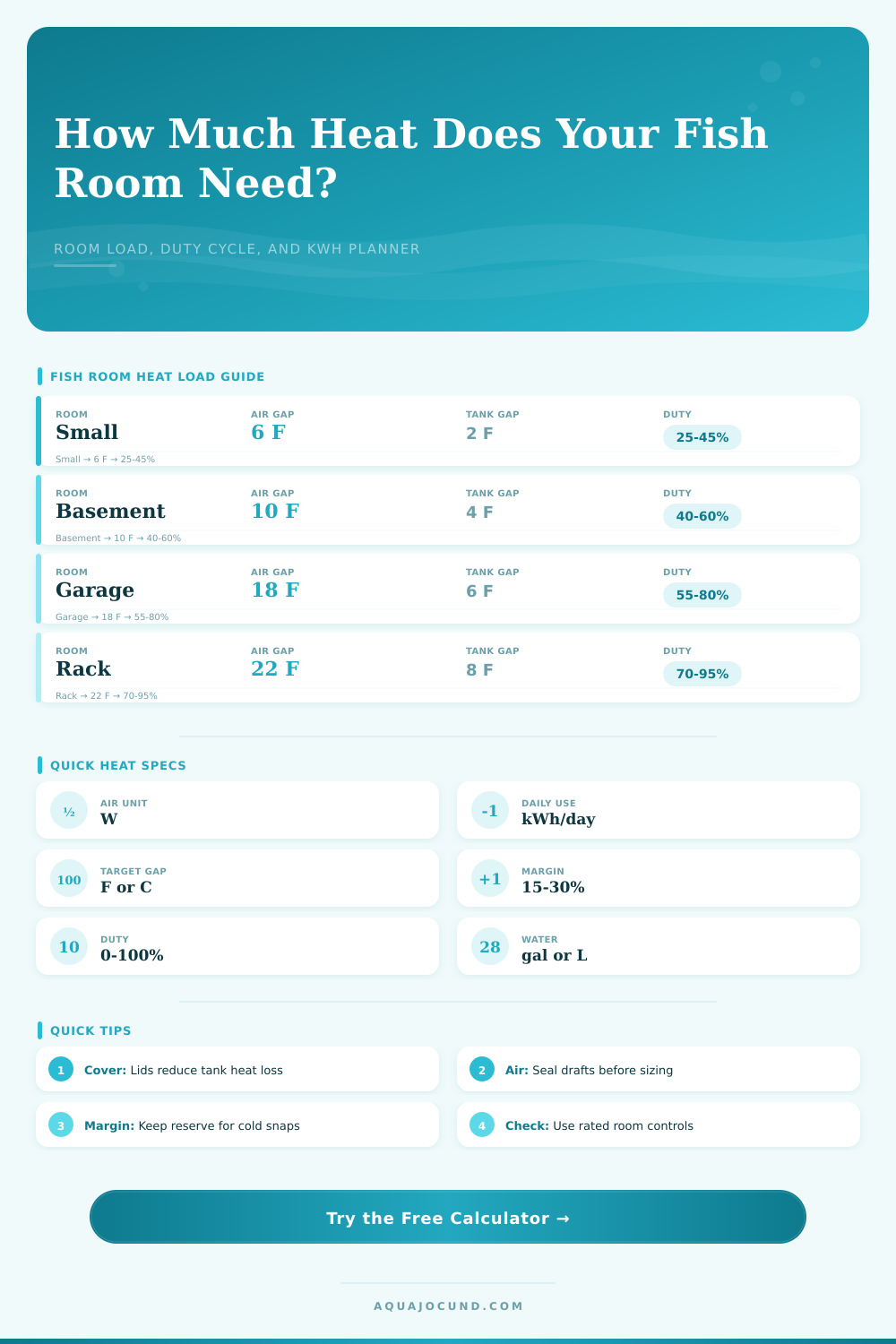
Insulation factors can be adjusted to see what happens if you seal off a drafty window. It turns abstract ideas like air exchange and thermal mass into real numbers you can change. The most economical upgrade tends to be insulation. Buying a larger heater does not always save more watts than adding lids to your tanks and weatherstripping your doors. The heat loss table on the page details the load in various rooms. How much of your house is heated and what is it? Is it an unheated shed? Is it a finished interior room? Each has its own characteristics for holding heat. This helps determine location of the tanks. Do you have a leaky garage that forces you to go with a larger capacity heater? Look also to ways to minimize the air volume you will need to heat. Small tight spaces is easier to work with.
All in all, building a fish room that’s stable comes down to planning not reacting. If you know how to calculate water volume, insulation, and air temp then you no longer guess. No more “I need the biggest heater I can find, even if it’s on sale.” You get the right size heater for the job and let it run efficienty and quietly while your fish swim happily. And that’s the beauty of it all; you create an efficient, quiet system that makes everyone but the power company happy. It doesn’t cost much, and that’s what makes this hobby affordable and fun. We know the numbers behind the glass so we can focus on the life behind it.