💨 Fish Room Ventilation CFM Calculator
Estimate exhaust fan CFM from fish room volume, open water surface, evaporation rate, temperature gain, humidity target, and duct losses.
✅ Fish Room Ventilation Results
| Fan Or Duct Type | Best Use | Typical Rated Range | Base Derate | Pressure Note |
|---|---|---|---|---|
| Bathroom exhaust fan | Small humid closet or single tank room | 50 to 150 CFM | 0.70 | Short straight runs only |
| 4 in inline fan | Nano racks, single display sumps | 100 to 250 CFM | 0.76 | Sensitive to filters and hoods |
| 6 in inline fan | Medium fish room or several racks | 240 to 500 CFM | 0.80 | Good balance for long ducts |
| EC inline mixed flow fan | Humidistat control and variable speed | 200 to 800 CFM | 0.84 | Holds airflow better under load |
| Through-wall fan | Direct wall exhaust with low duct loss | 120 to 450 CFM | 0.82 | Needs exterior damper clearance |
| HRV or ERV exhaust branch | Tempered makeup air and continuous exchange | 40 to 200 CFM | 0.72 | Verify branch balancing |
| Dehumidifier assist exhaust | Rooms where exhaust is supplemental | 50 to 250 CFM | 0.78 | Vent still removes stale air |
| Custom rated fan | Known fan curve or measured airflow | User selected | 0.80 | Use measured CFM if available |
| Tank Size | Common Dimensions | Surface Area | Open-Top Evap | Vent Note |
|---|---|---|---|---|
| 5 gal | 16 x 8 x 10 in / 41 x 20 x 25 cm | 0.9 sq ft / 0.08 m2 | 0.03 to 0.10 gal/day | Usually moisture, not ACH, controls closets |
| 10 gal | 20 x 10 x 12 in / 51 x 25 x 30 cm | 1.4 sq ft / 0.13 m2 | 0.04 to 0.16 gal/day | Covered tanks cut fan demand sharply |
| 20 long | 30 x 12 x 12 in / 76 x 30 x 30 cm | 2.5 sq ft / 0.23 m2 | 0.08 to 0.30 gal/day | Racks add water area faster than volume |
| 29 gal | 30 x 12 x 18 in / 76 x 30 x 46 cm | 2.5 sq ft / 0.23 m2 | 0.08 to 0.30 gal/day | Same footprint as many 20 long tanks |
| 40 breeder | 36 x 18 x 16 in / 91 x 46 x 41 cm | 4.5 sq ft / 0.42 m2 | 0.14 to 0.54 gal/day | Wide tops create noticeable humidity |
| 55 gal | 48 x 13 x 21 in / 122 x 33 x 53 cm | 4.3 sq ft / 0.40 m2 | 0.13 to 0.52 gal/day | Long tanks benefit from cross-room airflow |
| 75 gal | 48 x 18 x 21 in / 122 x 46 x 53 cm | 6.0 sq ft / 0.56 m2 | 0.18 to 0.72 gal/day | Lighting heat can exceed moisture demand |
| 125 gal | 72 x 18 x 21 in / 183 x 46 x 53 cm | 9.0 sq ft / 0.84 m2 | 0.27 to 1.08 gal/day | Sumps and refugiums often double area |
| Fish Room Condition | ACH Range | Humidity Clue | Heat Clue | Control Style |
|---|---|---|---|---|
| Covered single display | 4 to 8 | Glass stays clear | Small light load | Timer plus humidistat |
| Open planted tanks | 6 to 10 | Lids or windows sweat briefly | Moderate lighting | Humidity triggered exhaust |
| Multi-tank rack | 8 to 12 | Room feels damp after feeding | Pumps run continuously | Continuous low, boosted high |
| Breeder room | 10 to 14 | Many warm uncovered tanks | Air pumps and heaters add load | Variable fan with makeup air |
| Reef sump utility room | 10 to 16 | Sumps, skimmers, and refugiums | High lights and pumps | Humidistat plus temperature boost |
The next time you walk into your fish room it’s wet. The windows fog up with condensation and the air is heavy. You can almost smell moisture just off the ground. That’s a red flag that your ventilation isn’t working.
Most hobbyists tend to focus on water quality at first (rightfully so), but they overlook one part of the system: the air in the room. Heat and moisture management is critical. Let them get out of control and your environment turn swamp-like. Algae will bloom. Mold develops. Your equipment suffer from the stress.
How to Control Heat and Moisture in Your Fish Room
Evaporation‘s the main offender here. If it’s warmer in your tank then in the air, water evaporates from the surface. The calculator above will do the math for you after you enter size of your room and the percentage of the tank that’s covered.
It considers the amount of water, sure. But it also considers surface area exposed. A wide, shallow tank loses more water than a narrow, deep one of equal capacity. An open top planted tank with lots of surface agitation behaves as a sort of humidifier, while a closed sump on your reef behave like a leaky bucket. The former requires more air movement then the latter.
Don’t overlook this; you’ll end up buying what sounds like a loud fan but doesn’t do anything.
There’s another wrinkle, heat. All of your equipment (filters, pumps, lights) emit waste heat in addition to moisture. That waste heat get dumped into the room. If there is no way for it to exit the room, it raise the room temperature. That causes more evaporation. It’s a feedback loop and it can get out of hand very fast.
To prevent this from happening, the calculator will estimate how much air flow are needed to maintain the temperature increase at a safe level. This keeps your electronics from overheating while keeping your fish cool. You may believe you only have to account for ventilation due to humidity, but heat often plays just as big of role when determining fan size. A smaller allowable temperature increase requires more airflow then a larger one. Don’t lie to yourself on the input side about how much your room can tolerate.
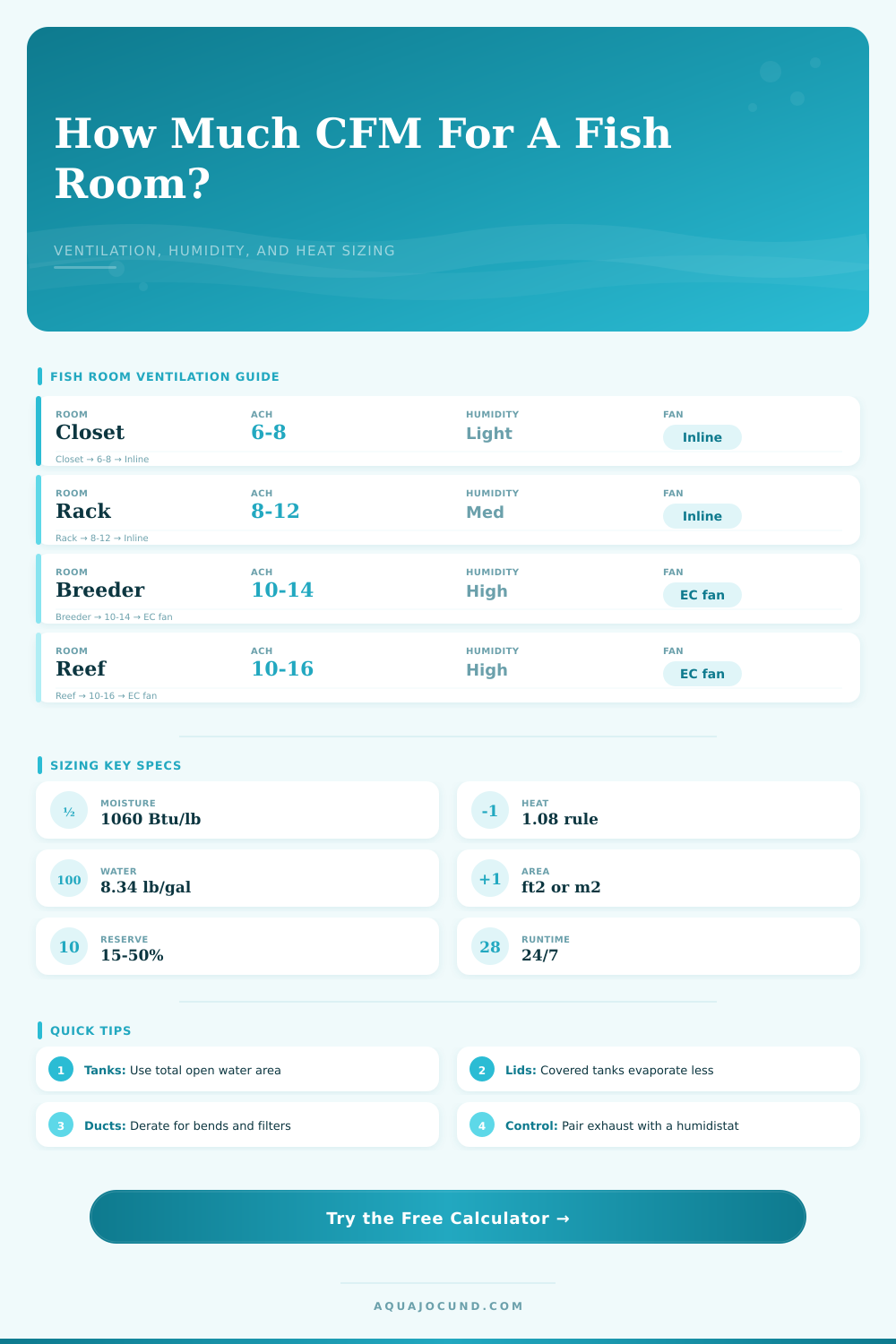
The usual measurement of ventilation rate is Air Changes Per Hour (ACH) which doesn’t make sense in a vacuum. If I’ve got 6 tanks stacked in a closet then maybe that require just six ACH. If I have a dozen or so open tub in a big breeder room, maybe that takes fifteen or more. Before you begin to adjust for any particular conditions in your space, here’s where the table on the page comes in, a basis of comparison by room type. These figures represent minimums, not goals for the day when humidity peaks. On those days when the sun blasts in through my window in the afternoon the demand increase.
Most do-it-yourself setups fall apart at this point. You purchase a fan that’s rated for four-hundred cubic feet per minute and you’re surprised to find out it only produces two-hundred. Filters, elbow bends, and long runs eat away at your static pressure and strangle the airflow. Based off your estimated fan type and duct length, the calculator will derate the output you expect. It does so in order to give you a realistic number of what is being delivered as opposed to an optimistic label rating. That’s where people go wrong; they size for the sticker, not the installation.
And lastly; no makeup air is negotiable. You can’t take all the air out of a sealed room with a strong exhaust fan. Whether you have a transfer grille or an undercut door (or both), you need a way for new air to get in. Otherwise, you will make negative pressure which could of stalled the fan completely or cause it to backdraft other flues.
When balanced correctly, a formerly troublesome, damp area becomes a stable atmosphere where your gear doesn’t wear out, and your fish don’t suffer. It’s not just about moving air. Its about controlling the atmosphere.