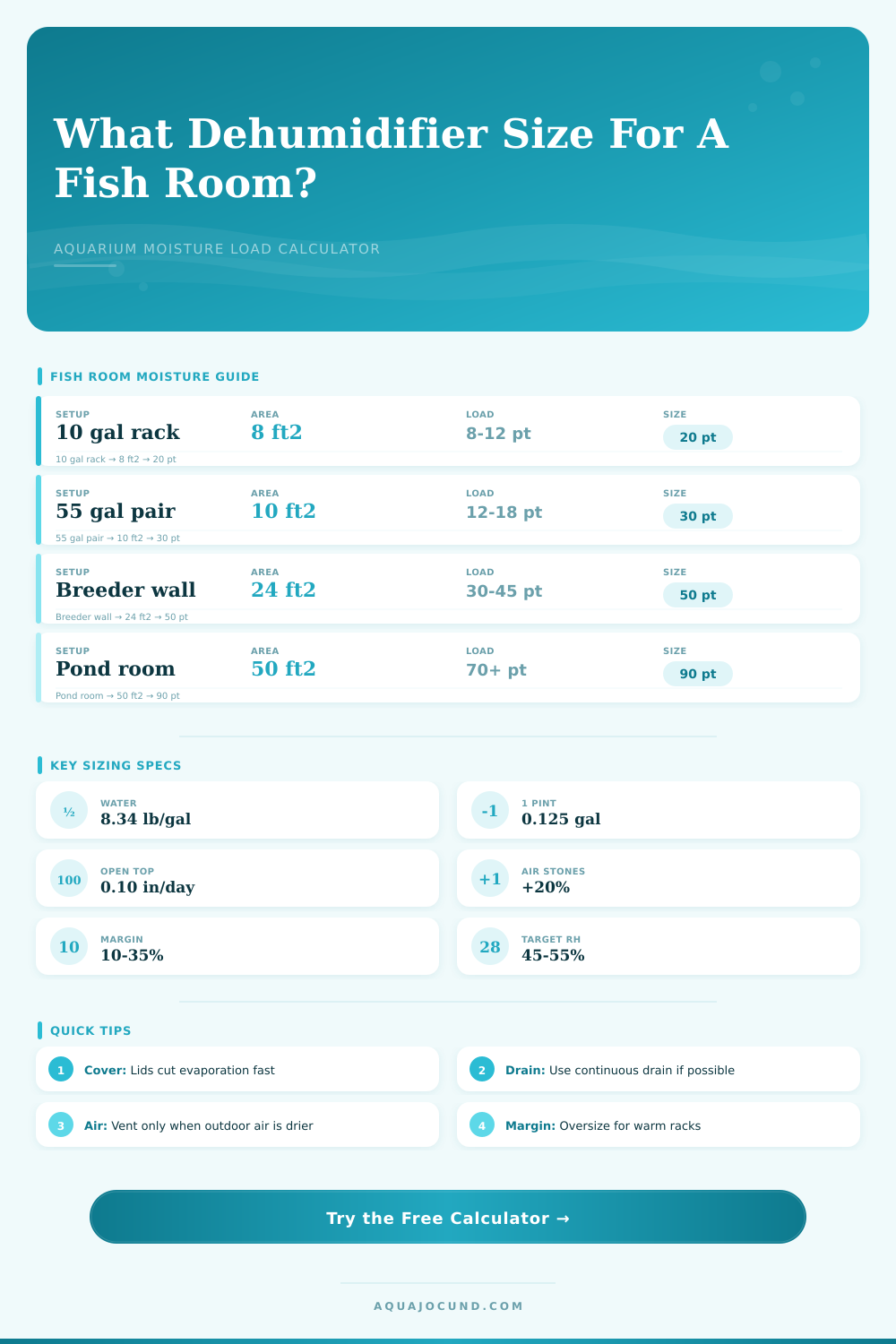
Fish Room Dehumidifier Size Calculator
Estimate aquarium room moisture load, recommended dehumidifier rating, open-water evaporation, and daily runtime planning.
Dehumidifier Size Estimate
| Surface Type | Base Evaporation | Typical Use | Adjustment Note |
|---|---|---|---|
| Tight glass lids | 0.035 in/day | Covered display tanks | Still needs margin around filters and feed gaps. |
| Partial lids | 0.060 in/day | Canopies with rear openings | Use when most water is covered but plumbing is open. |
| Open calm surface | 0.100 in/day | Open-top planted tanks | Good baseline for calm tanks near 78°F and 50% RH. |
| Air stones and sponge filters | 0.160 in/day | Breeding racks | Use when bubbles break the surface all day. |
| Open sumps and rack filters | 0.180 in/day | Central filtration rooms | Exposed filter flow raises vapor load. |
| Reef agitation | 0.220 in/day | Marine tanks with overflow | Surface skimming and warm water increase load. |
| Waterfall or trickle filter | 0.280 in/day | Ponds and wet-dry filters | Use for splashing returns or exposed media towers. |
| Warm growout tanks | 0.240 in/day | Fry racks and heated rooms | Warm water raises vapor pressure quickly. |
| Example Setup | Open Water Area | Likely Moisture Load | Common Rated Size |
|---|---|---|---|
| Nano shelf with lids | 5 to 8 ft² / 0.5 to 0.7 m² | 4 to 10 pints/day | 20 pint/day class |
| Two 40 breeder tanks | 9 ft² / 0.8 m² | 10 to 18 pints/day | 30 pint/day class |
| Six-tank breeding rack | 18 to 28 ft² / 1.7 to 2.6 m² | 25 to 45 pints/day | 50 pint/day class |
| Mixed reef and sump room | 18 to 35 ft² / 1.7 to 3.3 m² | 30 to 60 pints/day | 50 to 70 pint/day class |
| Indoor pond room | 45 to 90 ft² / 4.2 to 8.4 m² | 70 to 150 pints/day | 90 pint/day or split units |
| Warm fry rack room | 25 to 45 ft² / 2.3 to 4.2 m² | 45 to 90 pints/day | 70 to 90 pint/day class |
| Room Condition | Capacity Factor | Why It Matters | Planning Use |
|---|---|---|---|
| 80°F, 60% RH rating point | About 1.00 | Many portable ratings are easiest near warm, damp air. | Use rated pints nearly directly. |
| 75°F, 50% RH fish room | About 0.75 to 0.90 | Lower humidity gives the coil less moisture to condense. | Oversize modestly for steady control. |
| 68°F basement room | About 0.55 to 0.75 | Cool air reduces removal speed and can trigger defrost cycles. | Choose a larger unit or longer runtime. |
| Warm rack above 80°F | About 0.95 to 1.10 | Warm air holds more water, but tanks evaporate faster too. | Use the safety margin for growth. |
| Ventilated room with humid makeup air | Depends on grains | Incoming damp air can add latent load beyond tank evaporation. | Compare incoming RH to target RH. |
It’s a steamy summer day, and when you step into aquarium room and open the door, the heat smacks you in the face like a wet towel. Condensation beads down your walls and drips onto your equipment racks, making them look like they was rained on from the inside. Oh no, this is every aquarist’s nightmare. Uncontrolled humidity brings on mold (faster then you can clean it), kills electronics and eats away at your walls’ drywall.
What gives? Most folks purchase dehumidifiers based off square feet. Big mistake. In a fish room, the walls isn’t the culprit. The culprit is the fish tank(s). Once you enter your room conditions and surface area of your tanks into the calculator (above), it do all the math for you. No guessing about how much air should flow or what evaporation rate is. Instead, it considers moisture load as the determining factor.
How to Choose the Right Dehumidifier
Why? Because even though your room may be large, if there’s nothing but open water (i.e., three hundred gallons) in a small closet, your dehumidifier will drown! It’s important to understand that water temperature drive vapor pressure. Water releases moisture more aggressively when it’s warmer. So if you’re running an eight foot long cichlid room at eighty degrees Fahrenheit, you’re going to have a significantly greater evaporation rate then a cool-water, goldfish set up running at only seventy degrees. To account for this heat difference, the tool adjust the baseline evaporation depth to match.
The other big factor here is cover style. By cutting off that evaporation stream, you can cut your moisture load by half or even more depending on how tight the cover is. You’ll see this in the reference table on the page which illustrates how surface agitation impacts everything. The greater the exposure, the more evaporation there will be due to air stones, trickle filters, sumps, etc. These items breaks up the surface tension and expose more area. That mechanical breakup releases lots more vapor than the calm, still surface area do. If you have a breeding rack with heavy aeration, you’re fighting a much steeper uphill battle different than someone with covered display tanks. You don’t want to undersize your unit accidentally which is why the calculator allows you to choose these cover profiles.
Then there’s ventilation. You have to vent fresh air to regulate temperatures and bring in some oxygen. This means you are also sucking in humidity and pouring water into your home. If you’ve got your windows open, you’ll need a bigger dehumidifier to compensate for all that dank air. The tool accounts for rates of air exchange. It will tell you exactly how much additional load you’re placing on yourself by replacing nasty inside air with moist outside air. It’s a give-and-take balance. Want those windows open? You would of need a bigger dehumidifier.
Dehumidifiers becomes less efficient as the air around them cools down. One rated at fifty pints at eighty degrees may only be pulling thirty at seventy. That loss of effectiveness is why you end up with wet walls even though you’re running a machine all day. It is better to oversize it slightly.
Biggest is not always best when choosing your dehumidifier size. Match what you think the generation rate will be to what the removal rate should be. You don’t want one so big that it short cycles and leaves the air too dry. You also don’t want one so small that it’s working hard pulling moisture or constantly cycling on and off, that causes wear and tear on the compressor. A bigger unit may short cycle leaving the air overly dry, stressing some fish species as this can cause slight changes in the osmotic balance. You want steady, moderate extraction.
Use the estimates above, adjust for warmer days with a safety margin, then watch the condense output in the real world. If the bucket fills up quicker than predicted, you know that the real world is kicking the model’s butt. Make adjustments accordingly. It transforms a vague sense of moistness into an engineerable issue.
From here on out, you aren’t guessing… You’re controlling the vapor load. The wall remains undamaged, the air remains dry, and the fish remain content in a stable environment. It is the difference between fighting humidity and eliminating it. Instead of that warm, wet towel feeling when you open the door, your room will feel light, airy, crisp, and cool.