Aquarium Cabinet Ventilation Calculator
Estimate exhaust airflow, fan count, intake opening area, and air changes for enclosed aquarium stands and sump cabinets.
Cabinet Ventilation Estimate
| Package | Typical Free Airflow | Derate Used | Best Use |
|---|---|---|---|
| Passive vents only | 0 CFM fan airflow | Vent area only | Open backs or very low heat |
| 80 mm DC axial | 30 CFM / 51 m3/h | 50% | Nano and small freshwater cabinets |
| 92 mm DC axial | 42 CFM / 71 m3/h | 55% | Compact stands with short grilles |
| 120 mm quiet axial | 55 CFM / 93 m3/h | 62% | Most sump cabinets |
| 120 mm high-flow axial | 85 CFM / 144 m3/h | 60% | Warm reef cabinets |
| 140 mm quiet axial | 75 CFM / 127 m3/h | 64% | Lower-speed large openings |
| 4 in inline duct fan | 100 CFM / 170 m3/h | 70% | Remote exhaust ducting |
| 6 in inline duct fan | 250 CFM / 425 m3/h | 72% | Large sump cabinets or fish rooms |
| Tank | Typical Cabinet Interior | Cabinet Volume | Typical Ventilation |
|---|---|---|---|
| 10 gal nano | 20 x 10 x 24 in / 51 x 25 x 61 cm | 2.8 ft3 / 0.08 m3 | 15-25 CFM or large passive vents |
| 20 long sump | 30 x 12 x 28 in / 76 x 30 x 71 cm | 5.8 ft3 / 0.16 m3 | 25-45 CFM with screened intake |
| 40 breeder | 36 x 18 x 30 in / 91 x 46 x 76 cm | 11.3 ft3 / 0.32 m3 | 40-70 CFM with high exhaust |
| 75 gal reef | 48 x 18 x 32 in / 122 x 46 x 81 cm | 16.0 ft3 / 0.45 m3 | 60-110 CFM for sump humidity |
| 125 gal | 72 x 18 x 34 in / 183 x 46 x 86 cm | 25.5 ft3 / 0.72 m3 | 90-150 CFM or inline exhaust |
| 180 gal | 72 x 24 x 36 in / 183 x 61 x 91 cm | 36.0 ft3 / 1.02 m3 | 130-240 CFM with ducted exhaust |
| Basis | Formula Used | Conversion | Calculation Role |
|---|---|---|---|
| Cabinet volume | L x W x H | 1 ft3 = 0.0283 m3 | Air changes per hour requirement |
| Heat airflow | BTU/hr / (1.08 x delta F) | 1 W = 3.412 BTU/hr | Limits cabinet temperature rise |
| Moisture airflow | lb/hr / (60 x 0.075 x delta W) | 1 gal = 8.34 lb water | Limits relative humidity buildup |
| Vent opening | CFM / face velocity | 250 fpm target | Sizes low intake and high exhaust openings |
| Fan derate | Free air CFM x package factor | 50-72% used | Allows for grille and small static losses |
| Profile | Daily Evaporation Rate | Typical Cabinet | Ventilation Note |
|---|---|---|---|
| Covered freshwater sump | 0.03 gal/sq ft/day | Closed lids, low splash | Often heat-driven more than moisture-driven |
| Open freshwater sump | 0.05 gal/sq ft/day | Open top or wet media | Moderate humidity control target |
| Warm planted cabinet | 0.06 gal/sq ft/day | Refugium or plant light | Count light drivers as heat load |
| Reef sump with skimmer | 0.08 gal/sq ft/day | Open sump, skimmer, saltwater | Use margin for salt creep on screens |
| High-flow reef sump | 0.10 gal/sq ft/day | Splash, socks, roller mat | Higher exhaust and larger intake area |
| Canopy and sump water | 0.12 gal/sq ft/day | Warm enclosed canopy | Vent canopy heat separately when possible |
| Dry room or dehumidified room | 0.04 gal/sq ft/day | Room RH kept lower | More humidity capacity in incoming air |
If you own an aquarium, then you’ve likely noticed fine white powder on your clean aquarium stand. That’s called salt creep. And that point to something bigger. The cabinet containing your tank has too much heat and moisture in its air. When the air stagnates, it become saturated with heat and moisture until it condenses on cooler surfaces. Electronics gets damaged. Wood get ruined. Mold find a humid environment.
It doesn’t take expensive tools to solve this. All it takes is understanding movement of air. Air should of be moved to replace the air being lost to both heat and evaporation. When you input your equipment load and cabinet size, the calculator do the math. You don’t have to guess at how much air flow you have or what the static pressure will be. It tell you exactly how much room you must have for airflow.
Stop Salt Creep With Better Airflow
Most hobbyists do not consider sump cabinet as part of equation. They think that if they can’t see humidity, it doesn’t exist. What they fail to realize is a sump containing protein skimmer becomes a humidifier. Because the water is out of sight, it’s easy to forget how much surface area there is. It is often twice that of display tank. This means a lot of vapor is released into an enclosed space, the vapor stays trapped in the enclosed space.
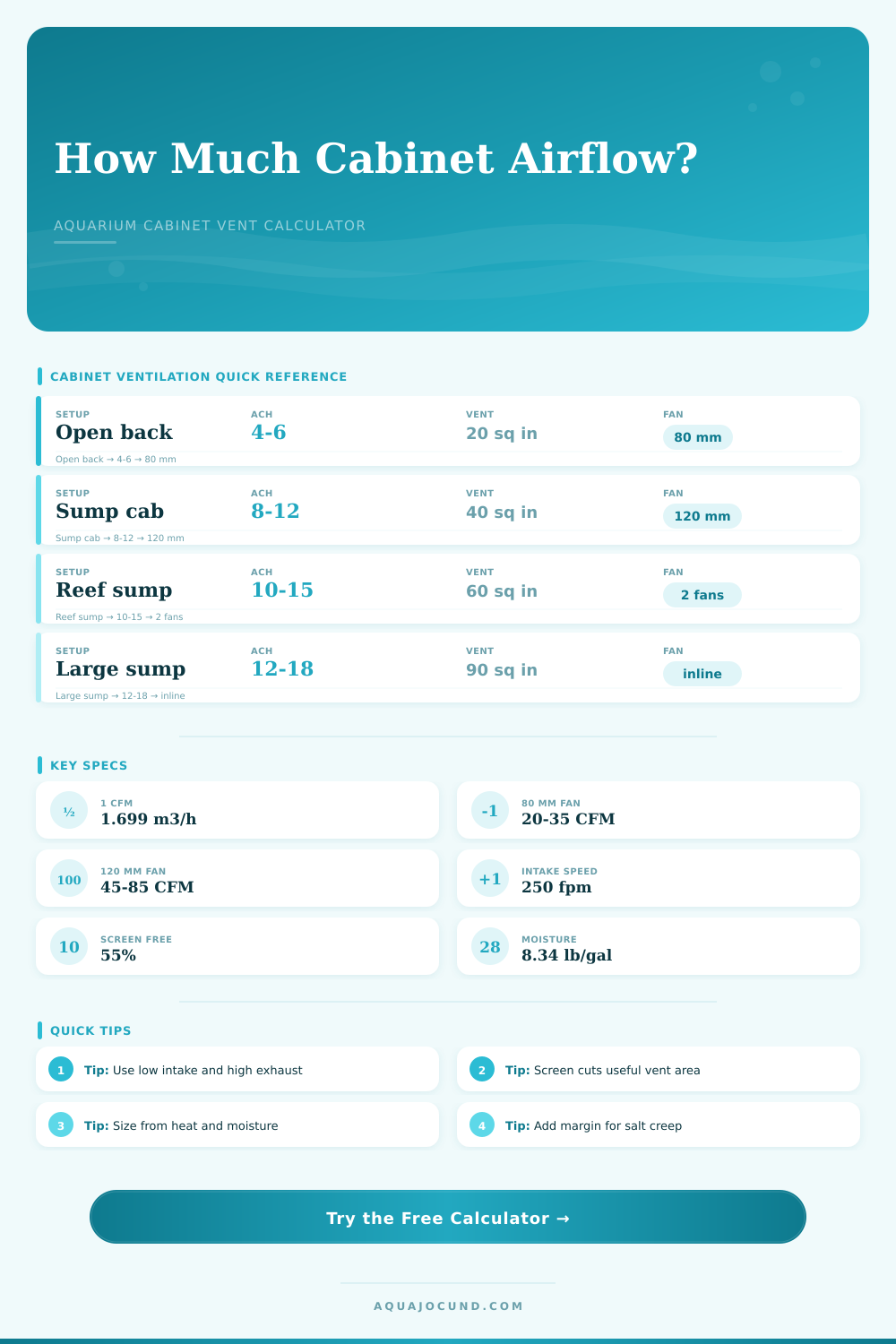
While heat and moisture move in tandem, the answer is not the same for both. Heat is generated by electrical equipment which need to be vented. Moisture created through evaporation also need to leave the space. By calculating air changes per hour, the tool will help you balance your loads. To keep a cabinet dry require between eight and twelve air changes an hour. Sounds like a lot? Well cabinets aren’t large. It just takes fast cycling of air to avoid getting saturated.
Most projects fail during fan selection. Customers purchase fans by maximum flow rating printed on the box, then they place these fans behind filters and grilles. Every time you add a restriction it halves the effective airflow. That’s why the calculator doesn’t show you maximum theoretical airflow, it shows you useful airflow. Choose a passive vent setup? No problem, the tool will calculate needed opening area. Active fans? It’ll tell you how many you need. It is a reality check on your hardware performance.
The other part of this deal is placement. Warm humid air rise. Placing the exhaust fan low on the cabinet means you’re pushing damp air around. You aren’t getting rid of it. The exhaust should be at the top and the intake near the bottom. That creates a thermal chimney effect. Fresh air is pulled in and stale air pushed out. Without that vertical gradient, all the best fan in the world won’t do much to clear the cabinet.
Consider the space where you have your cabinet. In a humid home, it will take some of that water with it when it draws air. That reduces how much moisture the exhaust can actualy clear from the cabinet. The room relative humidity gets included in the calc. That way if the air seems dry to you, we don’t size down too far. And it adds a little cushion for things like cable clutter and fan degradation. Over time, equipment age. Screens get dirty and dust accumulates. By adding this extra bit, you know you’ll be getting that same performance for years…not weeks.
Control The cabinet is its own ecosystem, and you control what happens to the moisture inside of it. You don’t eliminate evaporation by having an open sump, but you do get to decide where the water vapor exits. By treating the cabinet as its own environment, you protect your investement. If you want to avoid the white powder, treat it like a different world. Keep the electronics cool. Keep the wood dry. Not rocket science, but it’s physics. Use properly sized vents to respect airflow and let the hot air out. That’s the secret behind a cabinet that outlasts the tank it houses.