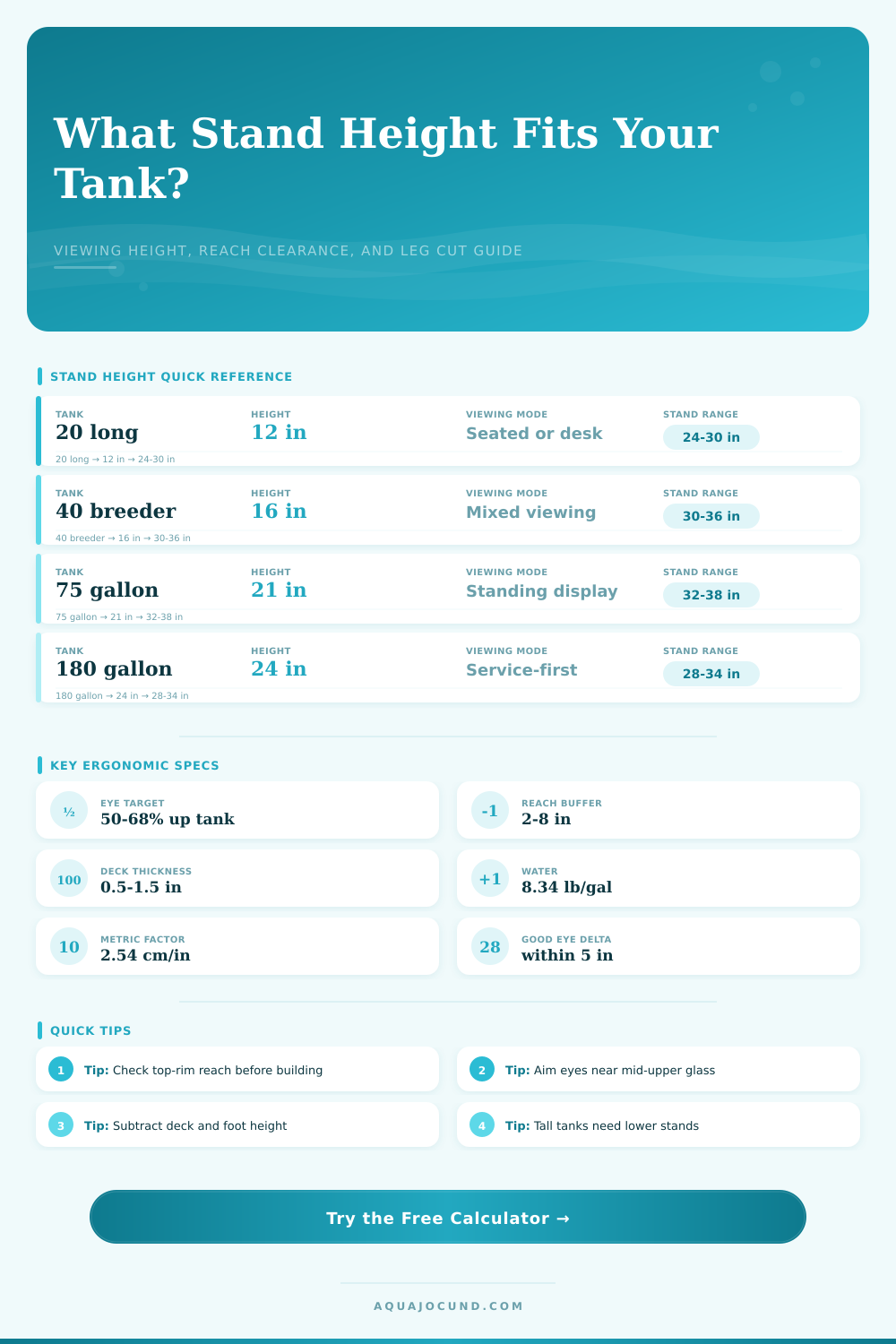
📏 Tank Stand Height Ergonomic Calculator
Find a comfortable aquarium stand height from viewer eye line, tank height, top-rim reach, display posture, and stand deck thickness.
| Profile | Eye Target In Glass | Service Weight | Best Use |
|---|---|---|---|
| Mostly seated viewing | 60% up visible height | Medium | Desk, sofa, office, or low lounge displays. |
| Mixed seated and standing | 58% up visible height | Medium | Most living room aquariums and family spaces. |
| Standing display focus | 64% up visible height | Low | Entry, hallway, shop, or gallery-style viewing. |
| Service-first aquascaping | 52% up visible height | High | Planted tanks, frequent trimming, and shallow frag systems. |
| Reef with lights or canopy | 55% up visible height | High | Systems with canopy height, light rails, and sump routines. |
| Peninsula or room divider | 60% up visible height | Medium | Tanks viewed from more than one side. |
| Child-friendly lower display | 68% up visible height | Medium | Classroom, family, and kid-height viewing. |
| Wheelchair seated view | 62% up visible height | High | Seated access with a lower eye-height input. |
| Tank Size | Typical Dimensions | Volume | Common Ergonomic Stand Range |
|---|---|---|---|
| 10 gallon | 20 × 10 × 12 in / 51 × 25 × 30 cm | 10 gal / 38 L | 24-32 in for desk or seated viewing |
| 20 long | 30 × 12 × 12 in / 76 × 30 × 30 cm | 20 gal / 76 L | 26-34 in for planted work access |
| 29 gallon | 30 × 12 × 18 in / 76 × 30 × 46 cm | 29 gal / 110 L | 28-34 in for mixed family viewing |
| 40 breeder | 36 × 18 × 16 in / 91 × 46 × 41 cm | 40 gal / 151 L | 30-36 in balances display and reach |
| 55 gallon | 48 × 13 × 21 in / 122 × 33 × 53 cm | 55 gal / 208 L | 30-36 in because the tank is tall and narrow |
| 75 gallon | 48 × 18 × 21 in / 122 × 46 × 53 cm | 75 gal / 284 L | 32-38 in for standing display emphasis |
| 120 gallon | 48 × 24 × 24 in / 122 × 61 × 61 cm | 120 gal / 454 L | 28-34 in for serviceable reef or planted layouts |
| 180 gallon | 72 × 24 × 24 in / 183 × 61 × 61 cm | 180 gal / 681 L | 28-34 in unless display height is prioritized |
| Top-Rim Clearance | Calculator Status | Meaning | Typical Adjustment |
|---|---|---|---|
| Reach gap above selected buffer | Good | Feeding, wiping glass, and tool access should feel manageable. | Keep height unless viewing line feels low. |
| 0-2 in short of buffer | Tight | Routine work is possible but deep cleaning may require a stool. | Lower stand 1-3 in or use longer tools. |
| More than 2 in short | Overreach | The display may look good but maintenance ergonomics are weak. | Lower stand, reduce canopy height, or plan a stable work step. |
| Deep tank over 24 in tall | Plan Access | Arm reach through water, lighting, and trim matters more than eye line alone. | Use a lower stand and removable light access. |
| Wall or alcove placement | Check Space | Side and rear access can matter as much as stand height. | Leave tool clearance above and around the tank. |
| Build Part | How Calculator Uses It | Example | Why It Matters |
|---|---|---|---|
| Finished stand height | Floor to tank bottom or support surface | 34 in / 86 cm | This sets the aquarium viewing and top-rim height. |
| Top deck thickness | Subtracted from finished stand height | 0.75 in plywood | Gives the leg or frame height before the deck is added. |
| Leveling feet or shims | Subtracted from finished stand height | 0.5 in adjustable foot | Leaves adjustment travel while keeping the final height correct. |
| Leg or frame cut height | Finished stand minus deck minus feet | 32.75 in for a 34 in stand | This is the practical fabrication number for vertical supports. |
| Current stand delta | Planned stand minus recommended stand | +2 in means taller | Shows whether an existing stand is likely high, low, or close. |
You set up your tank and then wonder where you will clip your plants. Oops, thats another overlooked item. You’ve spent weeks deciding on substrate and hardscape but forgot to consider stand height.
Stand height determine your interaction with the tank every day. It isn’t just about aesthetics. It doesn’t matter if it fits in a corner of the room, it matters for maintaining ecosystem.
How to Choose the Right Tank Stand Height
Armed with this new knowledge, how will you use it? First of all, you’re not necessarily going to get the same answer from both. Arm reach and eye line aren’t interchangeable.
For maximum viewing, you might prefer to center glass at eye level. However, if you only care about viewing angle then you risk having top rim too high and making every algae wipe and water change a chore.
The calculator figures it out for you. It finds a middle ground between those requirement without requiring you to make an educated guess. It uses your eye height and tank specs.
The majority of folks would expect you’d look at the middle of the tank. It just makes more sense to look up and down a bit rather than looking way up high, that way you won’t tilt your head back to get a good view of the layout.
So the tool allows for that by letting you choose which profile you’re looking at. Do you have a planted tank that require some trimming? You’ll want a lower stand. Is it a display piece? Then maybe you care more about visual angle.
Maybe the difference is just inches, or even a couple. But that can make the difference between feeling cramped or comfortabley.
Another source of mistakes are how thick the stand deck is. Depending on your choice of materials, that might matter. Remember to include whatever sits atop it when cutting your leg. It is three-quarters of an inch if you’re using a single sheet of plywood. It is much thicker than that with a double layer. Oops, the stand will be too tall unless you remember to adjust it.
The calculator accounts for this difference for you. It even adjusts for leveling feet (if the floor isn’t level). It provides a precise number for how many times to cut each leg.
How about weight? A full 75-gallon tank is heavy and cumbersome. If you’re not thinking about this at install time, getting that thing filled with all that glass and water is going to be tough. You should of gotten it correct beforehand.
Tank shape change the comfort sweet spot as shown in the reference table. You can’t reach into a tall, skinny display as easy as a short, wide breeder tank. The tool accommodates for different tank shapes. It keeps reach buffer reasonable.
Your stand is the base of your routine. Too high and you’ll skip chores. Too low and you’re straining back. Somewhere there’s a narrow band where everything falls easily into place. And to find that band you have to think about entire system.
Align the rim with your hands and glass with your eyes. When you get that locked in the aquarium stops being a project. Instead you simply look up and see what you’ve built.