Aquarium Canopy Lumber Calculator
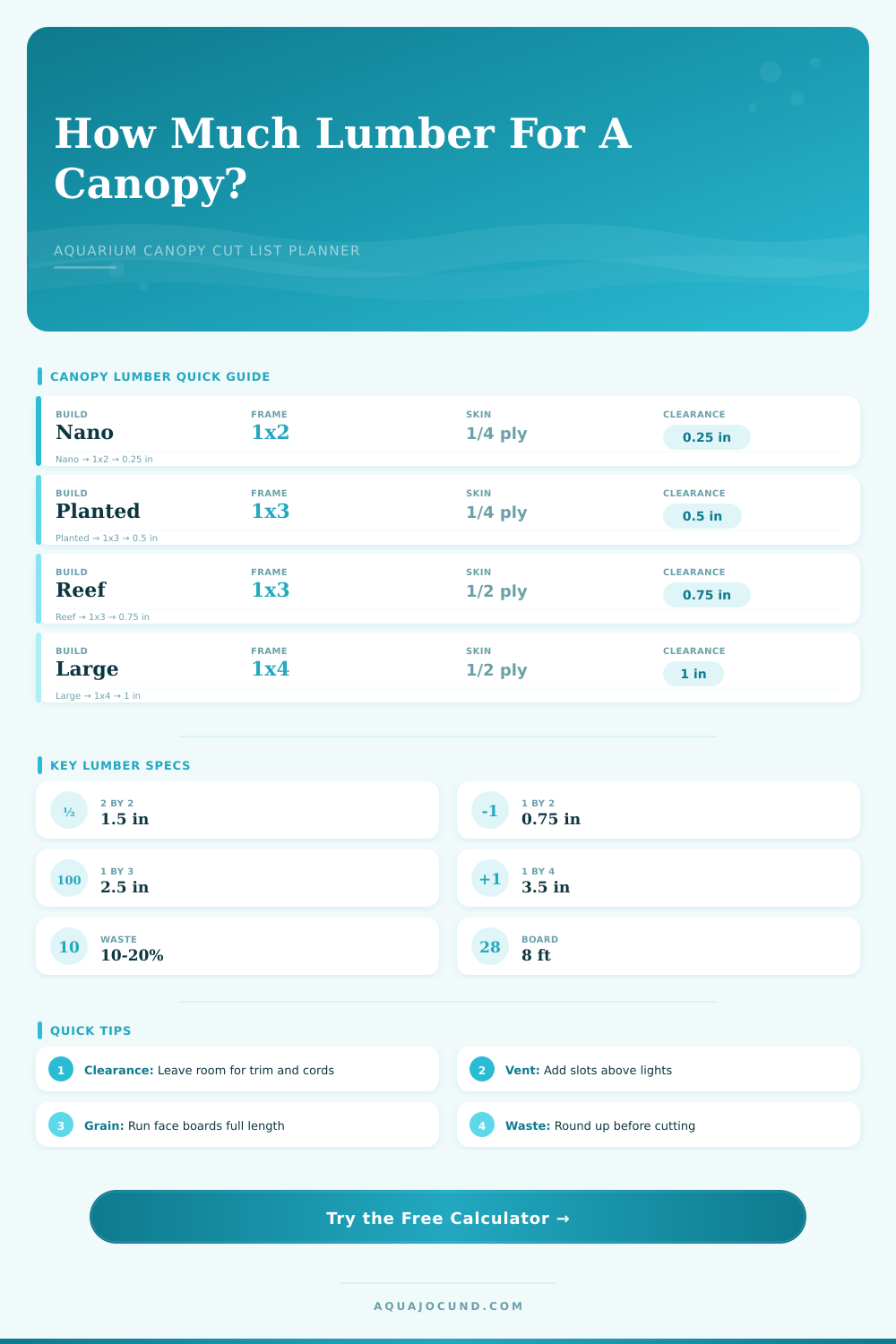
Build a topic-specific canopy cut list from tank footprint, clearance, height, frame stock, panels, lid style, and waste allowance.
📌Canopy presets
📐Selected lumber profile
📋Frame lumber comparison
| Profile | Dressed Size | Typical Use | Planning Note |
|---|---|---|---|
| 1 by 2 pine | 0.75 in by 1.5 in | Nano and shallow canopies | Light, easy to hinge, needs straight boards |
| 1 by 3 pine | 0.75 in by 2.5 in | Most planted and community tanks | Good balance of stiffness and low weight |
| 1 by 4 pine | 0.75 in by 3.5 in | Tall display faces | Useful when the canopy itself is the face panel |
| 2 by 2 pine | 1.5 in by 1.5 in | Corner posts and large spans | Strong but takes interior clearance |
| 1 by 2 cedar | 0.75 in by 1.5 in | Moist rooms and lighter builds | Seal all faces before installation |
| 1 by 3 poplar | 0.75 in by 2.5 in | Painted furniture-style canopy | Stable for doors, heavier than pine |
| 1 by 2 oak | 0.75 in by 1.5 in | Stained trim and face frames | Dense stock increases finished weight |
📏Common aquarium canopy starting sizes
| Tank | Tank Footprint | Canopy Outside Size | Typical Lumber Pull |
|---|---|---|---|
| 10 gallon | 20 in by 10 in / 51 cm by 25 cm | 20.5 in by 10.5 in | 2 boards at 8 ft plus small panel |
| 20 long | 30 in by 12 in / 76 cm by 30 cm | 31 in by 13 in | 3 boards at 8 ft plus panel skin |
| 40 breeder | 36 in by 18 in / 91 cm by 46 cm | 37 in by 19 in | 4 boards at 8 ft for framed skin |
| 55 gallon | 48 in by 13 in / 122 cm by 33 cm | 49 in by 14 in | 4 boards at 8 ft with front doors |
| 75 gallon | 48 in by 18 in / 122 cm by 46 cm | 49.5 in by 19.5 in | 5 boards at 8 ft for tall reef access |
| 125 gallon | 72 in by 18 in / 183 cm by 46 cm | 73.5 in by 19.5 in | 7 boards at 8 ft plus center support |
⚒Panel and opening allowances
| Style | Added Frame Parts | Panel Coverage | Best Use |
|---|---|---|---|
| Simple lift-off shell | 4 corner stiles, 2 rail rectangles | Front, sides, optional top | Small tanks with easy full removal |
| Front service door | Door rails, door stiles, hinge stile | Front opening removes about 35 percent | Feeding and routine access from the front |
| Split top lid | Center spine and two lid frames | Two top panels, vent adjusted | Long planted tanks and glass tops |
| Reef access canopy | Extra top rails and taller posts | More vent subtraction for heat | Lights, fans, skimmer cups, and cords |
| Heavy display canopy | Center posts and doubled front rail | Full face with door cutout | Long tanks where sag matters |
The frame is known as the canopy. It contains lights and cuts down on evaporation. This piece of wood above the tank are often ignored by many builders. Humidity will warp the wood causing your canopy to either stick or sag if not made well.
Measuring mistakes happen easy, but calculating the frame is easy. Never cut wood based off the footprint of the tank. For example, just because it’s a forty-eight inch tank doesn’t mean you should use a forty-eight inch frame. Plastic tank trim require room. Filter cords need room. Your hands needs room. When measuring for your canopy, don’t just measure the glass; you need to add a half inch on each side to account for your hands, cords, and the tank’s trim. That way the frame will slip onto the tank easy.
How to Build a Good Canopy
Not all builders do this. They end up with lumber that doesn’t fit their tank, then have to use tools to pry the lid off. A simple half inch difference mean you won’t have to use tools to get the lid off.
The type of wood used also affects how the canopy reacts to humidity. Popular woods include pine. It is very affordable, cuts easy, and is light enough that you won’t notice weight much if you make an errant cut with your saw. Pine, however, do expand when moistened and contract when drying.
If the tank is large, consider using stronger woods like oak or poplar for components. Oak is very dense and will not warp or otherwise move easy. But it will add substantial weight to the canopy. The formula on the calculator give you an idea of how much lumber the canopy holds and helps you weigh cost against stability.
You need a good mix of heating air out and keeping humidity in. You need to let heat escape, but also don’t let humidity sit in a puddle against your floor. Lights that get warm, like metal halides and T5s, creates some heat while LEDs do not. Keep at least 10% of the canopy space open for air flow. Having a skimmer or other device running in a reef set up might require more ventilation.
Because of this, this tool will adjust for how many vents you run and what panel size are needed. That way you won’t have to drill additional holes down the road.
The cut list depends on the lid design. The most straightforward lift-off shell can be built with the least number of cuts. This is basically a box with no top or a loosely fitted panel. Adding a split lid or hinged doors mean adding more rails and stiles. This require more lumber.
Every cut introduces the possibility of waste, warped, knotted boards are not straightforward. Allow for some waste in your material estimate… Ten to fifteen percent is a good starting point. Odds are that at least one board will get cut just a hair too short.
Before purchasing boards, inspect each board for straightness. Once you add them to your frame, even just a small bow of a one by three inch board will become obvious. From afar it may not appear to have any imperfections, but up close it will stand out. While at the store, take the board and slide it across the floor. Does it rock? If so, pick another one.
A clean looking canopy is as good as water inside your tank. Find out how many boards you need. Long boards is expensive, so you’ll want to plan your layout carefully. However, you must balance number of short cuts, as having too many or too few will weaken the joints in the frame. Have all long cut boards run the length of the tank (grain running horizontally). This makes the frame stronger and look better.
Know how big the panels will be and what size frame you need. The calculator does that for you. You don’t need to worry about the math; just focus on building it. The craftsmanship is more important than the frills. A good canopy has to hang correctly, keep you dry, and secure the lamp in place. If you get the measurements correct initially, everything else falls into place. The added half inch of space makes maintenance and feeding a breeze.
You should of checked your work too.