Tank Moving Weight Per Person Calculator
Estimate aquarium carry weight, mover count, and per-person lift load after draining water and removing movable contents.
Moving Weight Estimate
| Construction | Shell Estimate | Typical Use | Moving Note |
|---|---|---|---|
| Standard rimmed glass | 1.35 to 1.55 lb per gal | Most 10 to 75 gallon tanks | Lift from the stand level with even support. |
| Frameless glass | 1.75 to 2.00 lb per gal | Rimless display tanks | Avoid twisting loads across unsupported corners. |
| Low-iron display glass | 1.60 to 1.90 lb per gal | Clear front display builds | Often heavier because panels are thicker. |
| Acrylic aquarium | 0.65 to 0.90 lb per gal | Large light display tanks | Lighter shell, but scratches during sliding. |
| Bow-front glass | 1.50 to 1.80 lb per gal | Curved front aquariums | Use extra hands to control the curved face. |
| Thick glass large tank | 1.85 to 2.30 lb per gal | 90 gallon and larger tanks | Plan more people than the scale alone suggests. |
| Custom heavy build | 2.20 to 2.80 lb per gal | Eurobraced or custom panels | Verify actual empty weight when available. |
| Material | Bulk Weight | Approx Depth Load | Moving Advice |
|---|---|---|---|
| Aquarium sand | 95 to 105 lb per ft³ | 8 to 9 lb per ft² per in | Remove most sand before lifting glass tanks. |
| Aquarium gravel | 100 to 110 lb per ft³ | 8.5 to 9.2 lb per ft² per in | Gravel shifts and can stress bottom panels. |
| Planted aquasoil | 50 to 65 lb per ft³ | 4.2 to 5.4 lb per ft² per in | Lighter than gravel but messy when wet. |
| Crushed coral | 70 to 85 lb per ft³ | 5.8 to 7.1 lb per ft² per in | Remove enough to prevent sliding piles. |
| Rockwork only | Variable | Manual entry through decor field | Remove loose rock before any carry. |
| Reef rock and sand | 65 to 90 lb per ft³ | 5.4 to 7.5 lb per ft² per in | Account for retained water in porous rock. |
| Tank Size | Dimensions | Volume | Typical Move Load |
|---|---|---|---|
| 5.5 gallon | 16 x 8 x 10 in / 41 x 20 x 25 cm | 5.5 gal / 21 L | 10 to 18 lb after draining |
| 10 gallon | 20 x 10 x 12 in / 51 x 25 x 30 cm | 10 gal / 38 L | 16 to 28 lb after draining |
| 20 long | 30 x 12 x 12 in / 76 x 30 x 30 cm | 20 gal / 76 L | 34 to 55 lb after draining |
| 29 gallon | 30 x 12 x 18 in / 76 x 30 x 46 cm | 29 gal / 110 L | 55 to 85 lb after draining |
| 40 breeder | 36 x 18 x 16 in / 91 x 46 x 41 cm | 40 gal / 151 L | 75 to 115 lb after draining |
| 55 gallon | 48 x 13 x 21 in / 122 x 33 x 53 cm | 55 gal / 208 L | 100 to 145 lb after draining |
| 75 gallon | 48 x 18 x 21 in / 122 x 46 x 53 cm | 75 gal / 284 L | 135 to 200 lb after draining |
| 125 gallon | 72 x 18 x 21 in / 183 x 46 x 53 cm | 125 gal / 473 L | 230 to 330 lb after draining |
| Route Type | Multiplier | What It Represents | Planning Use |
|---|---|---|---|
| Straight, short carry | 1.00x | Flat path, few turns, close vehicle | Use actual weight plus safety margin. |
| Doorways or tight turns | 1.10x | Uneven hand positions and slow rotation | Good default for most home moves. |
| Stairs or long carry | 1.20x | Fatigue and angle changes | Add helpers before the route feels marginal. |
| Stairs plus tight turns | 1.30x | Awkward load and reduced grip options | Use for apartments and basement paths. |
| Very awkward route | 1.40x | Multiple obstacles or uneven ground | Lower the per-person target or add movers. |
What’s even worse? An aquarium isn’t just vessel holding water. It’s an object, and it has weight. Moving one is not something you want to do carelessy. And the calculator gives you a numerical value for yours. By knowing how much your tank weigh, we eliminate guesswork.
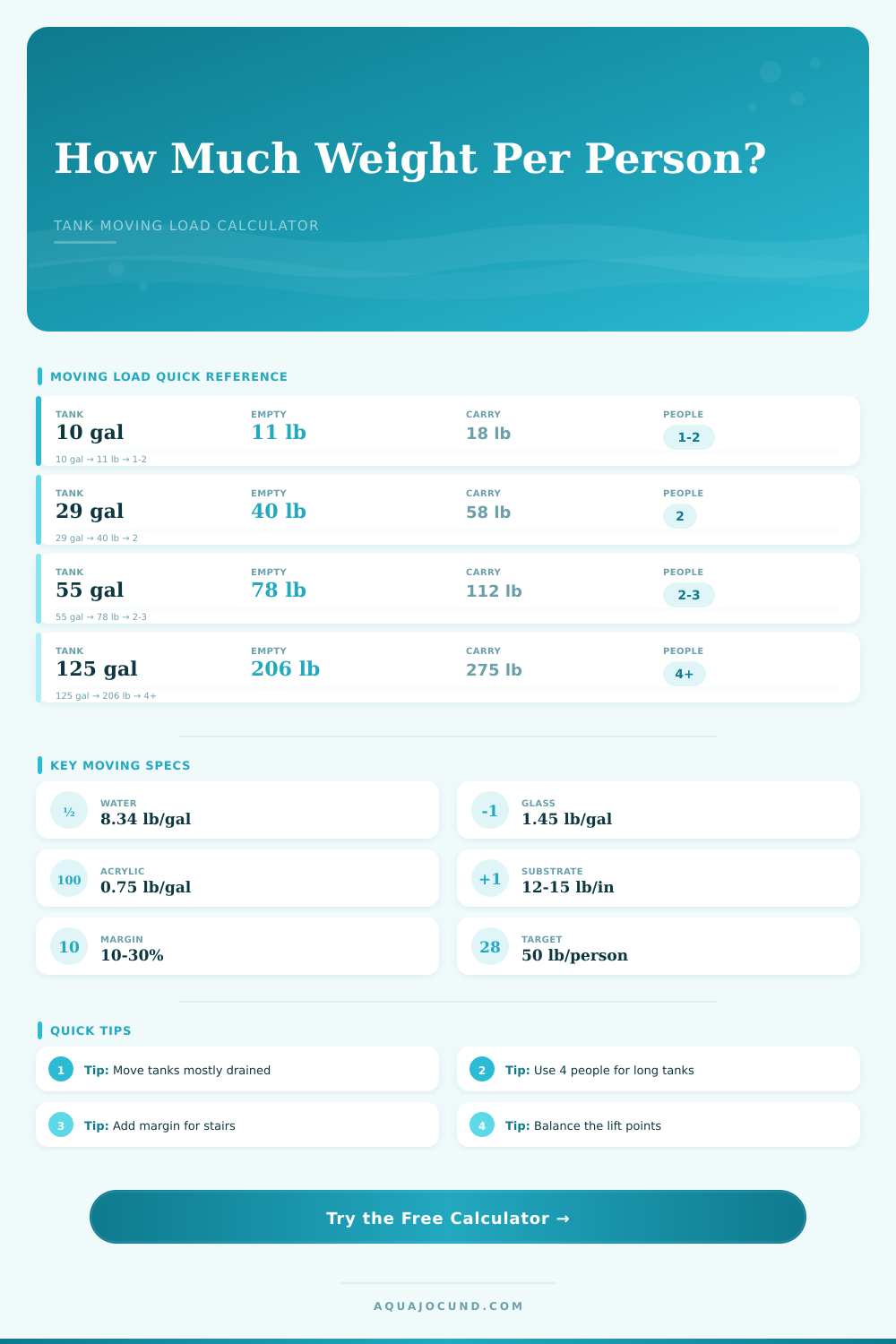
How do I know what the weight is? Physics of the lift: Weight is what most folks are concern with and rightfully so since water is heavier than everything else in a tank. It weigh over 8 pounds per gallon. That’s nearly 400 pounds just from the water inside your 55g. So yeah, you’ll want to drain it. But don’t empty it completely. Keeping some of it will help support the shell so it won’t shift sudden and cause cracks. That’s why the tool factor that leftover water into its calculation. It is not an estimate but a real-world weight.
How to Plan for Moving Your Tank
Glass is heavier than you think. Tank shells is part of the weight. A new, frameless tank has thick panes. Even a rimmed tank with standard thickness glass will weigh roughly 1.5 pounds per gallon empty. Frameless tanks can be as much as two pounds per gallon. Acrylic weighs less than glass. In addition acrylic is easy to shape. It will bend where glass won’t, that affects how you lift it. These tank construction difference are shown in the table below. You can use the reference table below for estimate the shell weight.
The second issue arises from substrate. Two inches of gravel isn’t light, people believe. Gravel is heavy. And it move around easily. When you tilt the tank, all that gravel slide to one side. That uneven weight can snap bottom pane. You can make up for it using the calculator for the substrate you extract. If you leave it there, then you’re adding some unaccounted-for weight. If you take it out, then you’re subtracting weight and increasing time costs (you have to repack the substrate later). Logistical work versus physical exertion: you make the call.
How many movers? Two hundred pounds is hard. Four people sharing the weight make it doable. It’s easier to carry a cube than a long thing with weight distributed along its length. A long tank want to twist. You have hands at the end. The middle of the tank might try to rotate or sag. More hands in the middle control shape of object. As the tool, I suggest how many movers you need if you assume 50 pounds per person. That’s a safe assumption for awkward shapes.
The last variable is route difficulty. Straight hallway? Easy. Stairs? More difficult. Tight turn? Yet more difficult. It’s not as simple as dividing weight per person. There needs to be a safety margin when going downstairs. That’s why the calculator have a multiplier on it. It compensates for friction. It is the distance between a controlled move and a panic moment.
Make a plan to move a tank. Before you touch the glass, eliminate the variables. Drain most of the water, but leave a few percent inside to help stabilize the shell. Know the weight of your shell. Select the substrate. Plan the number of movers. Lessen the stress by having a clear plan. Your tank is now a heavy thing. How many hands it will take to move?