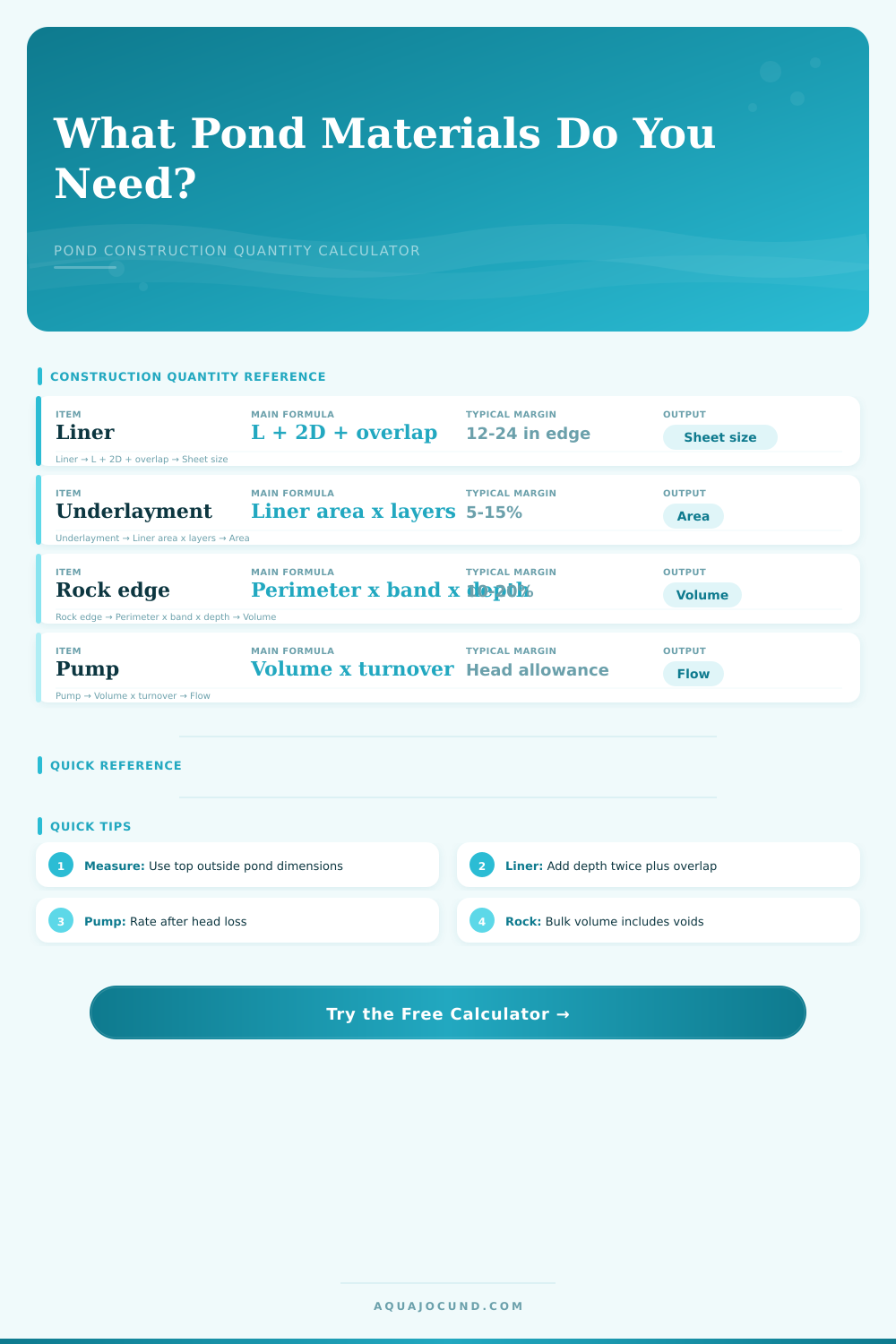
💧 Pond Construction Material Quantity Calculator
Estimate excavation volume, finished water capacity, liner sheet size, underlayment area, edging length, rock fill, and pump turnover from one pond layout.
| Liner Material | Typical Thickness | Approx. Mass | Best Fit |
|---|---|---|---|
| EPDM rubber | 45 mil / 1.14 mm | 0.29 lb/ft² / 1.42 kg/m² | Flexible garden ponds |
| Heavy EPDM | 60 mil / 1.52 mm | 0.39 lb/ft² / 1.90 kg/m² | Larger ponds and shelves |
| PVC liner | 20 mil / 0.51 mm | 0.13 lb/ft² / 0.63 kg/m² | Small simple shapes |
| RPE liner | 30 mil / 0.76 mm | 0.18 lb/ft² / 0.88 kg/m² | Low-stretch layouts |
| HDPE liner | 40 mil / 1.02 mm | 0.20 lb/ft² / 0.98 kg/m² | Broad, smooth basins |
| Butyl rubber | 30 mil / 0.76 mm | 0.26 lb/ft² / 1.27 kg/m² | Flexible premium folds |
| Pond Type | Example Dimensions | Approx. Capacity | Typical Pump Flow |
|---|---|---|---|
| Patio pond | 6 x 4 x 1.5 ft / 1.8 x 1.2 x 0.46 m | 260 gal / 984 L | 260-390 gph / 985-1476 L/h |
| Wildlife pond | 10 x 7 x 2 ft / 3.0 x 2.1 x 0.61 m | 650 gal / 2460 L | 325-650 gph / 1230-2460 L/h |
| Koi starter pond | 12 x 8 x 3 ft / 3.7 x 2.4 x 0.91 m | 1500 gal / 5678 L | 1500-3000 gph / 5678-11356 L/h |
| Large garden pond | 18 x 12 x 3 ft / 5.5 x 3.7 x 0.91 m | 3000 gal / 11356 L | 3000-4500 gph / 11356-17034 L/h |
| Rock Type | Bulk Density | Void Space | Placement Note |
|---|---|---|---|
| Pea gravel | 1600 kg/m³ | 34% | Compacts into narrow bands |
| River rock | 1650 kg/m³ | 38% | Common rounded pond edge |
| Rounded cobble | 1700 kg/m³ | 42% | Bulkier gaps between stones |
| Flat slate pieces | 1500 kg/m³ | 32% | Stacks with less void space |
| Lava rock | 900 kg/m³ | 45% | Light, porous decorative edge |
| Granite rubble | 1750 kg/m³ | 36% | Dense irregular edging |
Sometimes you’ll see a patch of dirt in the yard that could be a water feature or a koi pond. It sounds great, but then you start shopping for pumps and liners from the hardware store, and suddenly it becomes a money pit. What’s normally missing is accuracy: Between dream and checkbook comes poor estimating.
To estimate size, most homeowners simply guess at space, but you need to calculate soil displacement and liner overlap. The calculator do the math for you. First, create a basin outline. Most garden pond are organic shapes with curved lines that don’t conform to any simple formula.
How to Estimate Your Pond Needs
Enter two top-line dimensions representing the water line different than the excavation; after you do this, the tool calculates a depth allowance for freeboard. Freeboard is that vertical band of liner above the water surface, so it doesn’t spill over. Without allowing for this margin, the liner will slip downward and be pulled out. The tool assume that freeboard exists, and makes up for it by extending liner length accordingly.
Most people bust their budget on the liner. That’s the sheet that goes from side to side, up to the top, then back down to the bottom and around again for folding. It take a bit of practice and can be like wrapping a present, only under tension.
The material you choose changes the feel of the project. A typical selection is EPDM because it stretches and is forgiving if you have a few wrinkles to iron out. HDPE liners are more durable but difficult to handle in tight areas. Based off the reference table above, a 45 mil EPDM sheet will work for most residential applications.
Don’t overlook the underlayment. It’s more than a “maybe” item; it’s to prevent roots and sharp rock from poking holes in your liner, so don’t think of it as an afterthought! You can add one layer (or two) to your project; adjust to match in the calculator. Spend a few extra bucks now, it’ll give you peace of mind. It is like insurance; you get what you pay for.
Another instance of letting our gut lead us astray is pump sizing. We tend to select a pump for the max flow rate listed on the package without considering head loss from height, elbows, and pipe length. The greater the head loss, the harder the pump must works, meaning less flow.
Better to use turn over rate as your metric. How much do you want to turn over? To maintain clarity you’d like to see all the tank’s water turned over at least one time per hour. The tool takes into account head loss to give a realistic flow rating.
Last, think about the edge. This is the band of rock that holds the liner in place and covers the seams. Using cobble or river rock will add weight; however, keep in mind that rock volume include voids. That’s a bit of air you’re also paying for in your stone volume. Ten percent allowed for stone placement will eliminate stone shortages halfway around the perimeter.
There are layers to building a pond. There’s soil, then underlayment, then liner, then water, then stone. Once you know what each of those layer do, it all turns into numbers.
How many bag of rock to order? How big a pump to install? How much liner to buy?
The hole in the ground is changed from a hole into a landscape feature with measurements you trust. You should of used accurate measurement so the project looks luxurius and naturaly beautiful.