🐟 Koi Growth Rate Calculator
Project koi length, weight gain, specific growth rate, feed load, and pond volume pressure from real husbandry inputs.
| Feed Type | Protein | Base FCR | Growth Use | Best Temperature |
|---|---|---|---|---|
| Maintenance Pellet | 28% | 2.4 | Adult holding and light feeding | 60-72°F / 16-22°C |
| Wheat Germ | 32% | 2.0 | Cool shoulder season digestion | 50-68°F / 10-20°C |
| Seasonal Growth | 35% | 1.8 | Balanced pond growth | 64-76°F / 18-24°C |
| Growth Pellet | 38% | 1.6 | Tosai and nisai growth periods | 68-78°F / 20-26°C |
| Color Growth | 40% | 1.7 | Growth plus pigment support | 68-78°F / 20-26°C |
| High Protein | 42% | 1.4 | Warm-water grow-out feeding | 72-80°F / 22-27°C |
| Silkworm Treat | 45% | 1.5 | Short warm growth boosts | 72-80°F / 22-27°C |
| Mixed Pond Ration | 34% | 1.9 | Mixed-size pond feeding | 60-76°F / 16-24°C |
| Pond / Vat | Dimensions | Volume | Growth Use | Typical Growth Load |
|---|---|---|---|---|
| Indoor Vat | 6 ft × 3 ft × 2 ft / 1.8 m × 0.9 m × 0.6 m | 269 gal / 1019 L | Short quarantine | 1-2 small koi |
| Small Patio Pond | 6 ft × 4 ft × 2.5 ft / 1.8 m × 1.2 m × 0.8 m | 449 gal / 1699 L | Slow growth | 1-2 koi |
| Starter Koi Pond | 8 ft × 6 ft × 3 ft / 2.4 m × 1.8 m × 0.9 m | 1077 gal / 4078 L | Moderate growth | 3-5 koi |
| Standard Garden Pond | 10 ft × 8 ft × 4 ft / 3.0 m × 2.4 m × 1.2 m | 2394 gal / 9062 L | Good growth | 6-10 koi |
| Large Koi Pond | 14 ft × 10 ft × 5 ft / 4.3 m × 3.0 m × 1.5 m | 5236 gal / 19821 L | Strong growth | 12-20 koi |
| Grow-Out Round Tank | 8 ft dia × 3 ft / 2.4 m dia × 0.9 m | 1128 gal / 4271 L | Young koi growth | 8-15 small koi |
| Koi Stage | Common Length | Feed Rate | Daily SGR Range | Growth Pattern |
|---|---|---|---|---|
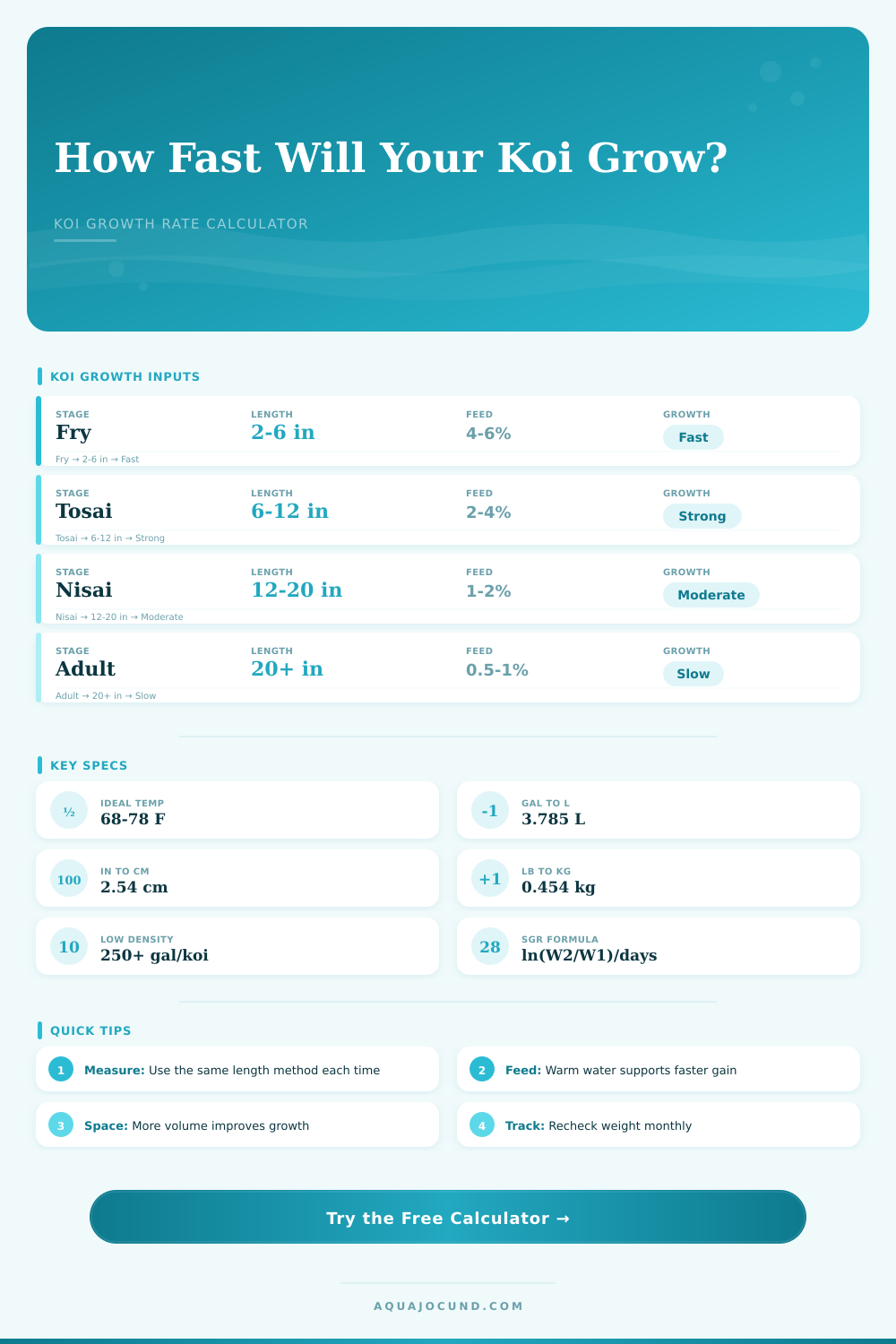
| Fry / Small Juvenile | 2-6 in / 5-15 cm | 4-6% | 1.2-2.2% | Fastest proportional gain |
| Tosai | 6-12 in / 15-30 cm | 2-4% | 0.6-1.4% | Strong frame growth |
| Nisai | 12-20 in / 30-51 cm | 1-2% | 0.25-0.8% | Steady size and body gain |
| Adult Koi | 20-28 in / 51-71 cm | 0.5-1.2% | 0.08-0.35% | Slower length gain |
| Jumbo Maintenance | 28+ in / 71+ cm | 0.4-0.8% | 0.03-0.18% | Mostly weight and condition |
| Condition | Multiplier | Use In Calculator | Growth Effect |
|---|---|---|---|
| Water below 50°F / 10°C | 0.05-0.20 | Temperature factor | Digestion and gain nearly stop |
| 68-78°F / 20-26°C | 1.00 | Temperature factor | Best growth range |
| Less than 66 gal per koi / 250 L | 0.45 | Stocking factor | Heavy volume pressure |
| 132-264 gal per koi / 500-1000 L | 0.90 | Stocking factor | Good pond room |
| Strong filter and air | 1.08 | Water support | Better feed conversion |
| Limited filter or low turnover | 0.65 | Water support | Feed must be conservative |
Use matching measurements: compare nose-to-tail length the same way each time, and weigh with water drained consistently from the bowl or bag.
Let temperature cap the forecast: koi may eat in cool water, but growth efficiency falls sharply below the main digestion range.
Have you noticed that fish in your pond just seem to keep getting bigger? Is the fish really growing or do you think your eyes is playing tricks on you? I don’t know about you, but sometimes I wonder if they are actualy growing or if I just haven’t measured them properaly in months.
Koi growth isn’t linear. It’s relative to water volume, temperature, food type/quality, and genetics. The calculator up top takes what you give it now (your stats), and spits out a projected weight and length for you based off that. You won’t have to guess about complex growth curves anymore. It is more like a measurable goal different than just hope.
How to Help Your Koi Grow
The most critical variable that you have control over are temperature. Because koi are cold blooded, their metabolism is completly dependent upon the surrounding water. Below fifty degrees, digestion basically shuts down because the gut bacteria responsible for breaking down protein becomes dormant. Above eighty degrees, stress increases and oxygen become depleted. Even with plenty of food available, this can slows growth. Between sixty-eight and seventy-eight degrees are the optimal range for rapid gain. That’s where the biological engine operates most effectivey.
As shown by table on the page, various feed types works best at different temperatures. For example, many people make the error of feeding a high-protein summer pellet in cool early spring water. Although the fish may consume it they cannot digest it. This results in wasted money and poor water quality. Temperature is important, and so too is feed type. Remember, you’re not just feeding a fish, you’re feeding a metabolic process.
An adult jumbo can be kept healthy on a maintenance pellet with less protein so the filter doesn’t gets overloaded. That same food does nothing, however, to promote size in a growing Nisai or Tosai. To grow their bodies, young fish need higher protein levels found in growth or color-enhancing feeds. Waste is the tradeoff here. More protein equals more ammonia production. If your filtration system isn’t up to the task of handling it, stress from poor water chemistry negates any growth gains. It is a small thing but it matters a lot for long-term health.
The second part of the equation are volume of the pond. Many believe that care in changing water allows one to keep big koi in small volumes. Factually speaking, natural foraging habits plus stable parameters creates space. Muscle development follows suit. The calculator considers how much your stocking size affects the environment. Eight big koi in a two-thousand gallon pond will most assuredly inhibit their growth despite feeding frequency. More consistent gains comes from low density which typically translates into better immunity. The calculator accounts for this by shifting the projection scale depending on gallons per fish.
Then there’s specific growth rate, or SGR. This is simply the percent gain in bodyweight per day. The higher the SGR, the better, meaning the fish are doing well under ideal circumstances. The lower the SGR, the worse it is. Meaning the fish is being held back by something such as crowding, nutrition, or maybe even temperature. It will appear in the results and give you an instant readout of how efficient your regimen is. If it’s lower than expected, check your logs for temperature and filter performance prior to altering food choices.
Most folks fumble on the measuring part of things. What do you use? You might use a scale, a ruler held up to glass, or a measuring net. Whatever you choose, make sure you are consistent with how you measure. Noise occurs when your measurements is inconsistent. Without seeing consistent numbers, you cannot see any trends. The best way to get a clear picture of what’s going on is to weigh your fish once per month during the prime growing season.
Make sure what you put into the tool is consistent. Summer months). Make sure what you put into the tool is consistent.
Keeping koi is a long game. This isn’t about hitting some number next week. This is about creating an environment in which growth is simply a natural byproduct of good care. The calculator allows you to set realistic expectations given your existing setup. It tells you what’s possible. The rest comes down to the stability of your water and your own patience. As you watch those frames widen and those colors deepen, you would of known that both the math and your care were right.