💧 Pond Sludge Remover Dose Calculator
Estimate sludge remover dose, split treatment amount, and container capacity from pond volume, bottom area, sludge depth, temperature, and treatment interval.
| Format | Planning Rate | Best Measurement Basis | Capacity Output |
|---|---|---|---|
| Liquid beneficial bacteria | 4 fl oz per 1,000 gal | Water volume plus sludge factor | fl oz, mL, cups, treatments |
| Liquid enzyme blend | 3 fl oz per 1,000 gal | Water volume and organic load | fl oz, mL, treatments |
| Concentrated liquid bacteria | 2 fl oz per 1,000 gal | Direct volume with margin | fl oz, mL, container coverage |
| Dry bacteria powder | 25 g per 1,000 gal | Gallons or liters treated | grams, ounces, treatments |
| Granular enzyme carrier | 35 g per 1,000 gal | Bottom area and sludge depth | grams, pounds, split amount |
| Sinking bacteria pellets | 45 g per 1,000 gal | Patch area and muck thickness | grams, pounds, treatments |
| Slow-release sludge tablets | 1 tablet per 1,000 gal | Rounded up by treated volume | tablet count and interval |
| Pond Type | Typical Size | Approx Volume | Standard Liquid Dose |
|---|---|---|---|
| Patio bowl | 4 ft round x 1.5 ft | 140 gal / 530 L | 0.6 fl oz / 18 mL |
| Small garden pond | 8 ft x 6 ft x 1.5 ft | 540 gal / 2,044 L | 2.2 fl oz / 65 mL |
| Koi starter pond | 10 ft x 8 ft x 2 ft | 1,197 gal / 4,532 L | 4.8 fl oz / 142 mL |
| Oval display pond | 14 ft x 10 ft x 2.5 ft | 2,058 gal / 7,790 L | 8.2 fl oz / 243 mL |
| Large natural pond | 24 ft x 16 ft x 3 ft | 8,618 gal / 32,622 L | 34.5 fl oz / 1,020 mL |
| Condition | Input Range | Dose Factor | Split Guidance |
|---|---|---|---|
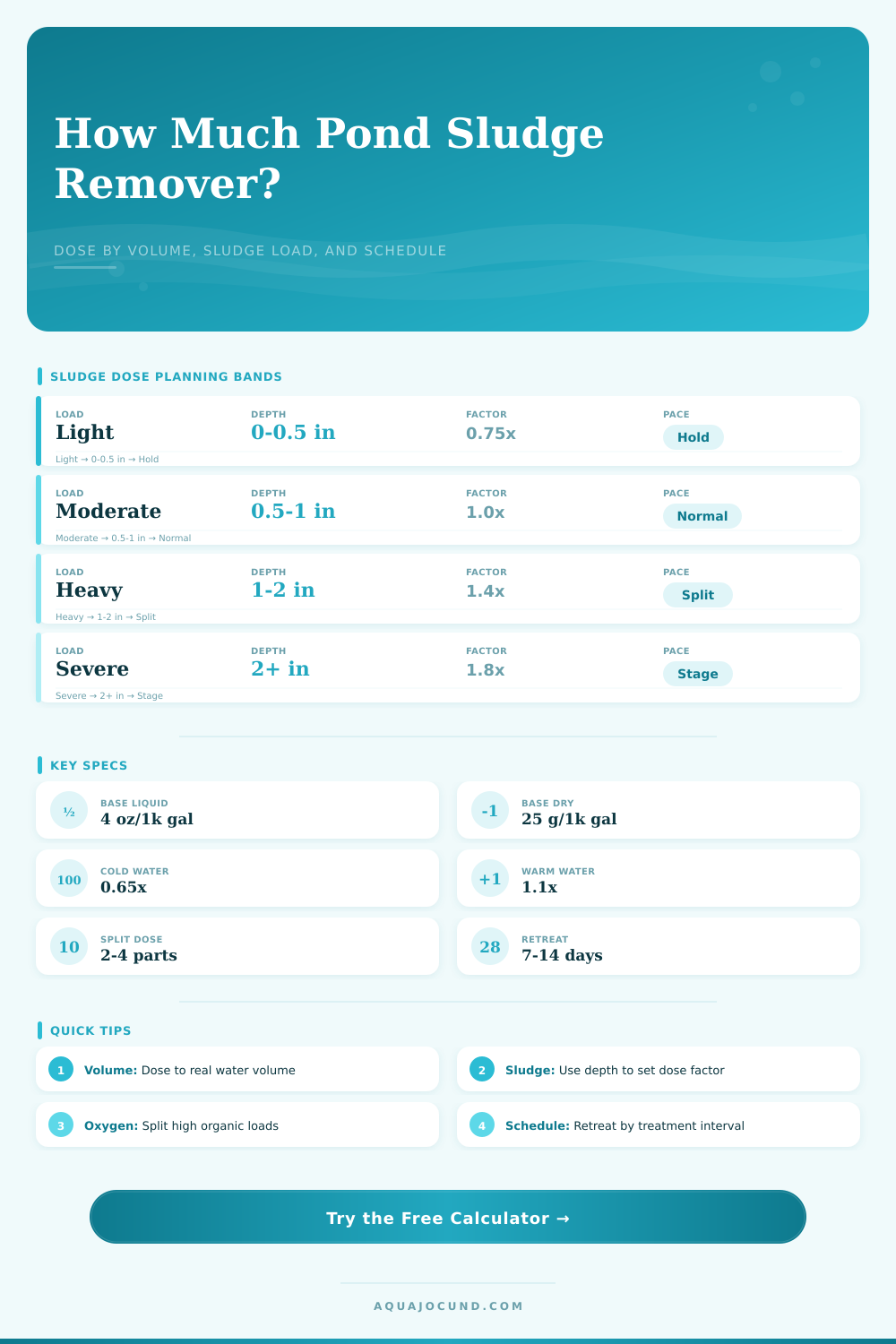
| Light sludge film | 0 to 0.5 in / 0 to 1.3 cm | 0.75 to 0.9 | Usually one application |
| Moderate sludge | 0.5 to 1 in / 1.3 to 2.5 cm | 1.0 to 1.2 | One or two applications |
| Heavy sludge | 1 to 2 in / 2.5 to 5 cm | 1.35 to 1.55 | Two or three applications |
| Severe sludge pocket | Over 2 in / over 5 cm | 1.7 to 2.0 | Stage over several days |
| Low aeration | Still areas or no waterfall | 0.85 to 1.0 | Split instead of increasing dose |
So you’ve been looking in your pond and it looks pretty good, the water looks thin and clear, but the bottom tell a different story with several inches of decaying leaves, waste, and food. It’s time to do something about it but how much Sludge Remover? How much is too much or not enough? Should you divide the dose or just dump out that entire bottle all at once? Turns out, it’s all about the quantity.
Too little will starve the bacteria and leave sludge behind, while too much risk depleting oxygen in the water. Why? The calculator do all the maths for you but knowing what goes in makes it easier to believe what comes out.
How to Choose the Right Dose
In most cases people look at the water volume alone; that’s only half the equation. The second input is how much sludge there is: it could be a thin layer requiring minimal maintenance or a thick one which presents problems for the system structure. Because thicker sludge demand more bacterial action, the calculator takes this into account by adjusting the dose accordingly.
Under-estimating the sludge mean starving your bacteria by not providing enough food. Over-estimating results in waste of product and a potential reduction of oxygen. It’s a tricky balancing act.
Water temperature affects beneficial bacteria because they are live organisms that respond to changes in temperature. Cold water slows them down. You may have to increase the dosage or treat more frequently if the water is cold (like in spring). If it’s hot (summer), not only will the bacteria be working faster but they’ll gobble up available oxygen as well.
The formula does consider aeration. If you’re using an air pump or a strong waterfall, it replaces oxygen and you can get away with a bigger dose different than you would if it were still water. Giving a big dose over multiple days rather than all at once keeps the oxygen level from plummeting which can kill your fish.
Bacteria: Bacteria are applied as liquids, so they is distributed throughout and penetrate into any thick sludge. Granular bacteria will drop out onto thick sludge. Each form has a different volume equivalence. See reference table for equivalencies.
Consistency is important. Pick one application type and stick with it through an entire cycle. Applying multiple products whose interactions you do not understand usually does not result in improved water quality. Some tank owner alternate using bacteria and enzymes each week. This causes confusion. Let the bacteria work awhile to develop a foothold.
People tend to treat their pond as if it’s a one time clean up job. Digestion of sludge takes time. The dose given from the calculator is usualy for a set period, which is normally two weeks. That pace lets the bacterial population build at a rate that doesn’t throw the water chemistry off. Pushing the process cause byproducts that cloud the water. Remember this is a biological system you’re dealing with…not scraping some sort of surface.
The entire process rely on accurately measuring the pond volume. In ponds that aren’t regular shapes, take an average of the length, width and depth. If your depth changes on the sides, don’t go with the deepest part of the pond. Go with the average depth. If you’re off by just 20%, you throw off the whole bacterial balance. These measurements allow our tool to do the guesswork for you.
After you get the figures, it’s easy. Dose according to the numbers, factor in the temperature and let nature do its thing. A clean bottom will result in clear water.