Barley Straw Pond Dose Calculator
Estimate loose barley straw weight, mesh bag count, surface coverage, activation timing, and replacement amount from pond size.
Barley Straw Dose Results
| Rate Level | lb per acre | g per m² | Use In Calculator |
|---|---|---|---|
| Light prevention | 90 lb/ac | 10.1 g/m² | Clear water or early season |
| Clear water prevention | 150 lb/ac | 16.8 g/m² | Small recurring green tint |
| Standard midpoint | 225 lb/ac | 25.2 g/m² | Default surface-area dose |
| Heavy history | 300 lb/ac | 33.6 g/m² | Past nuisance algae blooms |
| Upper practical rate | 450 lb/ac | 50.4 g/m² | Use cautiously with oxygen awareness |
| Straw Form | Pack Weight | Pack Equivalent | Calculator Use |
|---|---|---|---|
| Loose barley straw | 1 lb reference | 0.45 kg | Shows exact loose weight |
| 45 lb field bale | 45 lb | 20.4 kg | Large ponds and split stations |
| 20 kg bale | 44.1 lb | 20 kg | Metric bale planning |
| 4 lb mini bale | 4 lb | 1.8 kg | Small decorative ponds |
| 2 lb mesh pillow | 2 lb | 0.91 kg | Bagged small pond dose |
| 8 oz sachet | 0.5 lb | 227 g | Very small pond adjustments |
| Pond | Dimensions | Surface Area | Standard Straw |
|---|---|---|---|
| Patio rectangle | 8 ft × 6 ft / 2.4 m × 1.8 m | 48 sq ft / 4.5 m² | 0.25 lb / 0.11 kg |
| Garden pond | 20 ft × 12 ft / 6.1 m × 3.7 m | 240 sq ft / 22.3 m² | 1.24 lb / 0.56 kg |
| Large oval pond | 50 ft × 30 ft / 15.2 m × 9.1 m | 1,178 sq ft / 109 m² | 6.1 lb / 2.8 kg |
| Quarter acre pond | Known area | 0.25 ac / 0.10 ha | 56.3 lb / 25.5 kg |
| One acre pond | Known area | 1.00 ac / 0.40 ha | 225 lb / 102 kg |
| Water Temperature | Approx. Activation | Calculator Label | Replacement Planning |
|---|---|---|---|
| Above 68°F / 20°C | 1-2 weeks | Warm water | Check near 4 months |
| 50-68°F / 10-20°C | 2-4 weeks | Mild water | Plan 4-6 months |
| 40-49°F / 4-9°C | 4-8 weeks | Cold water | Use early placement |
| Below 40°F / 4°C | Very slow | Winter water | Count as dormant time |
What do you think about when you see a green algae bloom in your pond? That’s your sign the pond is out of balance. Before you even realize nutrients has shifted, clear water suddenly turns into murky soup.
For decades, folks have used barley straw as an organic remedy to this issue, but how does it work, and what’s the trick to using it effectivey? Turns out, it’s all about the chemistry; which has a lot to do with the time of year. And if you don’t dose correctly, you’re wasting both patience and money. Get it right, however, and those humic acid compounds released from straw naturally inhibit algae growth, while doing no harm to plants or fish.
How to Use Barley Straw for Your Pond
Then all you do is plug in size of your pond and the calculator will handle the rest… It’ll estimate number of bags required, amount of straw needed and when it will start to activate. It does this by calculating surface area instead of volume (that’s important because active compounds inside the straw disperse throughout water column). So if you have a wide, shallow pond vs. A narrow, deep pond with an equal amount of water, you’ll need fewer bags for former due to differences in spreading of the compounds from the straw. That’s where “shape,” “width” and “length” is requested. Then the calculator will find surface coverage for your desired treatment rate.
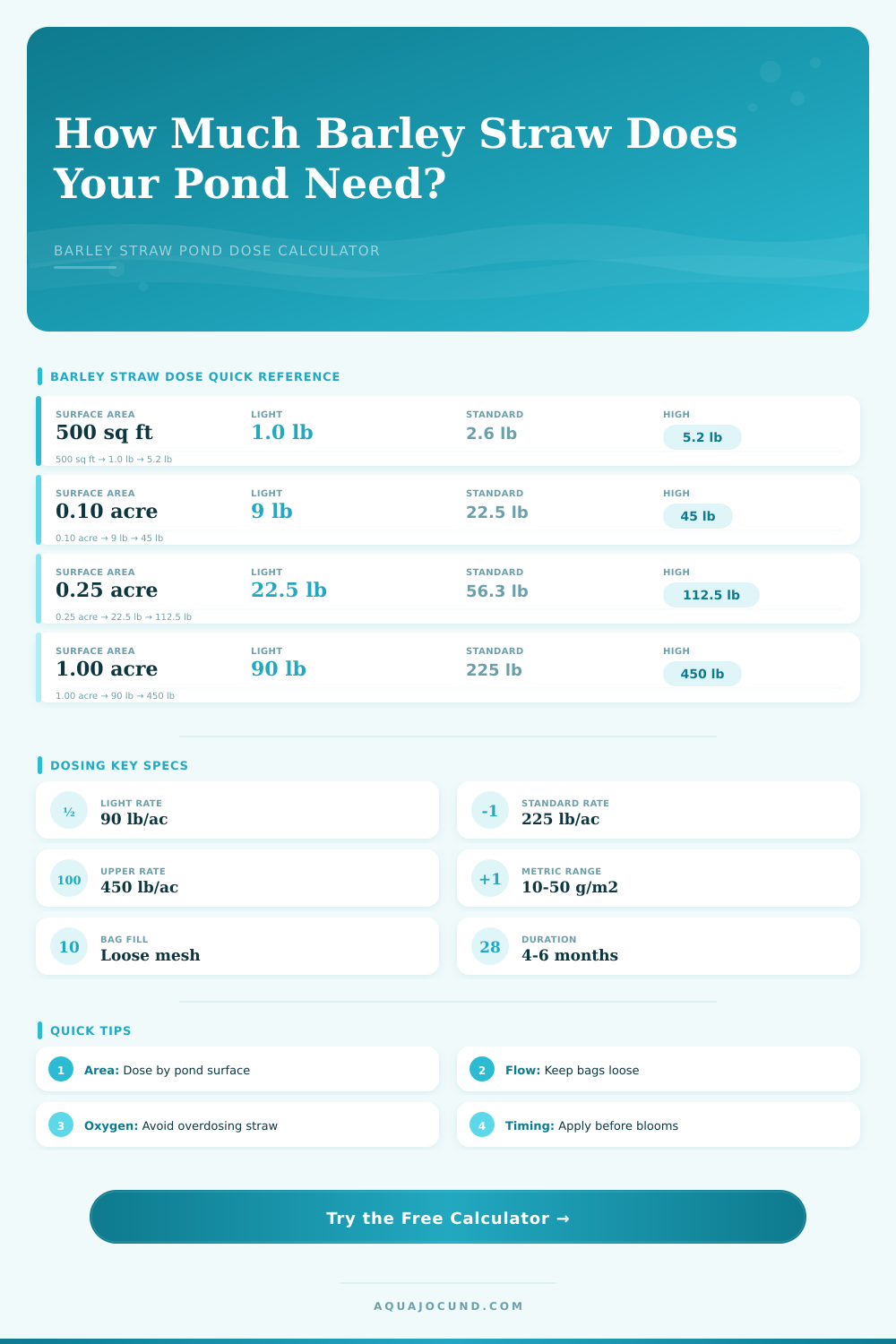
This is where many pond owners balk: picking the proper dose. For very small (patio) ponds with minimal nutrient input, the light prevention doses are appropriate. For average garden ponds with occasional fertilizer and leaves going in, standard dose is appropriate. For ponds which has been plagued by algae for years, go heavy history. You can move the slider around within the calculator, but more isn’t necessarily better. Too much straw will eventually use up your oxygen as it breaks down. This is not good for your fish at all. It is worse then a little algae. That’s why the table on the page spells out those ranges. And yes, there is such a thing as having too much, or just enough to do the job without killing it.
The other key element the calculator also assist with is timing. Barley straw doesn’t work right away. It takes some time to decompose and wet out. Water temperature play an important role here because warmer water speeds up decomposition. Straw put down in late summer probably won’t start working until next spring after it rots. Early spring is the best time when water temps are in the low forties to fifties. Based off your estimate of current water temperature, the calculator predicts how many weeks it will take for the barley straw to become active. That way you can plan ahead and have treatment ready once algae begins to get going. You won’t be reacting after the bloom has already set in.
The packaging of the straw also matters. Mesh bags of loosely arranged straw allow for maximum water flow through the material. That means maximum exposure and release. Tighter packing of pillow or compacted bale types will restrict that exposure, it slows the release of the humic acids. You can choose your bag fill size on the calculator. It’ll help you figure out how many bags you need to reach desired dose. Spread them out evenly on surface of the pond, keeping them loose. It’s a little thing but does make a big difference in how well it works.
How long will the straw last? This will vary according to the pond conditions and starting dose. A general rule of thumb is that it takes four to six months for the straw to fully break down. At that time, it will no longer stop algae from growing. Based on what you enter into the calculator, it will recommend a schedule for when you should of replace the straw. However, visual assessment is still the best approach. If the straw appears mushy and lacks structure, it’s time to go get some more.
Maintaining the straw regularly ensures a balanced pond with clear water during the growing season. Knowing these subtleties can transform barley straw into a precise and reliable tool in your pond-management kit. Remember, the goal isn’t just removing a single nuisance, but clear water.