💧 Pond Stream Length Pump Calculator
Estimate pump flow, head height, pipe fit, stream volume, and turnover for a recirculating pond stream or creek bed.
📋 Calculation Breakdown
quiet rill
natural stream
refresh target
long streams
| Stream Look | Flow Rule | Visual Result | Typical Width |
|---|---|---|---|
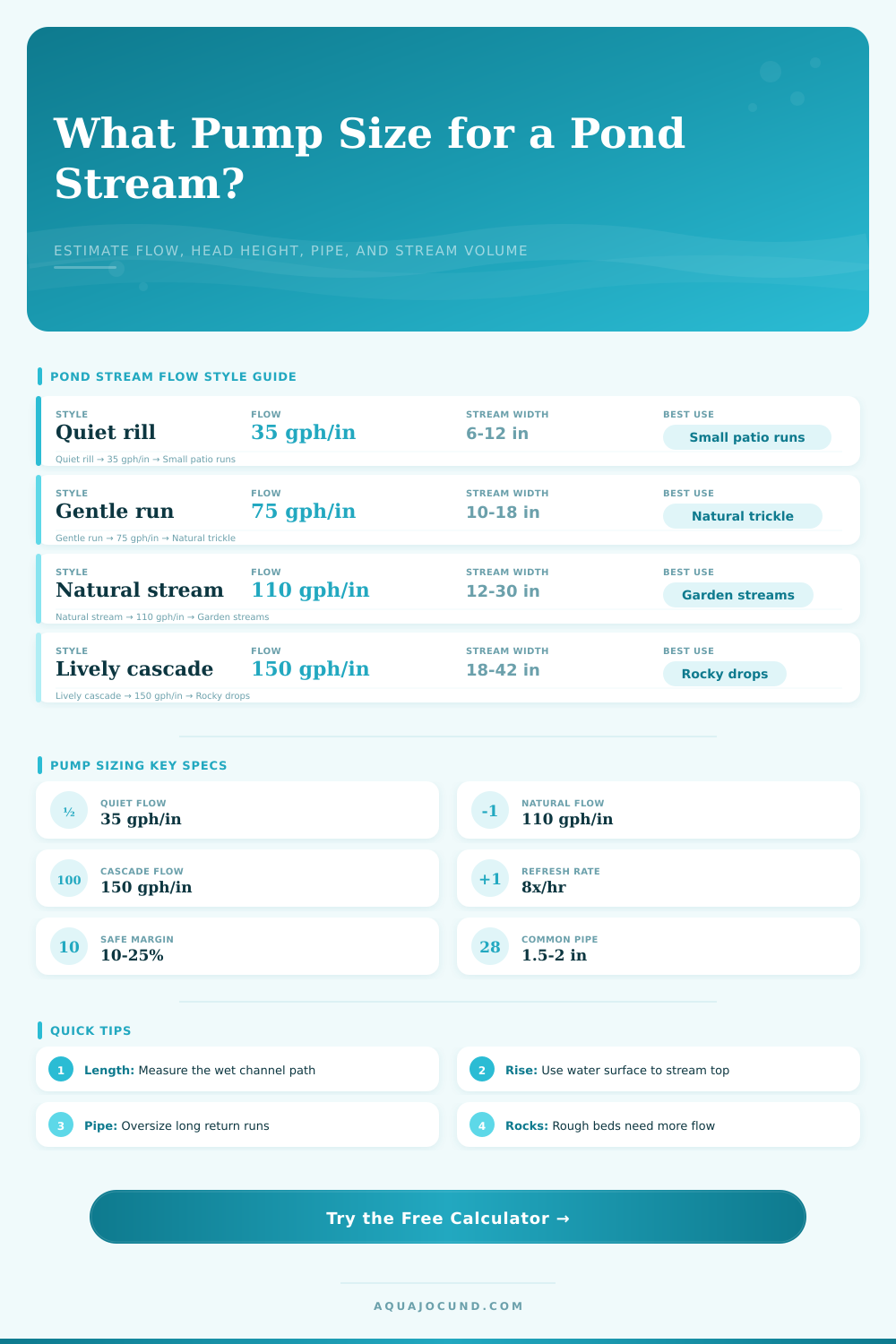
| Quiet rill | 35 GPH per inch | Thin moving sheet, low sound | 6-12 in |
| Gentle run | 75 GPH per inch | Clear movement around small stones | 10-18 in |
| Natural stream | 110 GPH per inch | Continuous shallow creek flow | 12-30 in |
| Lively cascade | 150 GPH per inch | Visible splash over rocks and drops | 18-42 in |
| Whitewater splash | 200 GPH per inch | Forceful aerated water over steep rock | 24-60 in |
| Bed Material | Flow Factor | Water-Hold Factor | Best Use |
|---|---|---|---|
| Smooth EPDM liner | 0.92 | 0.88 | Formal narrow channels |
| Pea gravel cover | 1.05 | 0.68 | Shallow planted edges |
| Rounded river rock | 1.12 | 0.62 | Most garden streams |
| Mixed cobble stream | 1.22 | 0.56 | Natural creek beds |
| Boulder cascade | 1.35 | 0.50 | Large splash pools and drops |
| Flagstone runnel | 0.98 | 0.82 | Clean sheet over flat stone |
| Planted bog stream | 1.18 | 0.52 | Slow gravel filtration channels |
| Stepped waterfall run | 1.40 | 0.48 | Short high-energy cascades |
| Stream Setup | Dimensions | Stream Volume | Typical Pump Range |
|---|---|---|---|
| Patio rill | 6 ft x 8 in x 0.75 in (1.8 m x 20 cm x 2 cm) | 2-4 gal | 300-800 GPH |
| Short goldfish run | 12 ft x 12 in x 1 in (3.7 m x 30 cm x 2.5 cm) | 5-8 gal | 800-1,800 GPH |
| Garden creek | 20 ft x 18 in x 1.5 in (6.1 m x 46 cm x 4 cm) | 12-20 gal | 1,800-3,500 GPH |
| Long meander | 35 ft x 20 in x 1.5 in (10.7 m x 51 cm x 4 cm) | 22-35 gal | 2,500-5,000 GPH |
| Wide koi stream | 30 ft x 36 in x 2 in (9.1 m x 91 cm x 5 cm) | 45-70 gal | 5,000-9,000 GPH |
| Pipe ID | Comfortable Flow | Use Case | Friction Risk |
|---|---|---|---|
| 3/4 in | Up to 600 GPH | Small spouts and bowls | High |
| 1 in | 600-1,000 GPH | Short quiet rills | Medium |
| 1-1/4 in | 1,000-1,800 GPH | Small garden streams | Medium |
| 1-1/2 in | 1,800-3,000 GPH | Medium streams and short cascades | Low |
| 2 in | 3,000-5,500 GPH | Long streams and koi pond returns | Low |
| 3 in | 5,500+ GPH | Wide streams and high-flow cascades | Lowest |
| Head Component | How to Measure | Calculator Use | Common Mistake |
|---|---|---|---|
| Static rise | Pond surface to stream start | Direct vertical head | Measuring from pump bottom |
| Stream slope | Length multiplied by grade percent | Estimates gentle rise | Ignoring long uphill grade |
| Waterfall drops | Count each larger step | Adds drop height to rise | Counting tiny ripples as drops |
| Pipe run | Return route from pump to stream head | Adds friction head | Using narrow pipe on long runs |
| Filter resistance | Box, bog header, UV, or pressure unit | Adds estimated head | Using clean-filter flow forever |
After weeks of running around the house gathering river rock and lining the thing, there comes one very scary moment when you fire up the pump and see nothing but a slow trickle of water that quickly vanishes under rocks before ever reaching the pond. It was not quite what you had envisioned as a “creek.” It was more like a drainage ditch.
Why? Because most folks purchase their pumps by pond size only. They forget that water has to travel through a hose/pipe, then uphill against gravity to overcome that slope and finally flow over the rocks.
How to Choose the Right Pond Pump
Once you input the slope and length of stream, calculator (above) takes care of the math for you. No need to guess at conversions or coefficients. You need to know what the numbers represent.
Entering the wet stream length isn’t just entering distance between the beginning of the channel and where it enters pond. It also factors in amount of friction the water will meet around each dip and turn. An easy one: a straight shot. A more difficult one: a meandering route that twists through your hostas. That cost a lot in terms of resistance. The tool take all those turns into account by considering both pipe run and fittings.
Remember, pump has to force the water through all the resistance in that tubing before it even gets the light of day. You enter in only length of pipe and suddenly you have a pump rated to deliver three thousand gallons an hour at zero head. It delivers half of that once it actualy has to do its job. That’s the trap most folks fall into.
Another important point is: What do you want your waterfall to sound like? With this tool, you select the flow style from a quiet rill to a lively cascade. But those aren’t mere aesthetics; they’re hydraulic goals.
For example, a quiet stream at thirty-five gallons per hour per inch of width will be a thin, glassy sheet of water, with no more than the slightest ripple across its surface. It is elegant but unforgiving; a single leaf can stop the flow.
By comparison, the flow in a natural stream setting might push up to one hundred and ten gallons per hour per inch, which is plenty water to cover rocks without any trouble at all. You’ll get that pleasing white noise, too, that you hear on every nature documentary ever made.
Above that, in the cascade range, you’re talking about aeration and splash. It is great for oxygenating the water, but it mean you need a much stronger pump.
What’s in the bed also makes a difference (more than you may realize). Water slides across smooth linings without much resistance at all. Mixed boulder and cobble surfaces tends to be rougher, which creates drag and slows the water. Because of this, it is less effective. For that reason, the tool adds a flow factor based off the type of material you select.
Selecting boulders means that the calculator understand you’ll have to supply more flow to get the same visual effect of depth you’d have had using something smoother (like a boulder.) Small detail, but it counts. You can’t run a high-flow cascade over a smooth liner without it becoming a fast, noisy slide. It doesn’t look like a textured stream.
Lastly, think about head height. That’s the vertical distance the water must be lifted. This means it has to pull water that high. It also has to deal with any losses from friction in those pipes. Every length of tubing, elbow, and valve contribute to that resistance.
The calculator takes into account the static rise. This is the total vertical distance between pond surface and where the water flows out into the stream. And then it estimate losses based on the number of fittings and size of pipe. You want to avoid a long run with a narrow tube or the friction will consume all of your pressure budget. Better to oversize the return pipe a little than risk underpowering the pump.
After you get the numbers, compare them to manufacturer’s pump curve. A pump advertised to put out five-thousand gallons per hour at zero head may only be able to provide two-thousand against twenty-feet of lift. This is the fine line between what looks like a design error and what feels like it was meant to be that way. The water need to flow easily in the right direction.