🧪 Pond Biofilter Volume Calculator
Estimate pond biofilter media volume, wet chamber size, TAN handling capacity, and circulation from pond dimensions and peak feeding load.
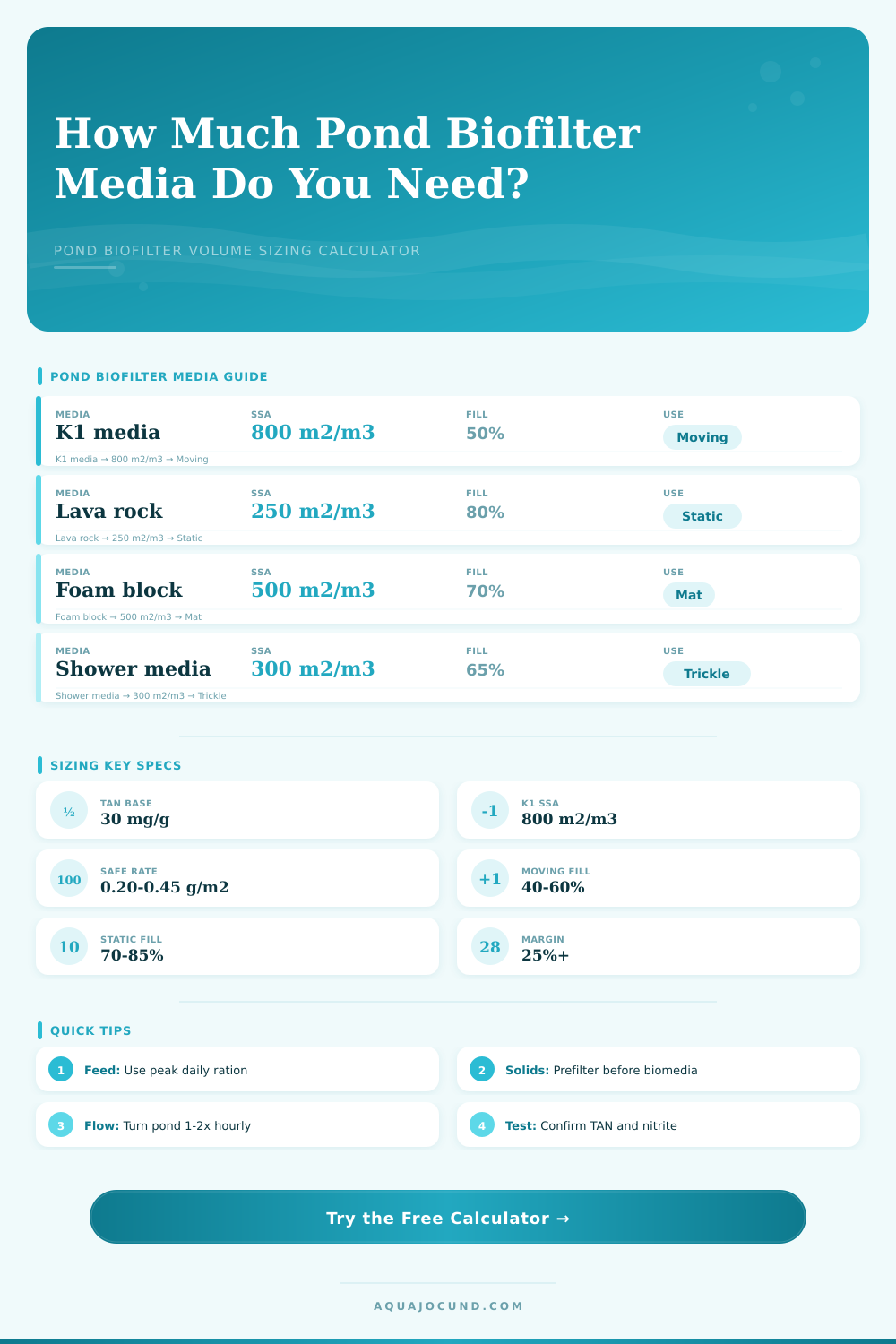
| Media | Protected surface | Planning removal | Normal fill | Best fit |
|---|---|---|---|---|
| K1 moving bed | 800 m²/m³ | 0.45 g TAN/m²/day | 40-60% | Aerated pond bio chamber |
| K3 moving bed | 500 m²/m³ | 0.40 g TAN/m²/day | 40-60% | Larger moving bed barrels |
| Lava rock / scoria | 250 m²/m³ | 0.22 g TAN/m²/day | 70-85% | Bog or upflow chamber |
| Ceramic rings | 350 m²/m³ | 0.26 g TAN/m²/day | 70-85% | Compact static baskets |
| Reticulated foam | 500 m²/m³ | 0.24 g TAN/m²/day | 60-75% | Mat or sponge polishing stage |
| Japanese mat | 250 m²/m³ | 0.25 g TAN/m²/day | 65-80% | Large koi filter bay |
| Bio balls | 200 m²/m³ | 0.20 g TAN/m²/day | 70-85% | Wet-dry or splash chamber |
| Shower tower media | 300 m²/m³ | 0.60 g TAN/m²/day | 55-70% | Highly aerated trickle tower |
| Pond example | Dimensions | Volume | Typical peak feed | K1 media estimate |
|---|---|---|---|---|
| Patio goldfish tub | Known volume | 150 gal / 568 L | 0.4 oz / 11 g | 0.4-0.8 gal / 1.5-3 L |
| Small garden koi | 8 x 5 x 2 ft / 2.4 x 1.5 x 0.6 m | 600 gal / 2,271 L | 1.5 oz / 43 g | 1.6-3.0 gal / 6-11 L |
| Suburban koi pond | 10 x 7 x 2 ft / 3.0 x 2.1 x 0.6 m | 1,000 gal / 3,785 L | 3 oz / 85 g | 3.0-5.5 gal / 11-21 L |
| Large display pond | 18 x 12 x 3 ft / 5.5 x 3.7 x 0.9 m | 4,800 gal / 18,170 L | 12 oz / 340 g | 12-24 gal / 45-91 L |
| Heavy koi feed season | Known volume | 6,000 gal / 22,712 L | 24 oz / 680 g | 24-48 gal / 91-182 L |
| Input | Low value | Normal value | High value | Effect on biofilter volume |
|---|---|---|---|---|
| TAN per feed | 25 mg/g | 30 mg/g | 35 mg/g | Higher waste load needs more media surface |
| Design removal | 0.20 g/m² | 0.35-0.45 g/m² | 0.60 g/m² | Lower rates are safer for cool ponds |
| Activity factor | 55% | 90-100% | 110% | Cold, low oxygen, or low pH increases size |
| Safety margin | 15% | 25% | 60% | Adds reserve beyond the exact TAN load |
| Solids factor | 0.94 | 1.00 | 1.18 | Dirty media loses active surface area |
| Status | Installed media | Meaning | Calculation response |
|---|---|---|---|
| Short | Under 85% | Below buffered TAN target | Add media or reduce peak feed |
| Close | 85-110% | Usable with little reserve | Feed up gradually and test water |
| Ready | 110-160% | Good everyday margin | Maintain oxygen and solids removal |
| Oversized | Over 160% | More media than load requires | Keep flow even through the chamber |
When most people start out as a pond owner they think bigger is better. They purchase the biggest barrel they can fit into their yard, fill it with fancy-looking media and hope for the best. Unfortunately this strategy fails more often then not because a biofilter isn’t just a device that cleans your water; it’s an ecosystem filled with living bacteria. These bacteria requires surface area to live and thrive. Guess incorrectly about size and you’ll be spending this summer dealing with ammonia spikes and testing your water chemistry.
Sizing a biofilter correctly is a simple matter if you shift your thinking from water volume to waste production. Feed; Filter size is driven by food rather than water volume. How much food? That’s what a filter must handle. It is not about how many gallons of water. You will not see any increase in fish waste because they are swimming around and breathing. If you were a vegetarian, how much would your diet cause your body to produce waste? Answer: More at the end of summer then in early spring. A lot more. Entering the size of your pond and your peak daily feed load tells the calculator all it needs to know. This changes the focus from static measures (water) to dynamic measures (biological stress). So now you’re planning for the worst case instead of just an average day.
How to Choose the Right Filter Size
Combining hardware and theory lead to media selection. Surface area matters because not all media is created equal. Some media, such as high-surface-area plastics (e.g., K1) provide lots of space for bacteria while using very little physical volume. This is great because they’re suspended via air lift in moving bed filters. Those types of media should of have some space to tumble around, which results in a low fill percentage (typically ~50%). Any tighter and they won’t be able to move. Oxygen cannot penetrates. Dead spots lead to oxygen-free areas with their nasty byproducts of harmful gasses. Ceramic rings or other static media has far lower surface area per gallon. You need significantly more physical space (chamber) to get the same amount of filtration. The table below shows required volume based off the specific surface area of each type of media:
That’s where temperature comes into play big time. When water gets cool, bacteria activity decrease a lot. So what may be just adequate sizing in August could be insufficient in May. If your sizing is right at the end of the summer load you’ll probably have issues. You need to add some safety margin. The calculator lets you account for bacterial activity rates according to temperature and oxygen levels as well. This means if you have low dissolved oxygen in your pond or live in a cold climate, you’re going to require way more media surface area to do the same amount of ammonia turnover. A lot of people fail because they don’t consider this. They size for maximum summertime efficiency, but then expect their system to carry them through transition seasons.
The second part of the equation that most folks ignore is solids management. When solids are trapped within your media biofiltration becomes compromised. K1 media offer an enormous amount of surface area. If the surface area gets covered with algae and fish waste then that surface area is lost. Bacteria can’t breathe in a blanket of sludge. That’s why having a good mechanical prefilter like a high quality sieve or drum filter is not negotiable. This prefilter removes bulk waste from entering the biological stage where the bacteria do their work. And yes, there’s a factor for this in the calculator because poor filtration means you’ll need more media to overcome reduced efficiency.
In pond keeping, balance means health. Healthy means there’s enough surface area for bacteria growth. There must be enough water flow to bring dissolved O2 to the surface area. There also needs to be enough mechanical filtration so that the surface is kept clean. So, what do you start with? Start with tool’s baseline number, then follow up with your test kit results and your own eyeballs as the finishing touch. Take the volume from the calculation and then watch your ammonia/nitrite readings. If it starts sliding, modify how much or when you feed. A properly sized filter simply operates quietely without calling attention to itself. It just does its job. That is what you want.