🌿 Pond Plant Coverage Percentage Calculator
Estimate summer plant coverage, open-water percentage, mature spread area, and how many extra plants are needed to reach a target coverage range.
✅ Pond Plant Coverage Results
| Plant Type | Typical Mature Spread | Coverage Per Unit | Useful Target Range | Coverage Note |
|---|---|---|---|---|
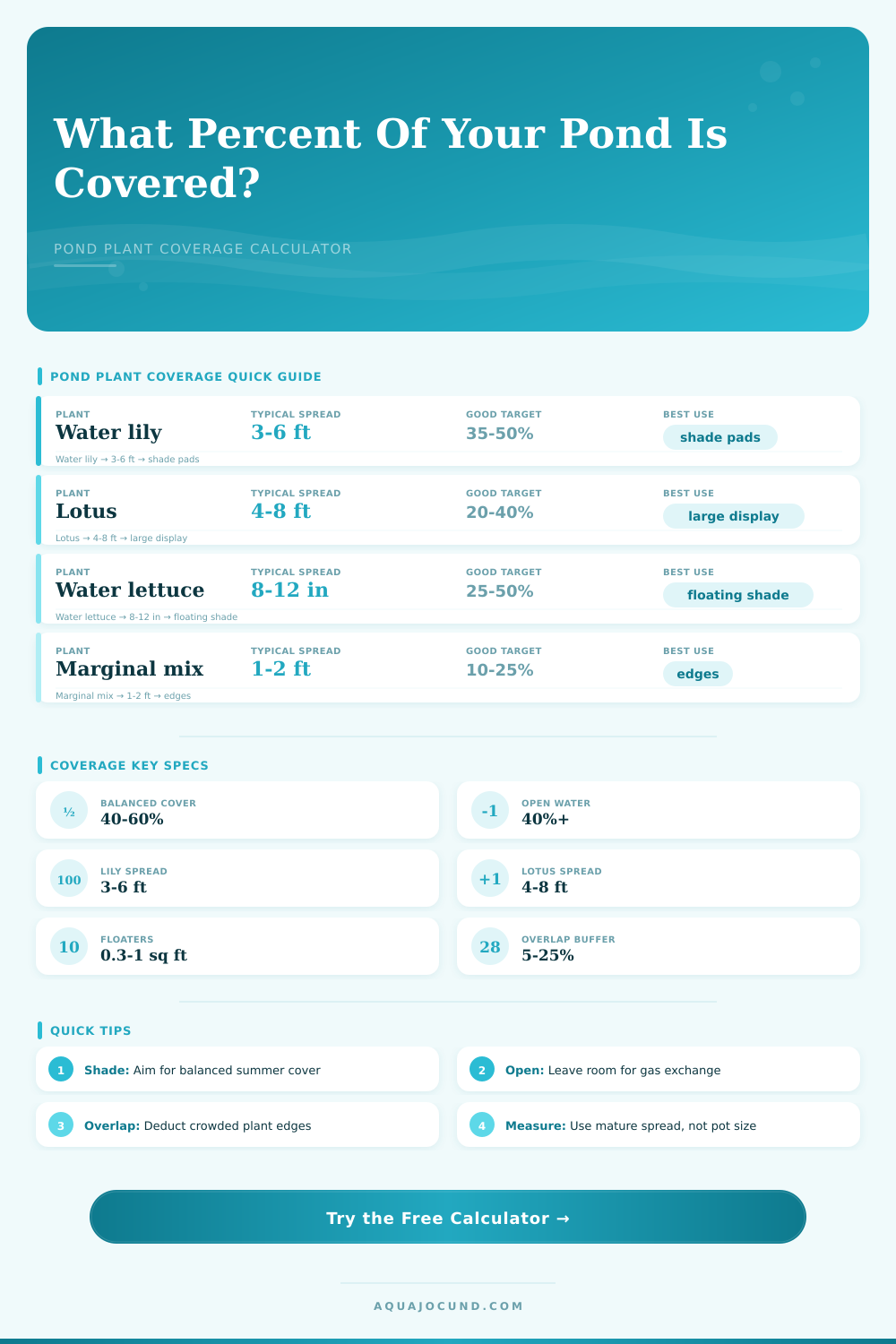
| Hardy water lily | 3 to 6 ft / 0.9 to 1.8 m | 7 to 28 sq ft / 0.7 to 2.6 m² | 35 to 50% | Round pad canopy; use mature leaf spread, not container width |
| Tropical water lily | 4 to 7 ft / 1.2 to 2.1 m | 13 to 38 sq ft / 1.2 to 3.5 m² | 35 to 55% | Often larger leaf reach in warm water and full sun |
| Dwarf water lily | 1.5 to 3 ft / 0.5 to 0.9 m | 2 to 7 sq ft / 0.2 to 0.7 m² | 20 to 40% | Good for tub ponds and tight shallow shelves |
| Lotus | 4 to 8 ft / 1.2 to 2.4 m | 13 to 50 sq ft / 1.2 to 4.7 m² | 20 to 40% | Large leaves can dominate small ponds quickly |
| Water lettuce | 8 to 12 in / 20 to 30 cm | 0.3 to 0.8 sq ft / 0.03 to 0.07 m² | 25 to 50% | Count mature rosettes or clumps, then recheck during warm growth |
| Water hyacinth | 6 to 12 in / 15 to 30 cm | 0.2 to 0.8 sq ft / 0.02 to 0.07 m² | 25 to 50% | Forms connected mats; overlap allowance matters |
| Floating heart / snowflake | 1.5 to 3 ft / 0.5 to 0.9 m | 2 to 7 sq ft / 0.2 to 0.7 m² | 20 to 45% | Use patch diameter for each planted crown or basket |
| Marginal plant mix | 1 to 2 ft / 0.3 to 0.6 m | 1 to 3 sq ft / 0.1 to 0.3 m² | 10 to 25% | Counts edge canopy only; do not include submerged stems |
| Pond Example | Dimensions | Surface Area | 45% Coverage | Typical Plant Plan |
|---|---|---|---|---|
| Patio bowl | 4 ft diameter / 1.2 m | 13 sq ft / 1.2 m² | 6 sq ft / 0.5 m² | 1 dwarf lily or a small floater group |
| Small formal pond | 6 x 8 ft / 1.8 x 2.4 m | 48 sq ft / 4.5 m² | 22 sq ft / 2.0 m² | 2 small lilies plus edge plants |
| Medium garden pond | 8 x 10 ft / 2.4 x 3.0 m | 80 sq ft / 7.4 m² | 36 sq ft / 3.3 m² | 2 to 3 hardy lilies or mixed pads |
| Oval wildlife pond | 10 x 14 ft / 3.0 x 4.3 m | 110 sq ft / 10.2 m² | 50 sq ft / 4.6 m² | 2 lilies plus floating plants checked often |
| Large koi pond | 12 x 18 ft / 3.7 x 5.5 m | 216 sq ft / 20.1 m² | 97 sq ft / 9.0 m² | 4 to 6 lilies with open feeding lanes |
| Coverage Percent | Open Water Left | Best Match | Planning Note |
|---|---|---|---|
| Under 20% | Over 80% | Display water, new plantings, cool weather | May not provide much shade at peak sun |
| 20 to 35% | 65 to 80% | Clear view ponds and small wildlife ponds | Often works when water stays cool and clear |
| 35 to 50% | 50 to 65% | Balanced garden ponds | Common summer shade range for lilies and floaters |
| 50 to 60% | 40 to 50% | Warm climates or high-sun koi ponds | Keep skimmer, waterfall, and viewing lanes open |
| Over 60% | Under 40% | Dense floating mats or crowded pads | Thin plants if circulation or gas exchange is restricted |
| Shape | Surface Area Method | Calculator Use | Field Measurement |
|---|---|---|---|
| Rectangle | Length x width | Formal ponds and raised basins | Measure inside water-line dimensions |
| Square | Side x side | Square patio ponds and framed liners | Use one side length |
| Oval | Pi x half length x half width | Rounded garden ponds | Measure longest and widest water-line points |
| Round | Pi x radius squared | Tubs, bowls, and circular wildlife ponds | Measure diameter across the water surface |
| Kidney / irregular | Oval area x 0.86 | Natural ponds with a pinched middle | Use the bounding length and width, then apply the irregular factor |
Each year, as your water lilies struggle to keep pace with the algae bloom, you stand on the shore of that garden pond and wonder how it happened again. Why isnt the pond clear? Oh, that is right. In spring you bought some plants and hoped things would be nice. July rolls around and then the sun beats down, the water warms up, and the invisible chemistry shifts. Overnight the water go green. Your fish is starting to gasp at the surface.
You didn’t fail because you didn’t try. You failed because you didn’t understand the math of shade. Shade is all about controlling light and out-competing the algae for nutrients. The trick is hitting it, and its tricky to do by eye alone. Enough leaves to block the sun from spawning algae, but not so many that they shut out OXYGEN from the water. Somewhere between forty percent and sixty percent of surface area seem about right. And it’s a thin line, that makes sense in your gut until someone asks you to estimate it on a piece of paper using a tape measure.
How to Use the Pond Shade Calculator
Instead, this calculator makes you think in terms of mature spread, not pot size, eliminating guesswork. For most of us, starting out, we read the nursery tag and see a tiny container; and figure the plant won’t get any bigger. Wrong. Plants don’t care about the tag. Put a three gallon pot of a hardy water lily into the water, where there’s lots of light and warmth, and that thing will expand three to six feet over time. That’s what matters, the actual shade cast on the water, which is why the tool asks for the mature diameter.
Plug in how big your pond is, and how many plants you have, and it’ll tell you what percent of the surface they’re covering now. Then it will tell you how many additional units you’d need to add to achieve a target range. Why does it matter? Adding just another lily or two to a small pond can tip the balance from being too open to just right (perfectly shaded).
Beyond the size, the shape matters more than most would think. Sharp corners on a rectangle catch trash. Roots can’t extend as far into this type of cornered shape. Irregular corners in a kidney shape make it hard to visually estimate the area. Based off your selected shape, the calculator accounts for this variation. For irregular ponds, there’s a correction factor built-in to account for the fact that the bounding box approach will inevitably be larger than the actual water surface. So if you have an irregular pond like a naturally formed one with a pinched center, the tool will reduce the calculated area to better reflect what is actualy wet. That accuracy keeps you from purchasing excess plants.
Too much is a problem. Crowding causes poor airflow and creates anaerobic pockets where nasty bacteria forms. Fast growing floating plants like water lettuce grow fast, doubling in size in just a few weeks in the height of the summer heat. That’s good and bad. This is good because it offers instant shade and hides things from view, but if left unchecked, it could of also smother the pond.
The tool includes an overlap allowance setting to account for this reality. If the plants are all tangled up and dense, then increase the overlap percentage. This directs the calculator to be more conservative in its estimates. It assumes there’s some amount of leaf area wasted on top of other leaves, not shading new water. This adjustment saves you from buying plants which will simply crowd each other out.
Finally there are open water lanes that should be considered as well. Room is needed for fish to move around and feed. The skimmer needs to draw in water. There needs to be clear returns for water falls to provide some movement. Use the calculator to set aside areas for those things. Perhaps you want to maintain a lane next to the pump. Or maybe the middle is left open so people can view it. Either way, this prevents plants from growing into and clogging mechanical equipment. And it maintains a healthy level of gas exchange in the water.
Gas comes in at the surface. Covering all of the surface reduces that amount. So the goal for coverage reflects that balance. At least forty percent of the surface should remain open on a balanced pond. That provides just enough shade to reduce algae while letting beneficial bacteria get the sunlight they need to grow.
All this depends on seasonal growth. In early spring, all you have is a crown. In midsummer, it’s a canopy. The tool allows you to choose which stage of growth to include in your calculations. Plan for less coverage in springtime then what you’ll get come July. Thinking ahead keeps you from underplanting. Buy plenty of stock right now so that when the time comes, the pond will look full. It’s a way to act ahead of time rather than waiting to react. Don’t wait till you see the green water. Plan for the shade you’ll need before the algae takes hold.
Now double check with the reference tables. They compare how much space each plant takes. Dwarf lilies don’t require much room, while lotus plants does. Marginals help stabilize the edges but stay smaller. Know that and create a good combination of species. A handful of big lilies combined with a bunch of little floaters gives you even spacing. That makes a layer of protection against algae. Plus it looks great.
Just remember… measure so you can adjust as the season goes on. Use the calculator to estimate at first. Monitor the water then cut back accordingly. No, no pond stays the same. A balanced pond needs maintenance, but knowing where to start with the math puts you in good shape. When dividing existing plants or adding new ones, go back to the calculator. Stay on top of the numbers, and your pond will remain clear.