Pond De-Icer Wattage Calculator
Estimate the practical wattage needed to keep a winter gas-exchange opening clear for koi ponds, goldfish ponds, stock tanks, and wildlife water features.
Your pond de-icer estimate
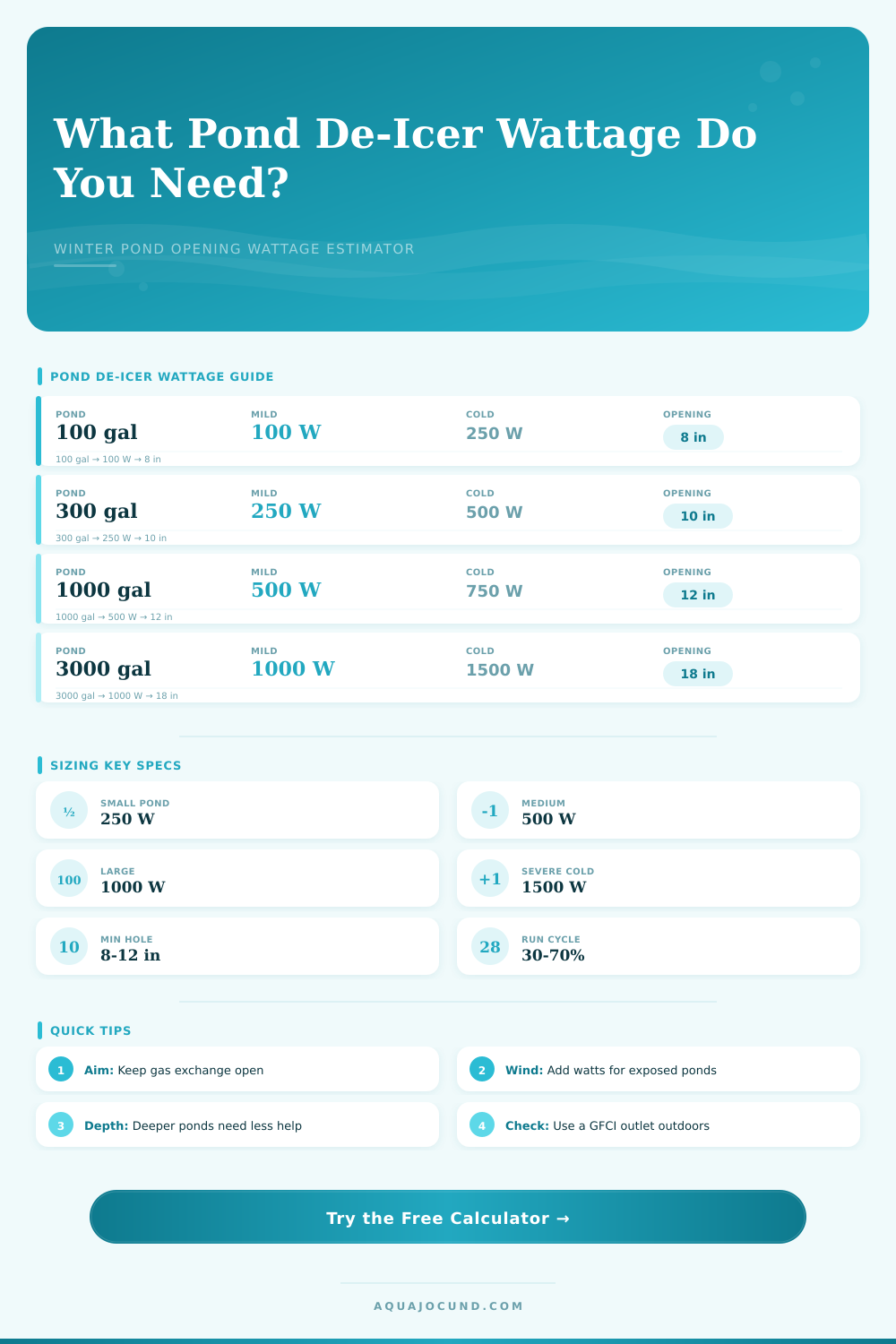
| Pond size | Mild winter | Cold winter | Severe winter | Opening target |
|---|---|---|---|---|
| Under 150 gal | 100 to 250 W | 250 W | 500 W | 8 in |
| 150 to 500 gal | 250 W | 500 W | 750 W | 10 in |
| 500 to 1,500 gal | 500 W | 750 to 1000 W | 1000 to 1500 W | 12 to 16 in |
| 1,500 to 3,500 gal | 750 to 1000 W | 1000 to 1500 W | 1500 W or two units | 16 to 20 in |
| Over 3,500 gal | 1000 to 1500 W | 1500 W or staged units | Two protected units | 18 to 24 in |
| Winter low range | Calculator factor | Typical use | Field note |
|---|---|---|---|
| 25 F and warmer | 0.75 | Light freeze protection | Short overnight ice skins |
| 15 to 24 F | 1.00 | Average backyard winter | Good baseline for goldfish ponds |
| 5 to 14 F | 1.25 | Reliable cold snaps | Wind begins to dominate sizing |
| -5 to 4 F | 1.55 | Northern koi pond | Use protected cords and inspect daily |
| Below -5 F | 1.90 | Severe winter exposure | Consider multiple smaller openings |
| De-icer style | Best pond | Watt range | Placement | Wind | Fish load | Notes |
|---|---|---|---|---|---|---|
| Floating saucer | Small to medium | 250 to 1250 W | Surface | Average | Light to normal | Common pond choice |
| Insulated floating ring | Koi pond | 250 to 1000 W | Surface | Good | Normal | Less heat lost upward |
| Submersible sinker | Deep pond | 500 to 1500 W | Below surface | Average | Normal to heavy | Keeps unit out of sight |
| Stock tank heater | Tub or trough | 250 to 1500 W | Tank wall or plug | Poor | Livestock water | Use only as rated |
| Aerator plus de-icer | Fish pond | 250 to 750 W | Shallow edge | Good | Heavy | Avoid chilling deep water |
| Dual low-watt units | Large pond | 500 plus 500 W | Two edges | Good | Heavy koi | Adds backup opening |
| Input factor | Low setting | High setting | Why it changes watts |
|---|---|---|---|
| Opening diameter | 8 to 10 in | 18 to 24 in | Larger openings lose more heat to air and wind |
| Wind exposure | Sheltered | Open field | Wind strips warm boundary air from the water surface |
| Pond depth | Under 18 in | Over 30 in | Shallow ponds have less thermal reserve below the ice |
| Fish load | No fish | Heavy koi | More fish need more reliable gas exchange through ice |
| Shelter | Poly cover | Running waterfall | Winter covers reduce heat loss, waterfalls increase it |
That little sheet of ice forms across pond overnight, quieting house as you awake. Fear strikes! Your fish has to be able to breathe somehow or they won’t make it through the winter. You don’t want to try to heat your pond like a tropical lagoon. No way! All you’re hoping for is to keep a small hole open. This allows oxygen to stay stable while letting methane and carbon dioxide vent out.
That’s where getting wattage right balances equipment safety with electricity cost. When you use the calculator, it look beyond surface area and finds balance for you. Most folks believe if they just melt the whole pond then everything will be good… not true. It’s too expensive and it’s unnecessary. You want a localized opening.
How the Calculator Works
When you enter your pond volume into the tool, yes it does factor that in, but it also takes into account how well the pond can hold winter shelter and what exposure the pond gets to wind. This is where most of these estimates goes wrong. Does the pond sit out in the open field or do you have a sheltered courtyard? That pond that sits out in the open field are going to lose heat quicker. The wind rips away warm air boundary from the water surface. So now this little bubble of water has to fight to stay like that. The pond get a lot of wind exposure. To fight the wind chill, the calculator will bump you up to a higher wattage class. This is usually somewhere around the five hundred watt mark for mediums.
The thing about depth is it’s counter-intuitive, too. There is less heat stored below surface of shallow ponds so they will freeze out quicker then deep ones. Deep ponds retains their heat longer and that one square foot of open water can be maintained more easyly by the de-icer. That’s where average pond depth changes things on the input side. It doesn’t change the fact that you’re keeping the immediate area right around the unit from going to freezing point (it just takes less power to do it). The math reflect what’s happening physically.
Another factor that makes a difference is livestock load. If your pond is stocked with fish, it require good gas exchange. Even if their metabolism slows down, they still need to breathe, and a higher stocking rate will requires more oxygen. This is why the calculator slightly increases its power recommendation for a stocked pond (assuming you have a high bioload). The heavier the stocking, the bigger the risk of the hole shutting off during a particularly cold snap. But it’s not very much different in terms of watts. It is just enough to make sure the device cycles often enough to keep the hole from freezing shut.
The biggest factor of all may be your environment (wind). Because wind increase heat loss and evaporation, the calculator include a wind multiplier. Depending on where you live, you could require fifteen hundred watts to match performance of a two hundred fifty watt unit on a covered patio. You can see this progression clearly in the reference table on the page, ranging from mild backyard environments through severe northern exposures. Outside temperature isn’t everything, it’s also about how hard that wind is blowing across that thin sheet of exposed water.
The type of de-icer used will make a difference as well. For example, floating saucer type de-icers are popular and do a great job, but sometimes a submersible sinker or an insulated ring works better. A sinker sinks the element below ice and keeps it out of way and away from debris, whereas a floating ring keep the heat near top of water. These positioning differences will change expected duty cycle when input into the calculator. This means you don’t want a continuous running de-icer, rather something that cycles on and off fairly regularly. If they runs all the time, either the wattage isn’t high enough for the circumstances, or it’s been positioned poorly.
Water + Electricity = Non-Negotiable. Check cords for weakness frequently and always use a GFCI outlet. A little bit of ice can conceal potential weak points and other sources of stress on equipment. You should of checked your wires too. When the calculator says it’s close but not sure about your watts, err on the side of larger. You want something that won’t work so hard that it freezes, rather than something too large that turns on and off too rarely.
The goal is to ventilate steadily without fanfare. Open hole, keep fish breathing, let water take care of the rest. That tiny amount of moisture is what separates thriving in the spring from dying in the winter.