🌱 Deep Water Culture Raft Area Calculator
Estimate DWC raft surface, plant holes, raft sheets, bed footprint, and water volume for floating raft systems.
✅ DWC Raft Sizing Results
| Crop | Center Spacing | Sites Per Sq Ft | Net Cup | Water Depth | Best DWC Use |
|---|---|---|---|---|---|
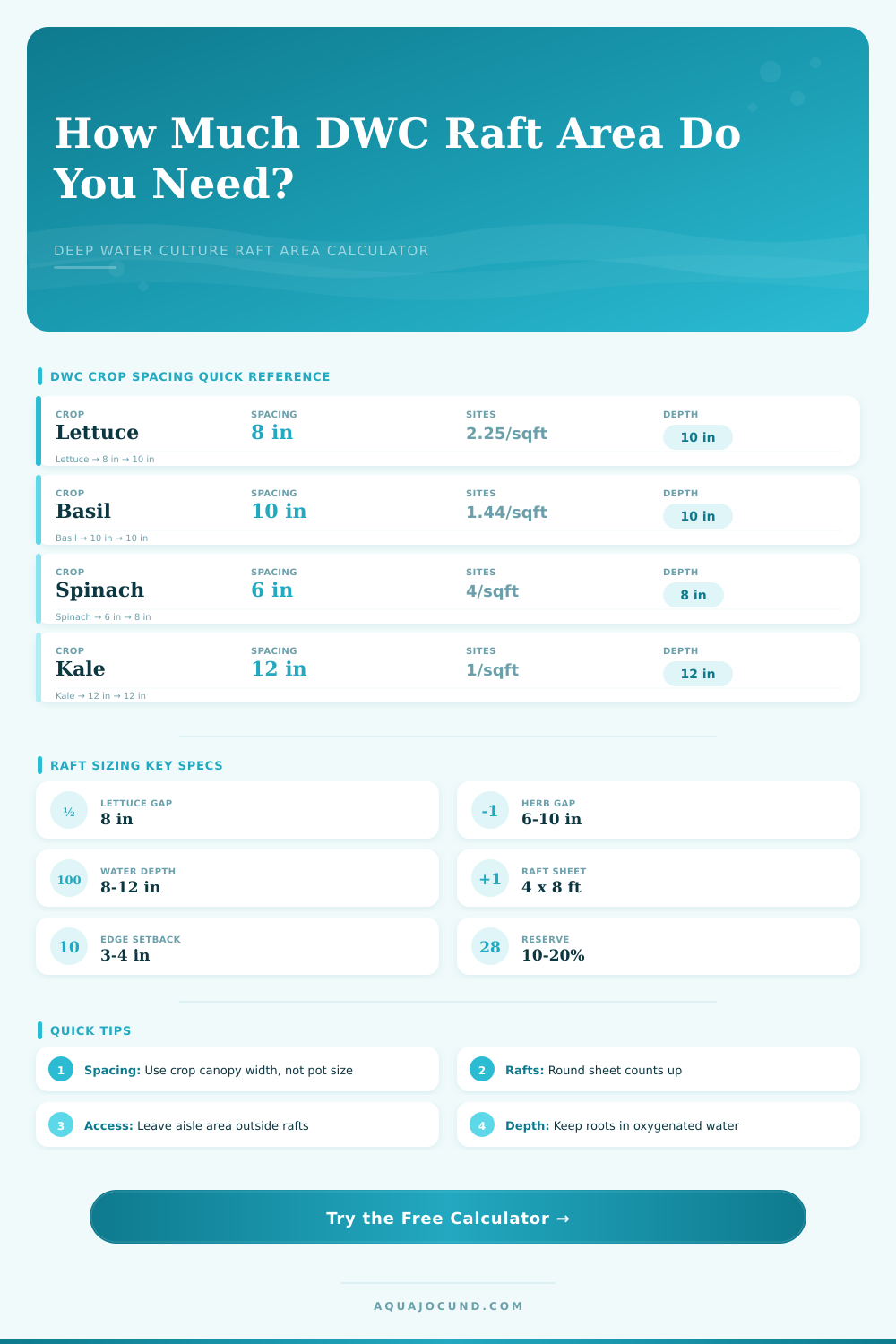
| Head Lettuce | 8 in / 20 cm | 2.25 | 2 in | 8 to 10 in | Standard raft beds and aquaponic lettuce runs |
| Baby Lettuce | 6 in / 15 cm | 4.00 | 2 in | 8 in | Short-cycle greens and nursery-style harvests |
| Basil | 10 in / 25 cm | 1.44 | 2 to 3 in | 10 to 12 in | Large canopy herbs with strong air movement |
| Spinach | 6 in / 15 cm | 4.00 | 2 in | 8 to 10 in | Cool-season rafts and smaller leaf spacing |
| Bok Choy | 8 in / 20 cm | 2.25 | 2 in | 10 in | Compact brassica spacing with steady aeration |
| Kale / Chard | 12 in / 30 cm | 1.00 | 3 in | 10 to 12 in | Larger leaf crops that need wider canopy room |
| Strawberry | 12 in / 30 cm | 1.00 | 2 to 3 in | 8 to 10 in | Low-profile fruiting rafts with clean crowns |
| Mixed Culinary Herbs | 6 to 10 in | 1.44 to 4.00 | 2 in | 8 to 10 in | Small crop blocks with similar harvest timing |
| Raft Sheet | Surface Area | Typical Holes At 8 in | Handling Notes | Common Use |
|---|---|---|---|---|
| 2 x 4 ft | 8 sq ft / 0.74 m² | 18 sites | Easy one-person lifting | Starter beds and small herb rafts |
| 3 x 6 ft | 18 sq ft / 1.67 m² | 40 sites | Fits narrow raceways | Greenhouse benches and test channels |
| 4 x 8 ft | 32 sq ft / 2.97 m² | 72 sites | Common but wide to lift | Commercial lettuce and aquaponic rafts |
| 60 x 120 cm | 7.75 sq ft / 0.72 m² | 17 sites | Metric table size | Nursery rafts and compact home systems |
| 1 x 2 m | 21.5 sq ft / 2.0 m² | 48 sites | Metric production raft | Modular raft bays and teaching systems |
| Bed Style | Dimensions | Surface Area | Approx Lettuce Sites | Water At 10 in |
|---|---|---|---|---|
| Home Starter Tub | 4 x 2 ft / 122 x 61 cm | 8 sq ft | 16 to 18 sites | 50 gal / 189 L |
| Single Foam Sheet Bed | 8 x 4 ft / 244 x 122 cm | 32 sq ft | 65 to 72 sites | 199 gal / 754 L |
| Narrow Greenhouse Channel | 12 x 3 ft / 366 x 91 cm | 36 sq ft | 73 to 81 sites | 224 gal / 848 L |
| Two-Sheet Raft Bay | 16 x 4 ft / 488 x 122 cm | 64 sq ft | 130 to 144 sites | 399 gal / 1510 L |
| Rounded Raceway | 20 x 4 ft / 610 x 122 cm | 93 sq ft | 188 to 209 sites | 579 gal / 2192 L |
| Commercial Bay | 48 x 8 ft / 14.6 x 2.4 m | 384 sq ft | 777 to 864 sites | 2394 gal / 9063 L |
| Design Item | Typical Range | Calculator Input | Why It Matters |
|---|---|---|---|
| Water Depth | 8 to 12 in / 20 to 30 cm | Working water depth | Controls water volume, root space, temperature stability, and aeration demand |
| Raft Edge Setback | 2 to 4 in / 5 to 10 cm | Raft edge setback | Keeps holes from cracking raft edges and gives plants support |
| Usable Coverage | 75% to 95% | Usable raft coverage | Accounts for channels, corners, handling gaps, and non-planted access space |
| Spare Holes | 5% to 20% | Sizing margin | Allows for uneven bed geometry, staggered crops, and damaged plant sites |
| Aeration Check | Higher for dense roots | Plant count and crop type | Dense raft plantings need oxygen-rich circulation under every sheet |
Foam: For most first-time hydroponics growers, this is free. It is at least somewhat free. When they shop for foam, they hear “four by eight” and think that sounds cool. So they purchase a sheet. And then they has to drill lots of hole in it. This takes forever (until their arm falls off). So they cram in a bunch of seedling.
A couple weeks later, when half of them are dead, it’s not because the lights aren’t perfect and the water isn’t pure enough. Nope. It’s almost always been because you didn’t calculate how much real space you had on that fancy raft. You crowded the canopy too close; you starved the roots of air; and now you’re making a humid swamp instead of an elegant raft.
How to Plan Your Hydroponic Raft
If you want to avoid this particular heartbreak, you need to figure out what size of raft you realy needed before you buy the polystyrene. The math is unexpectedly SIMPLE, but no one bothers with it because they’re chomping at the bit to get growing. Each crop have an approximate mature-canopy width, and the math say how far apart the centers must be, as a minimum.
For example: Eight inches between holes (minimum) makes sense for head lettuce, whose leaves want to spread out so they don’t rub on each other. Basil gets to 10 inches because it’s tall and bushy. Spinach only requires six inches, since it doesn’t get very tall or really wide or stiff. It is a looser, lower-growing plant. Throw kale into six-inch holes and by harvest time the leaves will be the size of postage stamps, because the plants were jockeying for light and air.
The Plant Profile section of the calculator does the math for you based off the crop profile and number of plants desired, so you’ll know exactly how big to make your beds. OK, now that you’ve got your spacing under control, time to consider the physical footprint. Round tanks is a waste in the corners; easy enough to visualize with a rectangular bed. Greenhouse raceways tend to be rounded on the end so there’s no dead spot where roots can rot away, while the water flows evenly throughout.
Don’t forget to factor in the edge setback. The buffer zone from the edge of the foam to the last net cup. That’s what prevents the cup tipping over and cracking the foam rim when the waterlogged plants gets heavy. For most ordinary rafts, three inches is a safe bet. It holds up the structure and provides a grip point when lifting the sheet.
The quiet variable in this equation is water volume. At ten inches of depth, a four by eight sheet contains almost two hundred gallons of water. Sure, that seems like a lot … but keep in mind that you must maintain that whole mass of water with oxygen for twenty four hours a day. Under-size your air pump and base it on the amount of visible surface area instead of real water volume, and your roots is going to suffocate during a heatwave.
This tool calculates water volume, allowing you to size your air equipment properly to do the job. Better to have an air stone that’s a bit overpowered than to watch your lettuce go brown as the dissolved oxygen gets too low.
Here is more information on material handling: four by eight rafts of saturated foam are heavy and clumsy to handle. Even though you’ll lose a couple of square feet with the gaps between sheets, it may make sense to break up the bed into smaller sheets (and buy extra foam) if you’re doing it solo. The gaps also allow easy access to the inside for root checks, plant swaps, etc., which are some of the reasons most growers leave 10-15% of their surface unplanted.
It’s laid out on the page with a reference table that shows you how various crops compare in terms of density. For instance, spinach grows four times the number of plants per square foot compared to kale. That has an impact on all your other demands (how fast will it deplete nutrients?) and your total harvest schedule. Fast growing means quick turnover and fast nutrient depletion. Slow growing means slower turnaround but potentially larger yield per head.
What are you trying to optimize for? Size or speed? Quality or volume? The calculator makes those tradeoffs clear.
Finally, there are those empty holes. Something’s going to go wrong. Transplants will die. Seedlings gets stretched out and fail. Net cups will crack. Don’t drill only what you think you’ll need for your first day, or you’ll be scrambling when something goes awry.
That ten percent buffer gives you breathing room to handle losses without needing to start drilling while the raft is still in the tank. Drilling wet foam doesn’t work well and creates a mess. Manage your space, water, and a little patience; good DWC farming isn’t so much perfect science as it is planning ahead for imperfection. You should of known that.