🌱 NFT Channel Length Calculator
Plan hydroponic or aquaponic NFT rail length from plant count, crop spacing, maximum run, slope, channel type, and target flow.
✅ NFT Channel Layout Results
| Crop Type | Plant Spacing | Flow Per Channel | Practical Run | Root Load |
|---|---|---|---|---|
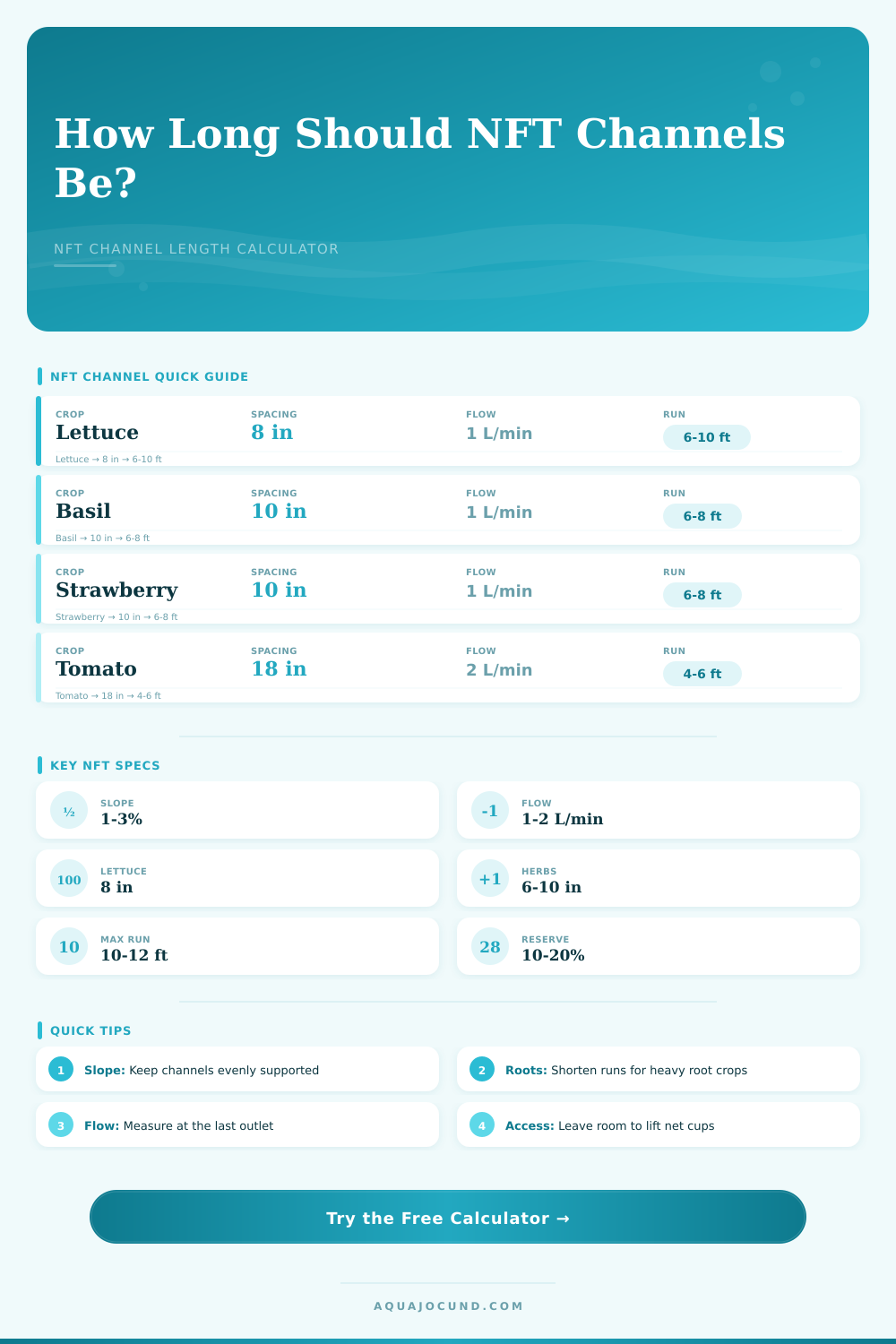
| Baby Greens And Microgreens | 4 to 6 in / 10 to 15 cm | 0.5 to 0.75 L/min | 4 to 8 ft / 1.2 to 2.4 m | Low but dense canopy |
| Lettuce, Pak Choi, Tatsoi | 7 to 9 in / 18 to 23 cm | 0.75 to 1.25 L/min | 6 to 10 ft / 1.8 to 3.0 m | Moderate, usually NFT friendly |
| Basil And Soft Culinary Herbs | 8 to 12 in / 20 to 30 cm | 0.75 to 1.25 L/min | 6 to 8 ft / 1.8 to 2.4 m | Moderate with regular trimming |
| Mint, Oregano, Spreading Herbs | 10 to 14 in / 25 to 36 cm | 1.0 to 1.5 L/min | 4 to 8 ft / 1.2 to 2.4 m | Can mat heavily |
| Strawberry Crowns | 9 to 12 in / 23 to 30 cm | 1.0 to 1.5 L/min | 6 to 8 ft / 1.8 to 2.4 m | Moderate, keep crowns dry |
| Kale, Chard, Larger Leafy Greens | 10 to 14 in / 25 to 36 cm | 1.25 to 1.75 L/min | 4 to 8 ft / 1.2 to 2.4 m | Heavy by harvest size |
| Compact Peppers | 14 to 18 in / 36 to 46 cm | 1.5 to 2.0 L/min | 4 to 6 ft / 1.2 to 1.8 m | Heavy, use trials only |
| Dwarf Tomatoes | 16 to 24 in / 41 to 61 cm | 1.5 to 2.0 L/min | 4 to 6 ft / 1.2 to 1.8 m | Very heavy for NFT |
| Channel Style | Typical Width | Best Use | Run Limit | Cleaning Access | Layout Note |
|---|---|---|---|---|---|
| 2 in Round Pipe | 2 in / 5 cm | Seedlings, herbs, tiny greens | 4 to 6 ft / 1.2 to 1.8 m | Narrow | Avoid large root crops |
| 3 in Round Pipe | 3 in / 7.6 cm | Lettuce and small herbs | 6 to 8 ft / 1.8 to 2.4 m | Moderate | Common compact DIY size |
| 4 in Round Pipe | 4 in / 10 cm | Larger lettuce and basil | 8 to 10 ft / 2.4 to 3.0 m | Better | Needs firm support to hold slope |
| Flat Bottom NFT Gully | 4 to 5 in / 10 to 13 cm | Leafy greens production | 8 to 12 ft / 2.4 to 3.7 m | Good | More even nutrient film |
| Wide Commercial Gully | 5 to 6 in / 13 to 15 cm | Strawberries and mature greens | 8 to 12 ft / 2.4 to 3.7 m | Good | Allows bigger root spread |
| Deep DIY Fence Post | 4 to 5 in / 10 to 13 cm | Backyard herb and salad racks | 6 to 10 ft / 1.8 to 3.0 m | Good if capped access remains | Watch standing water at low slope |
| Aquarium Or Reservoir | Example Crop | Plant Sites | Typical Channels | Total Length |
|---|---|---|---|---|
| 5 gal / 19 L desktop betta loop | Microgreens or tiny herbs | 6 to 10 | 1 short rail | 3 to 5 ft / 0.9 to 1.5 m |
| 10 gal / 38 L herb reservoir | Basil, parsley, baby lettuce | 10 to 18 | 2 rails | 8 to 12 ft / 2.4 to 3.7 m |
| 20 long / 76 L salad rack | Lettuce and pak choi | 18 to 30 | 3 to 4 rails | 16 to 24 ft / 4.9 to 7.3 m |
| 29 gal / 110 L basil loop | Basil and soft herbs | 24 to 36 | 4 to 5 rails | 22 to 32 ft / 6.7 to 9.8 m |
| 40 breeder / 151 L mixed greens | Lettuce, chard, strawberries | 36 to 54 | 5 to 7 rails | 30 to 45 ft / 9.1 to 13.7 m |
| 55 gal / 208 L display wall | Leaf lettuce and herbs | 48 to 72 | 6 to 9 rails | 42 to 60 ft / 12.8 to 18.3 m |
| 75 gal / 284 L strawberry rack | Strawberries and basil | 60 to 90 | 8 to 12 rails | 55 to 80 ft / 16.8 to 24.4 m |
| 125 gal / 473 L display aquaponics | Mixed lettuce wall | 90 to 140 | 12 to 18 rails | 80 to 125 ft / 24.4 to 38.1 m |
| Design Item | Conservative Range | Calculator Use | Watch Point |
|---|---|---|---|
| Channel slope | 1% to 3% for most short NFT runs | Computes inlet-to-outlet height drop | Too flat can leave warm stagnant puddles |
| Flow per channel | 1 to 2 L/min for mature leafy channels | Computes total manifold flow | Measure actual flow at the farthest rail |
| End clearance | 4 to 10 in / 10 to 25 cm total per rail | Adds unplanted length for fittings | Caps and elbows need real room |
| Hole count rounding | Round up to whole plant positions | Creates balanced channel count | Extra sites help stagger harvests |
| Maximum run length | Shorter for roots, longer for light greens | Limits recommended rail length | Long rails must remain perfectly supported |
| Rack gap | 4 to 10 in / 10 to 25 cm between rails | Estimates top-view footprint | Leaf size often drives width more than pipe |
The concept is simple: grow salad in PVC pipes.
But soon you realize that hydroponics isn’t simply a matter of knowing how to garden; it’s about how liquid move. To work, water has to circulate uniformely. For example, if you have excessively long channels, the roots of last plants will starve off oxygen. Too short? You’ve wasted space and plumbing becomes a headache.
Why You Need to Do the Math
That’s why sizing is important. The calculator (above) calculate this equilibrium: it translates crop type and number of plant into actualy measurements. You won’t have to guess anymore, and you won’t waste plants by letting them rot from a lack of water.
Distance vs. Diffusion is the primary problem with NFT design. Oxygen and nutrients enters at one end of the film; water carries them around, and the roots extract them. By the time it hits the final set of cups, the film might not be warm or thick enough to maintain the needed conditions. That’s why maximum run length isn’t optional, it’s a rule.
Eight- to ten-foot lengths are about max for most leafy green. Use shorter lengths for heavier feeders like tomatoes, because their thick roots can clog the flow. Don’t mess with root zone.
The system depend on slope. Water doesn’t move unless there’s slope… Unless gravity does its work. But too much slope makes it move to quickly, leaving root systems high and dry. A gentle but firm slope is best; most are one to three percent, which allows a slow-moving film to coat the roots without flooding them. Easy to mess up. An apparently level pipe standing on a slanted floor can be dangerously steep if the supporting structure sag.
That’s what the math figures in: it tells you how tall to make the inlet relative to the outlet. Just how tall? Small, but critical: Will the water trickle or gush?
Novices tend to guesstimate spacings. To recieve enough light, lettuce requires roughly eight inches between centers. Basil may require ten. Space them closer, and the uppermost leaves shade their lower cousins. Moldy invitation ensues, as does slower growth. Space them out too much, however, and you lose density of yield.
The tool will adjust for those spacing needs automatically, plus, it allows for additional end space to accommodate fittings and caps. People often forget this until the pipe is cut and they realize there isn’t enough length.
So much depends on the kind of channel you are drilling. Roots like something wide enough that there’s plenty of space to stretch out and oxygen can diffuse in. But what if your channel is two inches around? There isn’t much surface area! It’ll do okay for microgreens, but it will starve full-grown lettuce of oxygen.
And the wider the channels, the more water you must have to keep the film intact. Use a big pump with a small pipe and you get dry patches. Use a small pump with a big pipe and you get floods. The calculator pairs up the flow rate with the channel width. So you know the physics will work before you even make a hole.
Consider it like this: Your layout is a circuit. Water comes into the main reservoir and is taken off by each channel. Too many channels = pressure drop. There is less water to the furthest rails. Too few channels = over-pumping; wasted energy. Aim for an even balance. Have enough channels for the number of plants without overloading the pump. Efficiency.
And lastly: allow for contingencies. Allow for plumbing offsets and cutting errors. Life isn’t perfect; pipes flex and support structures move around. Ten percent provides for most of this.
Get the numbers correct, and it just works. Roots breathe, water flows, plants grow. It’s as simple as physics…but first you should of do the math.