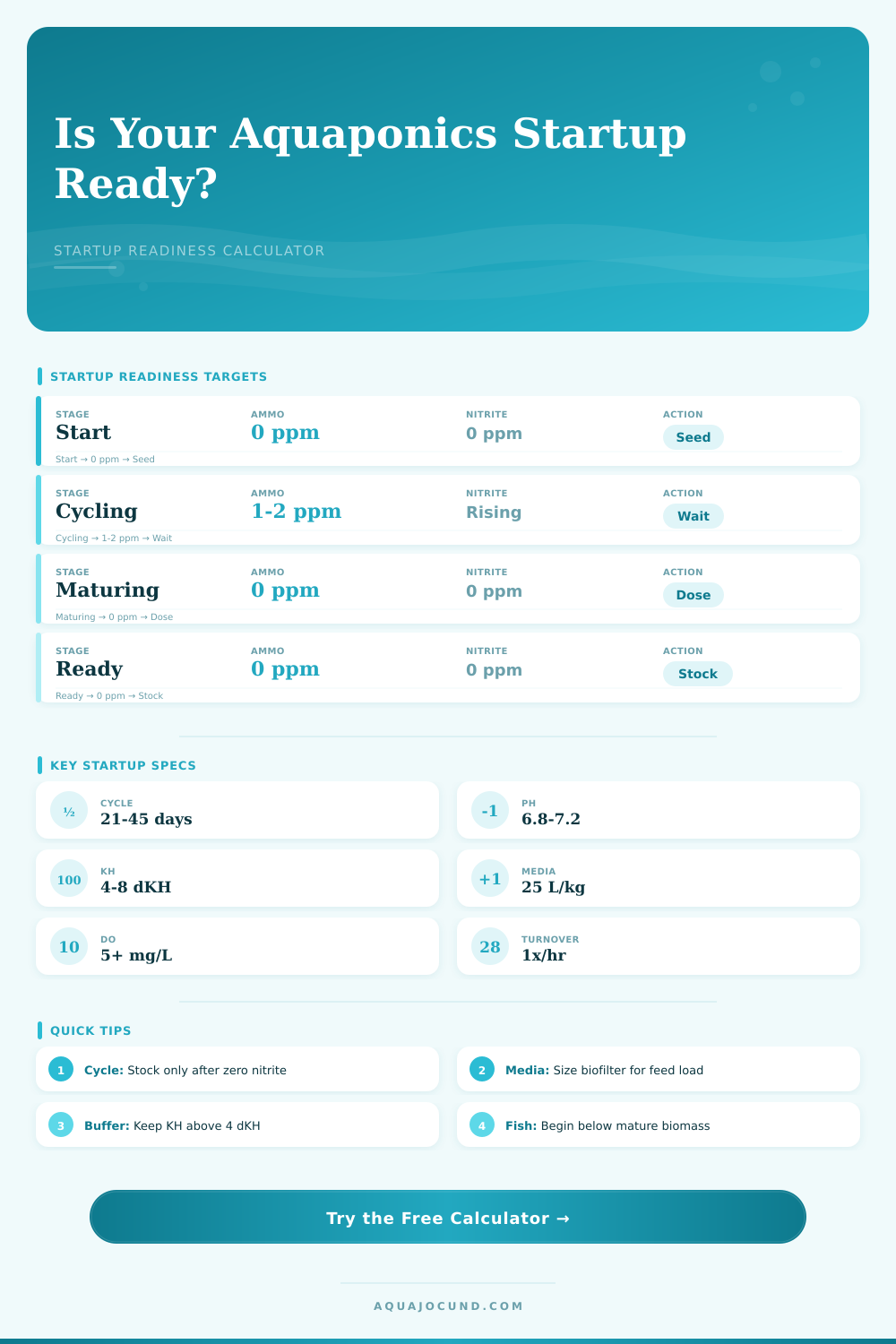
🌱 Aquaponics Startup Readiness Calculator
Estimate cycling time, biofilter media, first fish load, water volume, and buffer targets before a new aquaponics system is stocked.
| Media Type | Typical SSA | Startup Strength | Flow Note | Best Use |
|---|---|---|---|---|
| Expanded clay pebbles | 250-350 m²/m³ | Balanced | Good voids | Flood-and-drain beds |
| Lava rock | 300-500 m²/m³ | Strong | Rinse fines | Media beds with solids control |
| Pea gravel | 100-250 m²/m³ | Moderate | Heavy, lower voids | Large simple beds |
| K1 moving media | 500-800 m²/m³ | Strong | Needs aerated motion | Dedicated moving bed filters |
| Matala-style mat | 250-500 m²/m³ | Strong | Protect from clogging | Static biofilter chambers |
| Coarse sponge block | 350-600 m²/m³ | Strong | Clean gently | Small indoor aquaponics |
| Sand-capped bio bed | 600+ m²/m³ | Specialized | Needs prefiltration | Polishing and mature loops |
| Mixed media bed | 200-450 m²/m³ | Variable | Avoid dead zones | Custom grow beds |
| Stage | Ammonia | Nitrite | Nitrate | Readiness Signal |
|---|---|---|---|---|
| Fill and seed | 0 ppm | 0 ppm | 0 ppm | Chlorine removed, circulation running |
| Ammonia build | 1-2 ppm | 0 ppm | 0 ppm | Ammonia source is feeding bacteria |
| Nitrite spike | Falling | Rising | Low | First nitrifiers are active |
| Nitrate rise | 0 ppm | Falling | Rising | Second nitrifiers are establishing |
| Ready check | 0 ppm | 0 ppm | Present | Repeat zero ammonia and nitrite after dosing |
| Parameter | Startup Target | Watch Zone | Why It Matters |
|---|---|---|---|
| pH | 6.8-7.2 | Below 6.4 or above 7.8 | Nitrifiers slow outside the middle range |
| KH | 4-8 dKH | Below 3 dKH | Buffer prevents pH crash during cycling |
| Dissolved oxygen | 5+ mg/L | Below 4 mg/L | Bacteria and fish both need oxygen |
| Water temperature | 70-82°F | Below 65°F | Warm water cycles faster for most systems |
| Turnover | 1-2x per hour | Below 0.5x per hour | Keeps ammonia moving through biofilter media |
| System | Fish Water | Grow Zone | Startup Load | Cycle Pace | Buffer Need | Best First Fish |
|---|---|---|---|---|---|---|
| Countertop herbs | 5-15 gal | Small media | Very light | Moderate | Medium | Betta or guppy group |
| 20 long seedling bed | 18-22 gal | Media tray | Light | Moderate | Medium | Goldfish or minnows |
| 40 breeder media bed | 35-40 gal | Flood bed | Light-medium | Good | Medium | Goldfish or tilapia juveniles |
| 55 gal raft greens | 48-55 gal | DWC raft | Light | Slower | Higher | Hardy warm-water fish |
| 75 gal hybrid | 65-75 gal | Media plus raft | Medium | Good | Medium | Tilapia or bluegill |
| IBC backyard loop | 220-275 gal | Large media | Medium | Good | Medium | Tilapia or catfish |
| Cool trout raft | 250-350 gal | DWC raft | Light | Slow | Higher | Trout only after full cycle |
| Method | Expected Days | Readiness Boost | Stocking Start | Best Check |
|---|---|---|---|---|
| Fishless with seeded media | 18-30 | High | After repeated zero nitrite | 2 ppm ammonia clears in 24 hours |
| Fishless from clean media | 30-45 | Medium | After nitrate appears | Ammonia and nitrite both zero |
| Light fish-in cycle | 28-50 | Low | Very small biomass only | Daily ammonia and nitrite tests |
| Mature media transfer | 7-18 | Very high | Small load after stability check | Zero ammonia after test feed |
| Plants first, fish later | 24-40 | Medium | After root growth and zero nitrite | Nitrate uptake without pH swing |
Size media from feed load: water volume gives stability, but nitrification capacity follows the daily feed and the usable surface area of the biofilter.
Let test results set the pace: wait for ammonia and nitrite to return to zero after a small dose before adding the first real fish load.
The dream goes something like this: You get the tank and the pump, you fill it with a bag of clay pebbles, fill it up with water, and there’s the smell of nothing and the look of tap water. That’s where most aquaponics dreams comes crashing down. Sure, the hardware come easy, but it’s the biology part that’ll bite you if you don’t take your time.
So what does the calculator do for you? Once you input your tank size and type of media, it crunches numbers. This saves you from guessing at all the conversions and coefficients. It makes you think of it not as just a plumbing project but as living organism.
Why You Should Use a Calculator for Your Aquaponics System
Okay, so you’re going to try to cultivate two kinds of bacteria; one that consumes ammonia (from decaying food/fish waste), and another that consumes harmful by-product of the first task, nitrite. The first group gets hired, but the second is unemployed? Your water spikes with nitrite and your fish croak. That’s the trap.
Cycling isn’t a waiting game; it’s an active process of creating tiny work force. Because biology runs slow when its cold, the tool also asks what your water temperature is. Reasonable reproduction speed occur around seventy degrees Fahrenheit. Below sixty-five and time stops…well, nearly completely. They don’t die. They simply go to sleep.
To understand how different start up methods vary, read reference table on the page. But the take away message: be patient.
If you’re seeding your new media with gravel from a mature tank, you shave weeks off of the process. Introducing trained workers to the scene make that possible. If you want to do this without fish (and trust me, it’s better for both your conscience and your wallet), then expect a month longer than the calculator estimates…but it will still get there.
Whether you seed the media or are going from scratch is included in number of expected days. It also considers your biofilter media surface area. For example, a simple gravel bed has much less surface area per gallon compared to moving bed filter filled with K1 media. More surface = more room for more bacterias to hang out and do their thing.
Based off that surface area and intended feed load, the tool calculates how much biomass it thinks it can support. This is the critical part. What determines what you should of stock? It’s not how many gallons of water you have. How much you plan to feed determine what you should stock. The bacteria don’t eat fish directly; they eat the waste from the food. Overstocking means overdosing system with ammonia before the bacteria can catch up.
That’s conservative on the first fish load that comes out. So what do you get? A small number of fish that look good. That is good. You can’t put dead fish back in.
Another silent killer is buffer capacity. The calculator tests for KH. Because nitrification take time, if your KH is low, your pH will start swinging wildly until it falls into a pH range where the bacteria no longer function. Keep at least four dKH to maintain a pH between 6.8 and 7.2. Add potassium carbonate if your buffer runs low.
Don’t guess. Test it. Use data instead of faith to test the startup phase. Simultaneously watch the ammonia and nitrite plummet to zero. Don’t believe one test. Re-dose a small amount of ammonia. Wait twenty-four hours. If it clears, that’s your green light.
These processes shows themselves in the calculator’s readiness score. A high score indicates robust biology and clean chemistry. A low score? You need to wait.
Rushing the stock is the most expensive error in aquaponics. The equipment is expensive, yes, but more importantly, the fish are expensive. So too is the time lost. Give the invisible workers time to settle in.
When your system’s up and running, those plants will take off quickly. And they will realy take off before you realize it. Your water will be clean, and the fish will do well in it. But that’s where most of the secret lies… knowing what those numbers realy represent.
When should you stop waiting and begin stocking? That depends on the numbers. The biology doesn’t wait; the hardware does.