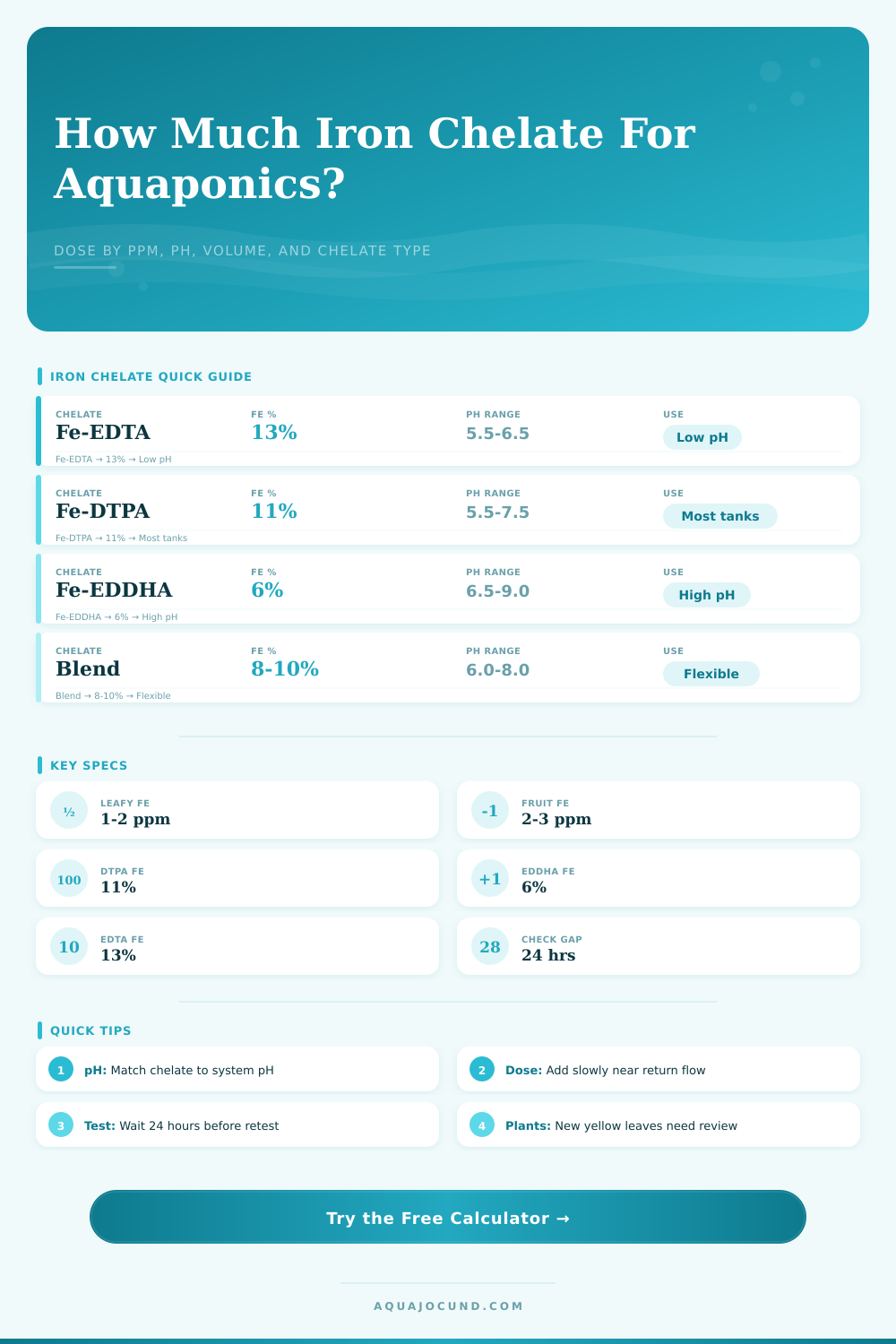
🌱 Aquaponics Iron Chelate Dose Calculator
Estimate Fe-DTPA, Fe-EDDHA, Fe-EDTA, or blended chelate dosing from system volume, target iron ppm, pH stability, and crop demand.
| Chelate | Typical Fe | Best pH | Water Color | Speed | Best Aquaponics Use |
|---|---|---|---|---|---|
| Fe-DTPA | 10-11% | 5.5-7.5 | Light tint | Medium | Most mature backyard systems near neutral pH |
| Fe-EDDHA | 6% | 6.5-9.0 | Red tint | Longer | Hardwater systems, limestone media, high pH loops |
| Fe-EDTA | 12-13% | 5.0-6.5 | Clear | Fast | Low pH hydroponic side loops or acidic systems |
| Iron Gluconate | 0.5-2% | 5.5-7.0 | Clear | Short | Small tanks and gentle foliar-style correction plans |
| DTPA / EDDHA Blend | 8-10% | 6.0-8.0 | Pink tint | Balanced | Mixed pH systems that drift during the season |
| Custom Label | Varies | Label | Varies | Varies | Use when your product lists an exact Fe percentage |
| Crop Load | Typical Fe Target | Maintenance Dose | Watch Point |
|---|---|---|---|
| Seedlings and microgreens | 0.5-1.0 ppm | Low and frequent | Avoid chasing old leaves |
| Soft herbs and basil | 1.0-2.0 ppm | Weekly to twice weekly | New leaves should green up |
| Lettuce and leafy greens | 1.5-2.5 ppm | Weekly top-up | Check pH before adding more |
| Kale, chard, pak choi | 2.0-3.0 ppm | Moderate weekly | Heavy calcium can compete |
| Strawberries | 1.5-2.5 ppm | Small split doses | High pH chlorosis is common |
| Tomatoes and peppers | 2.0-3.0 ppm | Crop-demand driven | Fast growth can outrun dosing |
| System | Fish Tank | Active Grow Area | Typical Chelate | Example Dose To Add 1 ppm Fe |
|---|---|---|---|---|
| Countertop herb raft | 10 gal / 38 L | 2 sq ft / 0.19 m² | DTPA | 0.34 g of 11% Fe-DTPA |
| 20 long lettuce bed | 20 gal / 76 L | 4 sq ft / 0.37 m² | DTPA | 0.69 g of 11% Fe-DTPA |
| 29 gal media greens | 29 gal / 110 L | 6 sq ft / 0.56 m² | DTPA | 1.00 g of 11% Fe-DTPA |
| 40 breeder basil | 40 gal / 151 L | 8 sq ft / 0.74 m² | DTPA | 1.38 g of 11% Fe-DTPA |
| 55 gal hybrid bed | 55 gal / 208 L | 12 sq ft / 1.11 m² | DTPA blend | 1.89 g of 11% Fe-DTPA |
| 75 gal fruiting bed | 75 gal / 284 L | 16 sq ft / 1.49 m² | EDDHA | 4.73 g of 6% Fe-EDDHA |
| 125 gal raft system | 125 gal / 473 L | 32 sq ft / 2.97 m² | DTPA or blend | 4.30 g of 11% Fe-DTPA |
| System pH | EDTA Fit | DTPA Fit | EDDHA Fit | Planning Note |
|---|---|---|---|---|
| 5.5-6.2 | Good | Good | Works | EDTA and DTPA both remain practical at this pH. |
| 6.3-7.0 | Fading | Good | Works | DTPA is a common choice for neutral aquaponic loops. |
| 7.1-7.5 | Weak | Usable | Good | DTPA may still work, but watch new leaves closely. |
| 7.6-8.2 | Poor | Short | Good | EDDHA is usually more reliable in hardwater systems. |
| 8.3-9.0 | Poor | Poor | Best | Expect red tint and use smaller split doses. |
| Observation | Likely Meaning | Calculator Adjustment | Check Before Redosing |
|---|---|---|---|
| Yellow new leaves, green veins | Classic iron chlorosis pattern | Raise target by 0.5 ppm | pH, alkalinity, and chelate type |
| Older leaves yellow first | Often nitrogen or magnesium, not iron | Do not increase Fe first | Nitrate, potassium, magnesium |
| Red water after dosing | Usually EDDHA color | Split the same weekly dose | Fish behavior and oxygen |
| No change after one dose | Plants need time or pH is binding Fe | Recheck after several days | Newest growth, not old leaves |
| Iron test remains zero | Test chemistry may miss chelated Fe | Use plant response with caution | Product label and sample timing |
Then one day you look at your basil or lettuce and realize it’s all washed out, with the telltale bright green veins contrasting with yellowed leaf tissue. This is a classic symptom of an iron deficiency, and it is also the point where most aquaponics gardener freak out. And then they reach for the closest bottle of supplement and dump. This is not usually a good idea.
Iron doesn’t behave in water the same way it does in soil, so dumping too much will not only confuse your fish (and cloud up your tank) but leave your plants no more satisfied than they was before. Rarely is the problem a lack of product on the shelf. More often it’s a mismatch between what you want and what water offers.
How to Add Iron to Your Aquaponics System
By plugging your parameters (target ppm, current iron level and system volume) into the calculator above, it does math for you. No need to guess that your tomato bed in a seventy-five gallon tank require the same treatment as your herb raft in a ten gallon tank.
But what do the numbers it spits out mean? What’s going on in the water?
Not all iron chelates are created equal. They’re like molecular cages that keep iron available to plant roots at various pH levels. Use the wrong cage in your water chemistry and voila! The iron drops out of solution. It becomes insoluble rust, Rust is something the plant can’t eat.
This is where people make their mistake. They purchase iron and forget about pH. Most of us use a neutral system like Fe-DTPA (that’s the workhorse from 5).5 to 7.5 pH. Above that, around 7.5 or so, DTPA begin to fail. You’ll dose with iron, notice the water turns just slightly colored, then watch as the chelate dissolve and the level drops. At that point you go to Fe-EDDHA. It’s pricier and contains less iron (in terms of percent by weight), but it stay stable in hard water with high alkalinity that cause other chelates to break down.
The page has a chart laying this all out. Which chelate goes where, what pH range. You don’t need to memorize it, but you should of check your pH meter before reaching for the bottle.
This is more of an art than a science, but dosing is important. You can overdose the bacteria on your biofilm (shock it) or cause stress in sensitive inhabitants such as shrimps by dumping all the chelate at once. Splitting the dose into several smaller, more frequent doses are often safer. This ensures a steady concentration without shocking the system with spikes that will bind up with solids and other stuff in water.
The sign is new leaf chlorosis. Yellow new growth mean the plant is starving for iron right this very moment. Old leaves yellowing is typical either a nitrogen or magnesium deficiency. Trying to fix old leaves with iron wastes both money and iron.
It’s not just about volume, it’s also about layout. Iron absorption depend on active water volume. The amount of iron that is actualy available isn’t equal in every setup. For instance, a deep water culture raft holds water different than a media bed with a sump. Similarly, a single small media bed in a 10g tank behave differently than two large media beds in a 55g tank. Your plant growing set up may or may not look like either of those.
The tool takes all this layout variation into account and corrects for it by adjusting the effective volume so you get a closer approximation of what your plant dose should be. This protects against over-dosing (which means staining your tank and filter) and under-dosing (leaving your plants pale).
But patience will be your best friend during this process. The iron level will fluctuate like crazy for several hours post-dose; the chelate has to circulate, then distribute itself throughout the tank. Wait a full day, because testing too soon give you a false high. Wait until the next morning, let things stabilize. Then check out some of the new growth. Does it look green? That is good. Did it fail to turn green? Adjust the target by just a bit.
You don’t want to go at this in heroic fashion. Consistency, not heroics, is how you get good at managing iron. Doing a little bit often beats doing a lot on a whim.
Do this all day long, It’s a little thing but it counts. Every new leaf on your plants gives you information. Listen to what they’re telling you.