🧪 Aquaponics pH Buffer Dose Calculator
Estimate KH buffer dose from real system water volume, current alkalinity, target alkalinity, buffer material, purity, and safe staged additions.
| Buffer | Formula | Factor | Main Ion | Speed | pH Push | Aquaponics Use |
|---|---|---|---|---|---|---|
| Potassium bicarbonate | KHCO3 | 2.00 | K | Fast | Mild | Routine KH and potassium support |
| Potassium carbonate | K2CO3 | 1.38 | K | Fast | Strong | Small corrective doses only |
| Calcium carbonate | CaCO3 | 1.00 | Ca | Slow | Mild | Passive buffering in media or bag |
| Calcium hydroxide | Ca(OH)2 | 0.74 | Ca | Fast | Strong | Experienced controlled dosing |
| Dolomite lime | CaMg(CO3)2 | 0.92 | Ca + Mg | Slow | Mild | Longer term mineral support |
| Magnesium carbonate | MgCO3 | 0.84 | Mg | Slow | Mild | Use when magnesium is low |
| Sodium bicarbonate | NaHCO3 | 1.68 | Na | Fast | Mild | Emergency only; sodium accumulates |
| Crushed shell grit | CaCO3 mix | 1.00 | Ca | Very slow | Self-limits | Background reserve, not quick repair |
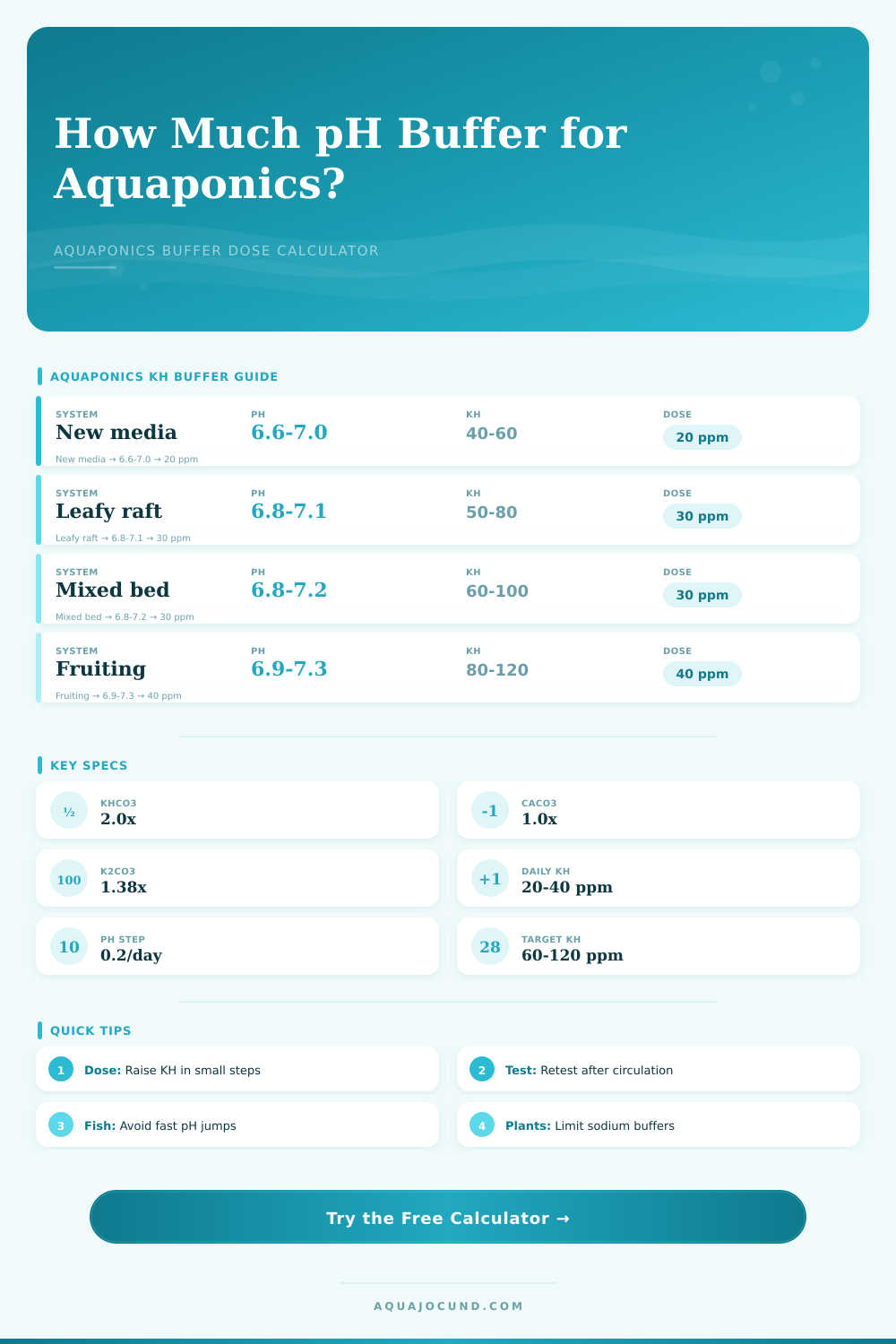
| System Type | Typical pH Aim | KH Target | Daily Rise | Notes |
|---|---|---|---|---|
| New media bed | 6.6-7.0 | 40-70 ppm | 15-25 ppm | Biofilter is still maturing; avoid sudden pH jumps |
| Leafy raft system | 6.8-7.1 | 50-90 ppm | 20-30 ppm | Good compromise for lettuce, herbs, fish, and nitrifiers |
| Mixed media beds | 6.8-7.2 | 60-100 ppm | 20-35 ppm | Often alternates potassium and calcium buffers |
| Fruiting crop system | 6.9-7.3 | 80-120 ppm | 25-40 ppm | Higher nutrient demand may need stronger mineral support |
| High fish load | 6.9-7.2 | 80-140 ppm | 20-30 ppm | Nitrification consumes alkalinity faster under heavy feeding |
| Passive shell buffer | 6.7-7.2 | 50-100 ppm | Not staged | Shell dissolves as water becomes acidic |
| System Volume | KHCO3 | K2CO3 | CaCO3 | Ca(OH)2 | NaHCO3 |
|---|---|---|---|---|---|
| 10 gal / 38 L | 1.9 g | 1.3 g | 0.9 g | 0.7 g | 1.6 g |
| 20 gal / 76 L | 3.8 g | 2.6 g | 1.9 g | 1.4 g | 3.2 g |
| 55 gal / 208 L | 10.4 g | 7.2 g | 5.2 g | 3.8 g | 8.7 g |
| 125 gal / 473 L | 23.7 g | 16.3 g | 11.8 g | 8.8 g | 19.9 g |
| 275 gal / 1041 L | 52.1 g | 35.9 g | 26.0 g | 19.3 g | 43.7 g |
| 500 gal / 1893 L | 94.6 g | 65.3 g | 47.3 g | 35.0 g | 79.5 g |
| Reading | Status | Likely Meaning | Calculator Response |
|---|---|---|---|
| pH under 6.4 and KH under 40 | Act | Low buffer reserve; biofilter may slow | Stage soluble buffer and retest |
| pH 6.6-7.2 and KH 60-120 | Good | Balanced range for many mature systems | Use maintenance dosing only |
| pH over 7.4 and KH over 140 | Wait | Hard water or over-buffering | Do not add pH-up buffer |
| pH moving more than 0.3/day | Slow | Fish may be stressed by rapid shift | Lower daily cap and split dose |
| Ammonia or nitrite present | Caution | pH rise can increase unionized ammonia risk | Correct water quality first |
Pre-dissolve soluble buffers: mix the measured dose in system water, add it to the sump or a high-flow area, and wait for full circulation before retesting.
Track KH with pH: pH shows the current point, while alkalinity shows how much reserve the biofilter has before the next downward drift.
So you add some potassium bicarbonate in your sump. You wait an hour and read your pH meter. Nothing changed! No problem, the buffer is doing its job. It doesn’t raise pH though.
So why can’t you understand? Because maybe you think of pH as a thermostat. What is pH anyway? It’s the surface tension of water chemistry. The reserve that holds up that tension is what we call alkalinity.
How to Add Buffer Slowly
When nitrifying bacteria consume ammonia and turn it into nitrate, they create acid every day. That acid consumption eats away at your alkalinity until water becomes acidic enough to dissolve more minerals. The minerals then raise pH. That’s the cycle. Slow. Biological. If you throw something into the tank suddenly, you throw off balance.
How does it work? It calculates the stoichiometry for you. It converts the water chemistry and tank dimensions to an exact weight. For example, potassium bicarbonate is commonly used because it increases potassium. It do not add sodium, which is bad for plants.
The tool includes the purity of powder as well as the total water volume (i.e., including water in grow beds). This is where many folks go wrong: they calculate the volume of their fish tank. But there’s also a lot of water in biofilter media. You’ll underdose the system if you base your dose only based off the fish tank. The calculator compensate for this total volume so that each liter of water that supports bacteria gets right dose.
This is how it stages the dose. Don’t add all of it at once! That’s not how this works. Adding too much all at once will shock your fish. It may even kill your biofilter.
To avoid that, the tool break up the dose so there is an initial portion for day one and the rest on later days. It will limit the daily increase in alkalinity to a safe level. In turn, this forces you to administer buffer slow. Add a little, let the system circulate, then wait. Then do it again the following day.
Doing this takes patience but helps bacteria function well while protecting fish health. If your pH is falling rapidly, adjust the daily cap downward. The calculator will extend treatment across additional days. This help protect your livestock from stress.
Here’s the comparison table of various buffer materials: Calcium Carbonate dissolves slowly. It is better suited as a material that buffers passively within media beds. Potassium Carbonate is fast acting, but it spikes pH too hard. Sodium bicarbonate is cheap and works well. But it will accumulate sodium which will burn plant root tips. Most systems are best buffered by a combination of calcium and potassium-based buffers. This keeps the nutrients balanced. The calculator will help you calculate those trade-offs.
For example, it will tell you how much lime (vs. It will tell you how much lime (vs. Bicarbonate) to add. And it will show you the dose factor for each material.
Keeping a buffer is keeping a stable environment. There isn’t a magic number. It won’t be perfect, it shouldn’t be. Temperature and feeding change your pH. That’s naturaly. Just ensure that your alkalinity is high enough so that it can safely fluctuate.
You’re providing the bacteria with a supply of carbonate ions. You’re not adjusting hydrogen ion concentrations directly. When you think of this as infrastructure, the math falls into place. Think about it like a foundation. You aren’t turning a dial, you’re building something.
Stage your additions accordingly. Stabilize the alkalinity. Let the pH take care of itself. It could of been easier if it was moddern.