Aquaponics Sump Tank Size Calculator
Estimate the sump volume needed to catch grow bed drain-down, hold pump reserve, and leave freeboard for stable aquaponics water levels.
Sump Tank Recommendation
| Grow Media | Typical Void Space | Flood Use In Sump Math | Sizing Note |
|---|---|---|---|
| Washed pea gravel | 28% to 32% | Use 30% | Heavy media; smaller water swing per bed volume. |
| Lava rock | 33% to 38% | Use 35% | Irregular pores can hold more residual water. |
| Expanded clay | 38% to 42% | Use 40% | Common media bed default for flood-and-drain. |
| Pumice | 40% to 45% | Use 42% | Light media; allow for trapped water after draining. |
| Coarse mixed media | 42% to 48% | Use 45% | Best measured with a bucket test when possible. |
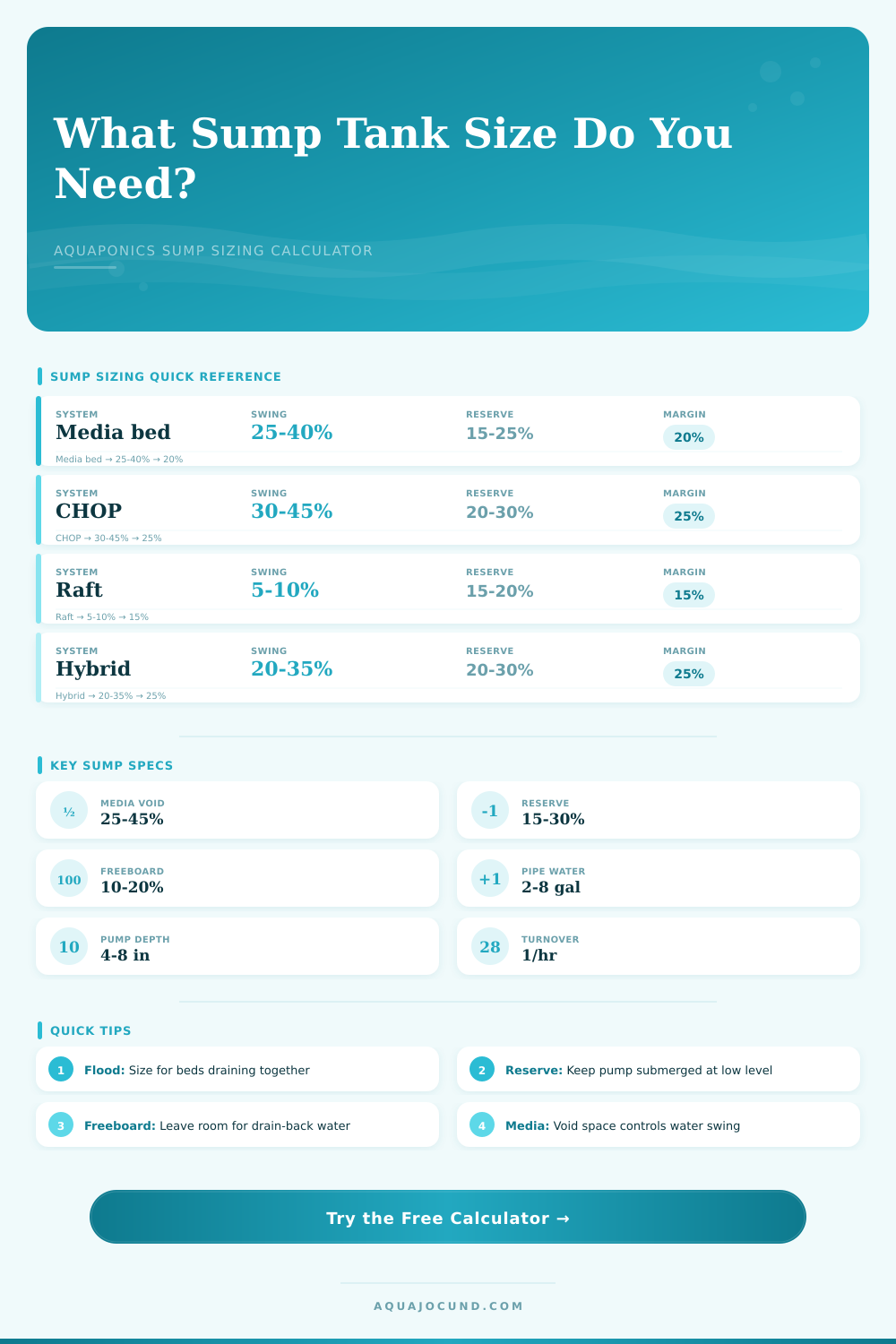
| System Type | Typical Sump Role | Water Swing | Reserve Target | Freeboard Target | Best Fit | Watch Point |
|---|---|---|---|---|---|---|
| Single media bed | Receives one bed drain cycle | Low to medium | 15% to 20% | 15% to 20% | Small patio systems | Evaporation can expose small pumps quickly. |
| Multiple siphon beds | Catches overlapping siphon dumps | High | 20% to 30% | 20% to 30% | Backyard grow rows | Assume beds may drain together unless timed. |
| CHOP layout | Keeps fish tank height constant | Medium to high | 20% to 30% | 25% to 35% | Stable fish tank systems | Sump is the main level-change tank. |
| Deep water raft | Buffers pump and filter return | Low | 15% to 20% | 10% to 20% | Leafy greens channels | Large raft tanks already store water volume. |
| NFT channels | Maintains pump supply | Low to medium | 20% to 25% | 15% to 25% | Herb and lettuce rails | Small pipe volume drains back fast. |
| Hybrid system | Balances beds, filters, and rafts | Variable | 25% to 35% | 25% to 35% | Expansion systems | Calculate every zone that can drain to sump. |
| Example System | Fish Tank | Grow Bed Load | Practical Sump Range |
|---|---|---|---|
| Barrel or tote demo | 30 to 55 gal | One 15 to 25 gal bed | 15 to 30 gal sump |
| IBC chop-and-flip | 200 to 275 gal | One or two 45 to 60 gal beds | 55 to 100 gal sump |
| Backyard media row | 300 to 500 gal | Three or four 50 gal beds | 120 to 220 gal sump |
| Greenhouse hybrid | 500 to 800 gal | Media beds plus raft tanks | 180 to 350 gal sump |
| Small production bay | 1000 gal or more | Timed zones and filters | 300 gal or larger sump |
| Low-Level Reserve | At 250 gph | At 500 gph | At 1000 gph |
|---|---|---|---|
| 15 gal reserve | 3.6 min | 1.8 min | 0.9 min |
| 30 gal reserve | 7.2 min | 3.6 min | 1.8 min |
| 60 gal reserve | 14.4 min | 7.2 min | 3.6 min |
| 100 gal reserve | 24.0 min | 12.0 min | 6.0 min |
When most people begin an aquaponics project in their back yard, they have a fish tank and a vision of eating fresh veggies grown without any soil, but all too frequently that vision ends up as confusion regarding a pump and a flooded basement. The difference between success and disaster isn’t usually the type of lettuce or the kind of fish you grow; it is called the sump.
A sump tank receive the drain down from your beds. It’s the catch-all for your system. It also provides the reserve to feed your pump and therefore absorbs shock of everything draining all at once.
Why Sump Tank Size Matters
One of the most common mistakes new growers make is getting size of their sump wrong. You could have the finest fish and the best media, but if you don’t get the size of your sump right, then your system is going to overflow. If it’s too big, then it’s going to fluctuate wildly in terms of water depth, which stress your fish and exposes your pump.
The system stays balanced because we know how to manage those numbers, but let’s take a look at why those numbers matter. First, volume displacement is the core concept here. Volume displacement means that when your grow beds is flooded with water, water flows up from your sump and fills the media. Then as the grow beds drain, that water drains back down into the sump. That difference (or flood swing) needs to be accounted for by the sump.
To help illustrate this, imagine two media bed filled with expanded clay, which has a void space of roughly forty percent. Each bed will hold quite a bit of water! The calculator accounts for the void percentage of the media you use. For example, a gravel bed displaces less water than a clay bed. Therefore, a gravel bed results in a lower swing in sump level. A pumice bed displaces even more water, and that’s where folks go wrong. Folks think that all media beds displaces the same volume, but they don’t.
You must have a pump reserve or safety net in addition to the swing. When the water in your sump reaches its lowest point, this is what keeps your submersible pump under water. Over time, the water level will drop due to evaporation, plant uptake, and minor leaks. Without accounting for this, you risk running your pump dry, overheating it, and causing it to fail.
Based off the size of your fish tank, the tool prompts for a reserve percentage. This guarantees that the pump remains submerged even during a hot day with high evaporation. Your goal is to buy yourself some insurance against a catastrophic pump failure. That’s expensive and stressful.
What about Freeboard? You might ask “what’s freeboard?” It’s the void above the water line (at the top) of your tank. If nothing else, it provides a buffer against those times when some drain back occurs unexpectedly. Think: What if the power goes out? When the pump shuts down, all that water contained in the beds, the filters, the lines, etc., will all drain back into the sump… All at once! Where does this water go? Nowhere good, unless you have freeboard.
How much do you need? There is a standard table on the page showing common percentages by type of system. However, the concept applies regardless of system type. Plan on having some room for chaos.
One thing I’ve found most challenging is what I call hybrid systems; combining both floating rafts and media beds in the same system. As you start adding/removing components, the water level can fluctuate wildly. The calculator helps you see the combination load; no more guesswork.
This is where the kind of system you’re running comes into play. If it’s a CHOP system that maintains your fish tank at a fixed elevation, then the sump is doing all the work in terms of maintaining levels, and calculation will take this into account. Likewise, if you have a deep water raft system, there isn’t as much swing since the raft tank itself contains a lot of still water. Depending on what system you choose, the calculator modifies its suggestions accordingly.
It recognizes that a traditional flood and drain bed has a different set of plumbing losses compared to a vertical tower system. And these subtleties do matter. Just a slight miscalculation here could result in a cycling pump that won’t last as long.
So what size sump should you make? To be honest, it’s a balancing act. On one hand, you need sufficient capacity to level things out but on the other, if it gets too large, the system may get sluggish and hard to control. The calculator is a good place to start but local conditions like hardware and climate will adjust the number.
So before you plumb it in forever, test it out. Use some marks on the wall of the tank to note high and low water. Observe it for a week. Let the numbers guide you but always trust what you see.
A good sump sits quietly in the background. It works for you so that you can work on growing plants and keeping your fish happy. When the water is stable, there’s less stress on you and your crop.
Begin with the calculator. You should of trusted the process. Let the water do the work.