💧 Aquaponics Bell Siphon Size Calculator
Size standpipe diameter, bell pipe, media guard, pump flow, and flood-drain timing for reliable media-bed cycling.
✅ Bell Siphon Sizing Results
| Nominal Standpipe | Approx ID | Pipe Area | Typical Bell Pipe | Media Guard | Best Bed Range | Drain Character |
|---|---|---|---|---|---|---|
| 1/2 in | 0.62 in / 16 mm | 0.30 sq in | 1-1/2 to 2 in | 2 to 3 in | Mini herb trays, 5-10 gal beds | Finicky |
| 3/4 in | 0.82 in / 21 mm | 0.53 sq in | 2 in | 3 to 4 in | 10-30 gal tabletop beds | Stable |
| 1 in | 1.05 in / 27 mm | 0.86 sq in | 3 in | 4 in | 20-70 gal media beds | Common |
| 1-1/4 in | 1.38 in / 35 mm | 1.49 sq in | 3 to 4 in | 5 to 6 in | 50-100 gal flood beds | Strong |
| 1-1/2 in | 1.61 in / 41 mm | 2.04 sq in | 4 in | 6 in | 80-150 gal beds | High Flow |
| 2 in | 2.07 in / 53 mm | 3.36 sq in | 6 in | 8 in | Large greenhouse beds | Pump Hungry |
| Media Type | Void Space Used | Typical Grain Size | Siphon Effect | Common Bed Depth |
|---|---|---|---|---|
| Expanded Clay Pebbles | 40% | 8-16 mm | Easy bell break and fast refill response | 10 to 12 in |
| Lava Rock | 35% | 10-20 mm | Good bacteria area, moderate water volume | 12 in |
| Washed Gravel | 30% | 6-12 mm | Lower water volume but heavier root blockage risk | 12 in |
| Expanded Shale | 38% | 8-16 mm | Balanced flood volume and drainage | 10 to 12 in |
| Pumice | 42% | 8-20 mm | High void space and quick air return | 10 in |
| Pea Gravel | 28% | 5-10 mm | Can slow flow through the guard slots | 12 in |
| Clay / Lava Blend | 37% | 8-20 mm | Moderate drain volume with good startup | 12 in |
| Mineral Media + Biochar | 43% | 6-16 mm | High water capacity, keep fines out of bell | 10 to 12 in |
| System Style | Bed Dimensions | Media Volume | Flood Water | Standpipe | Bell Pipe | Typical Pump |
|---|---|---|---|---|---|---|
| Counter herb tray | 24 x 12 x 8 in | 10 gal | 3-4 gal | 3/4 in | 2 in | 90-140 gph |
| 20 long lettuce | 30 x 12 x 10 in | 16 gal | 5-6 gal | 3/4 in | 2 in | 120-180 gph |
| 29 gal media bed | 30 x 18 x 10 in | 23 gal | 7-9 gal | 1 in | 3 in | 150-250 gph |
| 40 breeder greens | 36 x 18 x 12 in | 34 gal | 11-14 gal | 1 in | 3 in | 220-330 gph |
| 55 gal loop bed | 48 x 24 x 12 in | 60 gal | 20-24 gal | 1 in | 3 in | 350-500 gph |
| 75 gal tomato bed | 48 x 30 x 14 in | 87 gal | 27-34 gal | 1-1/4 in | 4 in | 450-650 gph |
| IBC top bed | 48 x 40 x 12 in | 100 gal | 32-40 gal | 1-1/4 in | 4 in | 550-750 gph |
| Greenhouse run | 96 x 30 x 12 in | 150 gal | 48-60 gal | 1-1/2 in | 4 in | 800-1100 gph |
| Cycle Target | Fill Time | Drain Time | When It Fits | Watch For |
|---|---|---|---|---|
| Fast oxygen cycle | 8-10 min | 4-6 min | Warm water, heavy roots, high oxygen demand | Short cycling if pump is too strong |
| Standard media bed | 10-15 min | 5-8 min | Most backyard flood-and-drain aquaponics | Slow bell break if drain tail is submerged |
| Gentle seedling bed | 15-20 min | 8-10 min | Small plants and shallow roots | Dry pockets if media is coarse |
| Large flood bed | 20-30 min | 8-12 min | IBC tops and long greenhouse beds | Need sump capacity for full drain volume |
| High solids bed | 10-15 min | 4-7 min | Systems relying on media for solids capture | Clogged guard holes and root mats |
| Low pump system | 20-30 min | 6-10 min | Light fish load and low head height | Siphon may not start cleanly |
| Part | Rule Of Thumb | Purpose | Adjustment Clue |
|---|---|---|---|
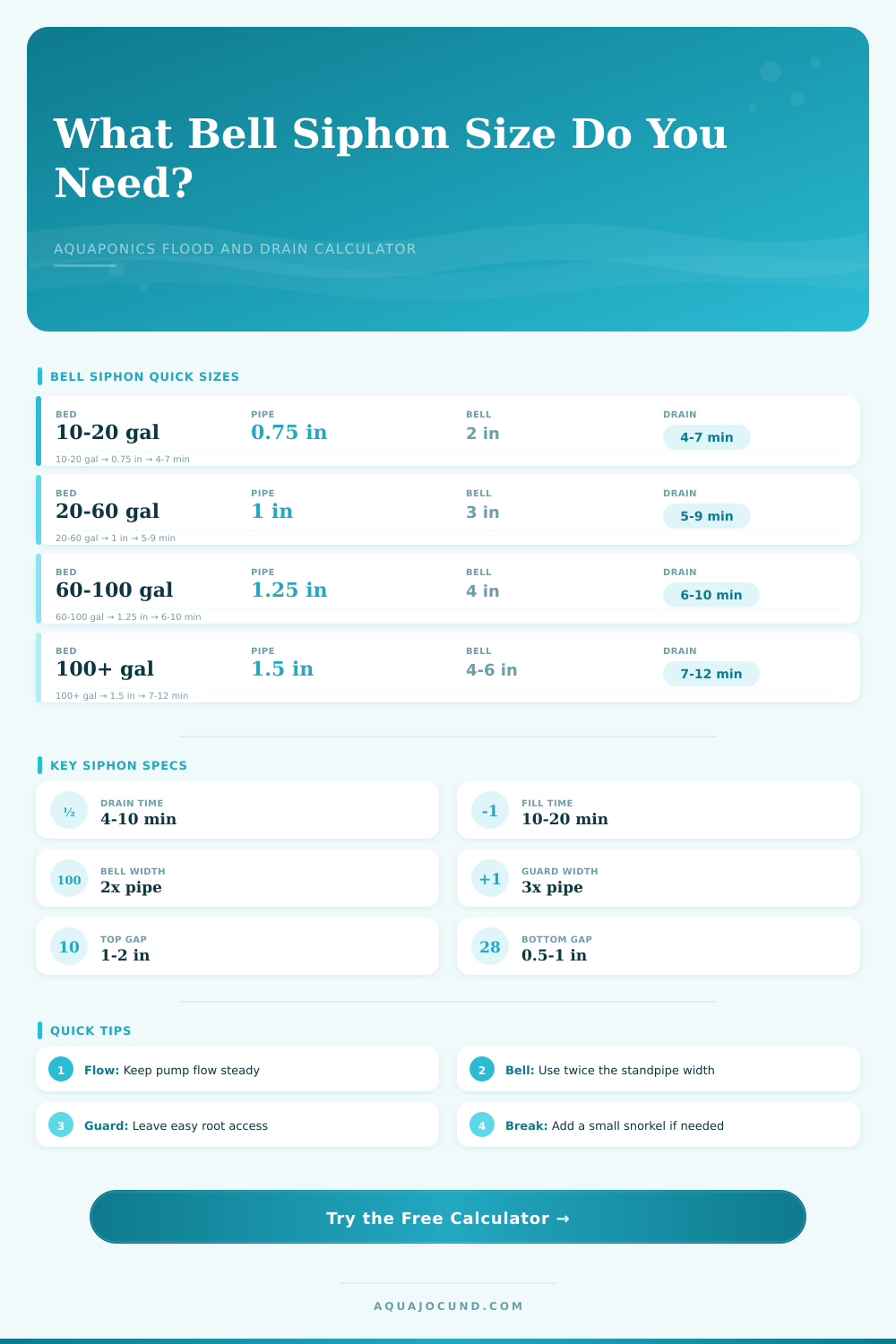
| Bell pipe diameter | About 2x standpipe | Leaves enough annular area for a stable siphon draw | Use larger bell if startup is weak |
| Bell bottom gap | 0.5 to 1 in / 13 to 25 mm | Lets water enter under the bell without choking flow | Raise bell if drain pulses or stalls |
| Top air gap | 1 to 2 in / 25 to 50 mm | Keeps the cap above the peak flood line | Add height if water splashes into cap holes |
| Media guard diameter | 3x to 6x standpipe | Keeps roots and media away from moving water | Go wider for tomatoes or mint |
| Guard slots | More open area than pipe area | Prevents the guard from becoming the restriction | Add slots if water outside guard sits higher |
| Drain tail | Short drop with an air break | Helps siphon start and break repeatably | Vent or shorten if siphon never stops |
You hear it: the tell-tale sign something’s happening. A rapid burst of water noise; a gurgling (stops suddenly), nothing for a second or two, then a torrent comes rushing out. Yes! The bell siphon did its job, which is exactly why you paid good money for it. But it is also why many first-time aquaponic grower stay up late worrying if they got it right. It sounds like a frustrated parent trying to teach a difficult child how to behave.
Bell siphons controls the heartbeat of your media bed, keeping the air and food flowing that sustains your plants and fish. And when the beat gets off-tempo, so does the entire system.
How to Set Up Your Bell Siphon
Don’t let yourself think it’s as simple as buying some PVC and a pipe and gluing it together. The devil is in the details, and sizing those component is where the fight is lost by most amateur home grower before they even fill them with water.
You only need to know what kind of media you’re using and how big your bed is, then just plug it into the calculator above and it will do all that fancy water flow stuff for you. You don’t have to guess if your pump will keep up with how much water flows out. That’s typically how most people new to this choose their pumps: they go by overall tank volume instead of how quickly it needs to top off the bed before the siphon kicks in. Too slow and your siphon never primes and you have exposed roots in standing water. Too fast and you run the risk of stressing your plant roots with rapid fluctuations as well as sucking all oxygen out of your media.
The calculator predicts the right pump size and how long it’ll take to drain so the water doesn’t sit around aimlessly. It moves with purpose.
There are also some key details regarding the physical shape of the siphon itself. How big does the bell have to be? The bell size determine how smoothly the air exchange happens, but if there’s too much space, the siphon might fail to start. How large should the standpipe be? That will dictate the starting point of the cycle. If there’s too little distance between the bell wall and the standpipe then you won’t be able to push the air out; if there’s too much distance then the siphon won’t get going. There’s a standard set of ratios (table found on the page) that shows that a bell-to-standpipe ratio of about two-to-one seem to be the sweet spot for most systems. This is one small mechanical detail that will dictate whether your siphon runs like clockwork or requires constant babysitting. An overly wide bell may not break the vacuum and a tight bell can be finicky.
Another heavy hand in the calculations is the media you’re using. A cubic foot of gravel or lava rock has a different void space than expanded clay pebbles, meaning the media holds different amounts of water. This is taken into account by the calculator and it adjust the estimated flood volumes accordingly (you won’t overfill the bed and leave the roots dry). When you’re focused on the pipes, it’s easy to forget that the media itself is the real engine that processes nutrients. So if your pump was sized around gravel, but now you’ve switched to clay, you’ll be waiting twice as long before the cycle completes. And all of that waiting time equals lost efficiency. Lost oxygen.
A bell siphon is never really a plug-and-play situation. Chances are, you’re going to want to go through a wet test cycle with clean water to adjust the height of the stand pipe and the pump flow until things gets consistent. And this is non-negotiable. Wet testing gives you time to hear that tell-tale gurgle and watch the water drop cleanly…without any dribble. Get the mechanical rhythm dialed in, then add some fish. Then it’s a much less risky bet.
Don’t forget: you’re not just moving water, you’re trying to move it predictably. Once the siphon gets going you stop thinking about it and start thinking about when you’ll be harvesting from it. You can hear that rhythmic draining in the background. That’s the sound of a system finally on your side.