🐟 Aquaponics Fish Stocking Density Calculator
Estimate safe fish count, standing biomass, tank load, and daily feed pressure for a cycled aquaponics system.
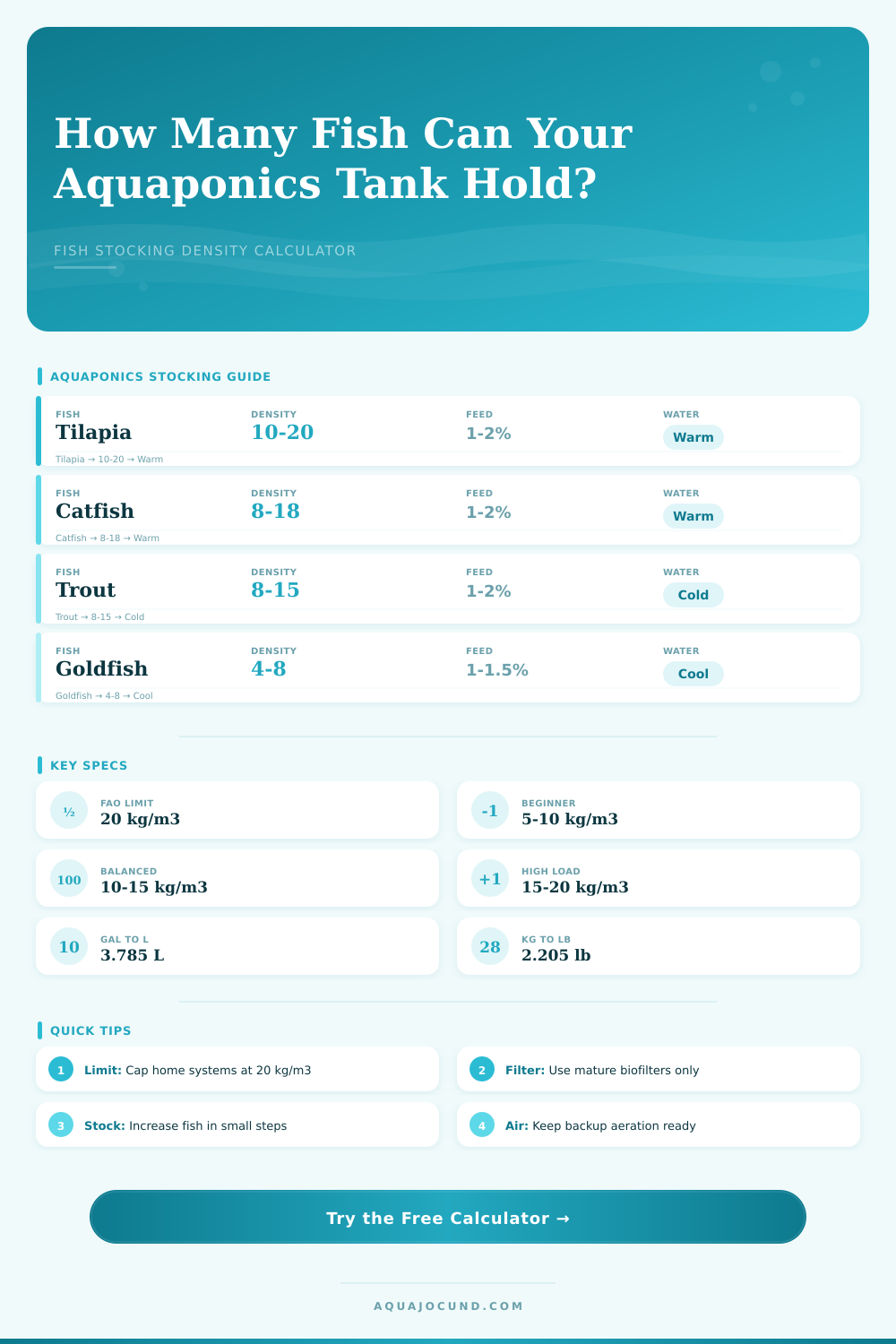
| Fish Type | Home Density | Feed Rate | Temperature | Aquaponics Notes |
|---|---|---|---|---|
| Tilapia | 10-20 kg/m³ | 1.0-2.0% BW | Warm, 75-86°F | Tolerant, fast grower, common in warm systems |
| Channel Catfish | 8-18 kg/m³ | 1.0-2.0% BW | Warm, 72-82°F | Hardy, but solids load is heavy near harvest |
| Rainbow Trout | 8-15 kg/m³ | 1.0-2.0% BW | Cold, 50-65°F | Needs high dissolved oxygen and cool water |
| Yellow Perch | 8-15 kg/m³ | 1.0-1.8% BW | Cool, 68-75°F | Moderate density; watch grading and size spread |
| Bluegill / Sunfish | 6-12 kg/m³ | 1.0-1.6% BW | Warm, 70-82°F | Good small-system fish when kept lightly stocked |
| Goldfish | 4-8 kg/m³ | 1.0-1.5% BW | Cool, 65-75°F | Useful nutrient fish; avoid crowding fancy types |
| Koi | 3-7 kg/m³ | 0.8-1.5% BW | Cool, 65-75°F | Large waste producers; needs more water volume |
| Small Ornamentals | 2-6 kg/m³ | 1.0-2.5% BW | Species-specific | Best for display aquaponics and herb systems |
| Band | kg/m³ | lb/gal | System Readiness |
|---|---|---|---|
| Very Light | Under 5 | Under 0.042 | Easy for display or new systems |
| Beginner | 5-10 | 0.042-0.083 | Stable with cycled media and air |
| Balanced | 10-15 | 0.083-0.125 | Watch solids and nitrate trend |
| Experienced | 15-20 | 0.125-0.167 | Demanding filtration and aeration |
| Above Small-System Cap | Over 20 | Over 0.167 | Risky without advanced RAS design |
| Setup | Volume | Balanced Biomass | Example Fish Weight | Estimated Count |
|---|---|---|---|---|
| 10 gal herb display | 10 gal / 38 L | 0.45 kg / 1.0 lb | 0.15 lb | 6 small fish |
| 20 long nursery | 20 gal / 76 L | 0.9 kg / 2.0 lb | 0.25 lb | 8 juveniles |
| 29 gal media bed | 29 gal / 110 L | 1.3 kg / 2.9 lb | 0.35 lb | 8 fish |
| 40 breeder greens | 40 gal / 151 L | 1.8 kg / 4.0 lb | 0.75 lb | 5 fish |
| 55 gal mixed bed | 55 gal / 208 L | 2.5 kg / 5.5 lb | 1.0 lb | 5 fish |
| 75 gal grow-out | 75 gal / 284 L | 3.4 kg / 7.5 lb | 1.1 lb | 6 fish |
| 125 gal raft tank | 125 gal / 473 L | 5.7 kg / 12.5 lb | 1.0 lb | 12 fish |
| 275 gal IBC | 275 gal / 1041 L | 12.5 kg / 27.5 lb | 1.1 lb | 25 fish |
| 500 gal greenhouse | 500 gal / 1893 L | 22.7 kg / 50.0 lb | 1.25 lb | 40 fish |
| Condition | Multiplier | Use When | Density Effect | Action |
|---|---|---|---|---|
| New biofilter | ×0.45 | Cycle is young or ammonia appears | Major reduction | Stock lightly and feed slowly |
| Young biofilter | ×0.70 | Plants growing, bacteria still building | Moderate reduction | Increase biomass over weeks |
| Mature biofilter | ×1.00 | Stable ammonia and nitrite at zero | Normal target | Use calculated result |
| Oversized biofilter | ×1.10 | Extra media, solids removal, clear flow | Small increase | Still respect fish welfare |
| Backup aeration | ×1.10 | Redundant pump or power backup | Improves oxygen cushion | Helpful at warm temperatures |
| Basic aeration | ×0.75 | Single small air stone or low turnover | Reduces safe biomass | Add air before adding fish |
Count fish at harvest weight: small fingerlings can make a tank look understocked, but the biofilter must handle the biomass they become.
Allow test results to overrule the calculator: ammonia, nitrite, low oxygen, or stressed fish means reduce feeding and delay new stock.
Most home aquaponic systems fail because tank is too crowded. Guess what happens if you don’t pay attention to the stocking density limits? Dead fish.
It’s tempting to think that a little barrel could support several fishes. Wrong! How many fishes are there in a tank doesn’t matter. What matters is how much waste can be processed by bacteria without crashing system.
How Many Fish to Keep
To help you avoid guessing how much your biofilter can sustain, the calculator turns your species choices and tank dimensions into a safe biomass limit. The most important thing is kilograms per cubic meter. Light load equals five kg/m3; heavy load are twenty.
Novices tend toward heavier side for increased harvest. This causes overworking. The banding chart above demonstrates which densities falls into demanding work zones and which are easy to maintain. To keep things balanced in home system, stay within the middle. Balanced means making something useful, food, without having to test water constantly. Find out where you lie on that scale.
Aquaponic systems work different than most tanks: they is powered by the fish. Overload them and system stalls.
The calculator also requires the percentage of fill with usable water. Why? Things displace water in an aquaponics system. Grow beds filled with media, pipes, and rafts on the water’s surface all take up space that makes some water unusable. What if you thought you had fifty-five gallons, but really only have forty? That ten gallons make a big difference. That means you need less water to dilute the waste. To account for this, the tool lets you change the fill level so it can still give accurate results.
The density limit is based off species. Warm-water species like tilapia are hearty; coldwater species such as trout are delicate. They requires cold, oxygenated water. The calculator factors this into the limit. Goldfish generate more waste per body weight then other species. So, the calculator reduces the limit for goldfish. Channel catfish have a heavier solids loading. That is also factored in.
The amount fed affects the feed rate. You don’t feed the fish, you feed the bacteria. Overfeeding kills the bacteria. Killing the bacteria kills the fish. A chain reaction begin with excess pellets.
Most people freak out over biofilter maturity. You can’t put the same load on a brand-new tank as you could of a year-old tank. To account for this, the calculator has a maturity selector. It applies a multiplier that reduces your safe stock number based on filter age. It’s conservative but it must be that way. Media doesn’t becomes colonized with bacteria overnight. It takes time. Slowly stocking gives the bacterial colony an opportunity to grow and keep pace with demand. Ammonia spikes happen when you rush things.
Aeration is a safety net. Even with a perfectly stocked tank, a power outage or an air stone clog can cause failure. The tool helps you consider aerator reliability. If your redundancy includes extra pumps, then it is a little more dense. If you have basic air stones, then you must include a bigger safety margin. It’s about risk management. You want your dissolved oxygen levels sufficient for both bacteria and fish.
Check out the preset buttons to see normal tanks. Those are real world loads of typical tank sizes. Tweak inputs with your own equipment details. You get a fish count along with a day’s feed limit. Feed no more. Observe your test results. Any sign of ammonia? You’ve fed beyond what system can handle. Back off on the feeding and let it settle.
That’s where the calculator starts you out. Observations keeps the system alive. Balancing isn’t a number but a habit.