Water Change Frequency for Nitrate Calculator
Estimate how many days your aquarium can go between water changes before nitrate reaches your limit, using tank volume, source nitrate, bioload, plants, and change size.
Calculation Breakdown
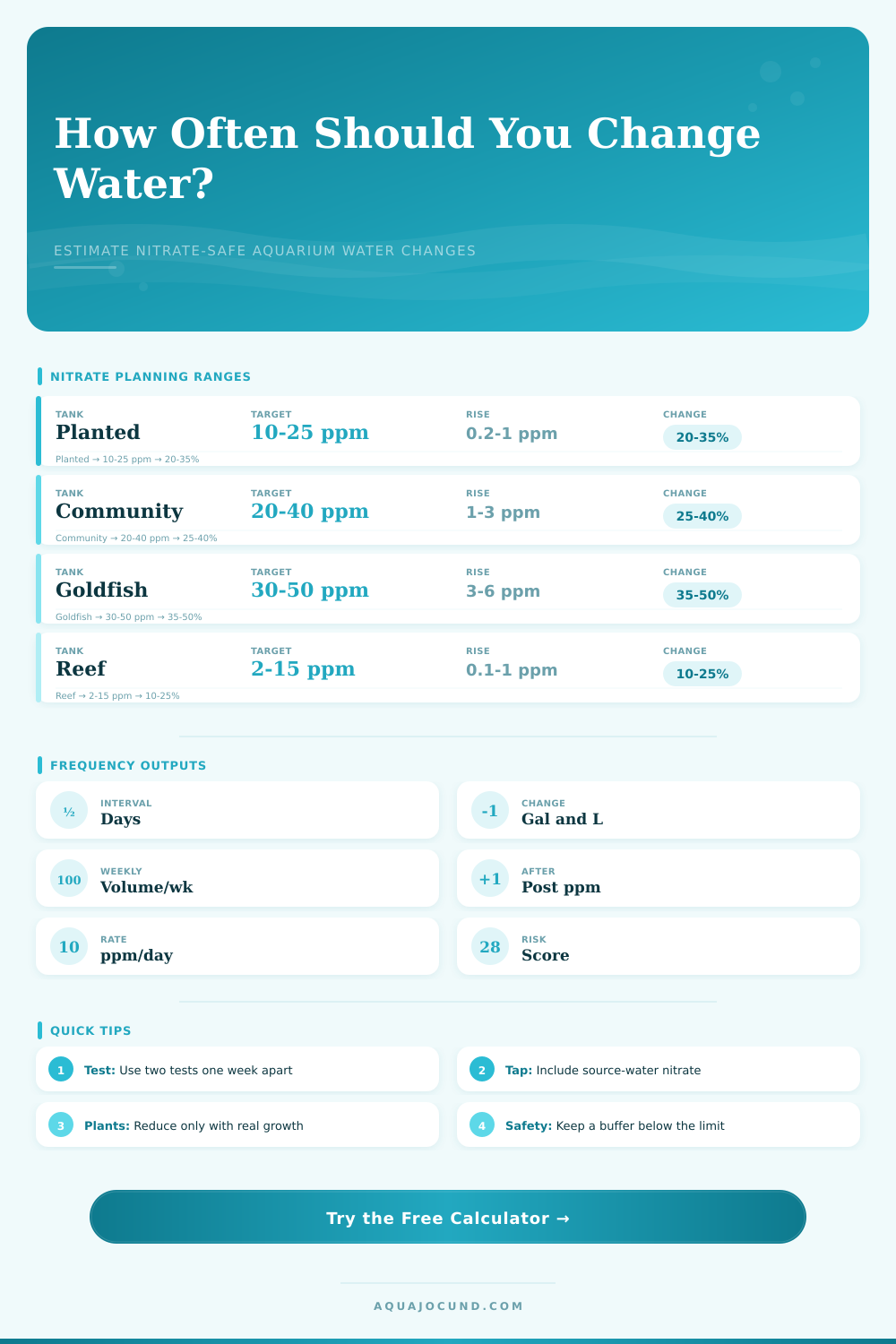
| Tank Profile | Usual Net Rise | Common Limit | Typical Water Change |
|---|---|---|---|
| Light planted or shrimp nano | 0.1 to 0.8 ppm/day after plant uptake | 10 to 25 ppm depending on livestock | 15% to 30% every 7 to 21 days |
| Moderate freshwater community | 1 to 3 ppm/day with normal feeding | 20 to 40 ppm for most hardy community fish | 25% to 40% every 5 to 14 days |
| Goldfish, large cichlids, turtle, predator | 3 to 8 ppm/day if heavily fed | 30 to 50 ppm, lower when possible | 35% to 60% every 3 to 10 days |
| Marine FOWLR | 0.5 to 2 ppm/day depending on export | 10 to 30 ppm for many fish-only systems | 10% to 25% every 7 to 21 days |
| Mixed reef or SPS reef | 0.05 to 1 ppm/day with skimming/export | 2 to 15 ppm based on coral goals | 5% to 20% every 3 to 14 days |
| Tank Size | Typical Dimensions | Nominal Volume | 30% Change Volume |
|---|---|---|---|
| 5 gal nano | 16 x 8 x 10 in / 41 x 20 x 25 cm | 5 gal / 19 L | 1.5 gal / 5.7 L |
| 10 gal standard | 20 x 10 x 12 in / 51 x 25 x 30 cm | 10 gal / 38 L | 3 gal / 11 L |
| 20 long | 30 x 12 x 12 in / 76 x 30 x 30 cm | 20 gal / 76 L | 6 gal / 23 L |
| 40 breeder | 36 x 18 x 16 in / 91 x 46 x 41 cm | 40 gal / 151 L | 12 gal / 45 L |
| 75 gal display | 48 x 18 x 21 in / 122 x 46 x 53 cm | 75 gal / 284 L | 22.5 gal / 85 L |
| 125 gal long | 72 x 18 x 21 in / 183 x 46 x 53 cm | 125 gal / 473 L | 37.5 gal / 142 L |
| Calculated Interval | What It Usually Means | Adjustment to Consider | Testing Check |
|---|---|---|---|
| 1 to 3 days | Nitrate rise is very fast or the limit is already close. | Increase change percent, reduce feeding, or add export. | Retest source and tank nitrate with a second kit if surprising. |
| 4 to 7 days | Weekly maintenance is likely appropriate. | Keep changes consistent and avoid skipping weeks. | Test before the next change until the trend is stable. |
| 8 to 14 days | Normal community or planted cadence. | Round down to a routine day that is easy to remember. | Check nitrate monthly after the schedule is proven. |
| 15 to 30 days | Low nitrate production or strong plant/export support. | Still inspect filters, evaporation, and mineral buildup. | Verify nitrate, phosphate, and alkalinity before stretching further. |
Have you ever wondered why your tank looks cloudy? Why are my fish acting sluggish?” Then you do water changes like a religion. Without having a clue what’s going on, you reach for that bucket and more often than not end up either over-working or spiking your ammonia because you guessed wrong.
Once you enter how much nitrate rises, as well as your tank volume, the calculator above figures out the math for you. You don’t need to guess at conversions and coefficients, and you won’t have to base your routine on how something feels without understanding why. That’s chemistry, not habit.
How to Manage Nitrate Levels Correctly
The last step in the nitrogen cycle; nitrate; is what’s leftover once the bacteria has broken down the uneaten food and fish waste. It gets used by algae and plants, though too much can be stressful for your fish over time.
Not all tanks accumulate nitrate at the same rate: A densely planted tank will scrub it away, whereas a heavily stocked goldfish bowl will spike it fast. That’s one reason a generic “change water every week” schedule doesn’t work. Changing water weekly doesn’t make sense (it’s just needless stress on your livestock) if your tank has such heavy plant growth that there isn’t much nitrate produced. Conversely, you don’t want to let the nitrate build slowly in a low-tech tank either; that’s harder to fix than an immediate spike.
The inputs reflect what’s actualy being introduced into your own system, which is its true biological load. Your choice of bioload profile informs the algorithm about the quantity of waste it should assume your tank produces. A small nano with just shrimps produces less waste than a heavily populated community tank with cichlids. Because of this, the feeding intensity parameter adjusts accordingly.
No amount of water changes will offset overfeeding which, incidentally, is one of the most common beginner mistakes. To make up for overfeeding, people start increasing their water change volume. That doesn’t really solve anything. You need to feed only what the fish cannot eat within two minutes. If you dump food, the calculator assumes you’re not doing that. Its result will therefore be overly optimistic.
Another thing people get tripped up on is source water quality. Many of us use tap water. And if that’s sourced in an area with agriculture, there may be some nitrate present in your tap water. Replacing half your tank volume with tap water won’t reduce your nitrates as much as you expect if your tap water currently contains twenty parts per million of nitrate. This is why the tool asks about the nitrate content of your source water.
Ignore this and you could assume you’ve reset your clock to zero when really you have only swapped out slightly dirty water with slightly less dirty water. Doesn’t sound like much, but it’s enough that the water never quite clears over time due to this baseline buildup.
However, you get your answer back which includes a suggested interval. But you want to consider this an upper limit, rather than a goal. If the result is say ten days, make it eight or nine. The safety buffer feature in the tool allows you to do this by adding some wiggle room.
The nitrate test isn’t exact, different kits may differ, and no test is perfect. One day you get 40 parts per million, the next day it’s 35. Depending on lighting, test kit reagents age. Because there is a margin of error, you aren’t actually at the limit. You have some breathing room so if you miss a day here or there you don’t crash the tank.
Now corals are much more finicky than most freshwater fish… A few parts per million of something can bleach them or stop their growth. So it’s up to the reef keeper to be even more strict with the tool because they can set lower limits for their needs. The idea is to get things stable in a reef tank. Nitrate levels change more often than you want temperature or salinity to change, which is why large, infrequent water changes can shock the system. Often times, smaller but more regular changes are preferred over huge monthly drains. The calculator will show you how much you really need to change to remain inside your tight safety zone.
Plant tanks are also different because healthy plants will compete with algae for nitrate. A plant’s uptake of nitrate is captured in the nitrate control profile input. The denser the plant mass, the greater the reduction in nitrate increase per day. But when plants lack nutrients or are struggling, then they won’t take up nitrate anymore. So unless plants are doing well, the calculator assumes healthy plants, meaning you may have to change water more frequently than it says if the plants is dying or the tank is bare.
Ultimately, it’s about consistency. It’s not better to frantically manage the situation when a problem develops, but rather to have a set schedule to maintain your nitrates in the safe zone.
Testing is still necessary too. The tool uses averages to predict, but every tank is different. Take the suggested frequency as guidance and then test it against your particular setup. The key is understanding what we are measuring, and once that becomes clear, the rest will make sense. No more guessing, just management.