Ammonia Toxicity by pH Calculator
Estimate toxic un-ionized ammonia from TAN, pH, temperature, salinity, tank volume, and livestock sensitivity.
Ammonia Toxicity Estimate
| Water | Temp | pH 7.5 | pH 8.0 | pH 8.5 | pH 9.0 |
|---|---|---|---|---|---|
| Cool freshwater | 68°F / 20°C | 0.40% | 1.26% | 3.88% | 11.2% |
| Tropical freshwater | 78°F / 25.6°C | 0.56% | 1.76% | 5.36% | 15.2% |
| Warm freshwater | 86°F / 30°C | 0.74% | 2.31% | 6.96% | 19.4% |
| Marine, 35 ppt | 78°F / 25.6°C | 0.66% | 2.06% | 6.24% | 17.5% |
| Calculated NH3-N | Typical Risk | Best Fit | Response Priority |
|---|---|---|---|
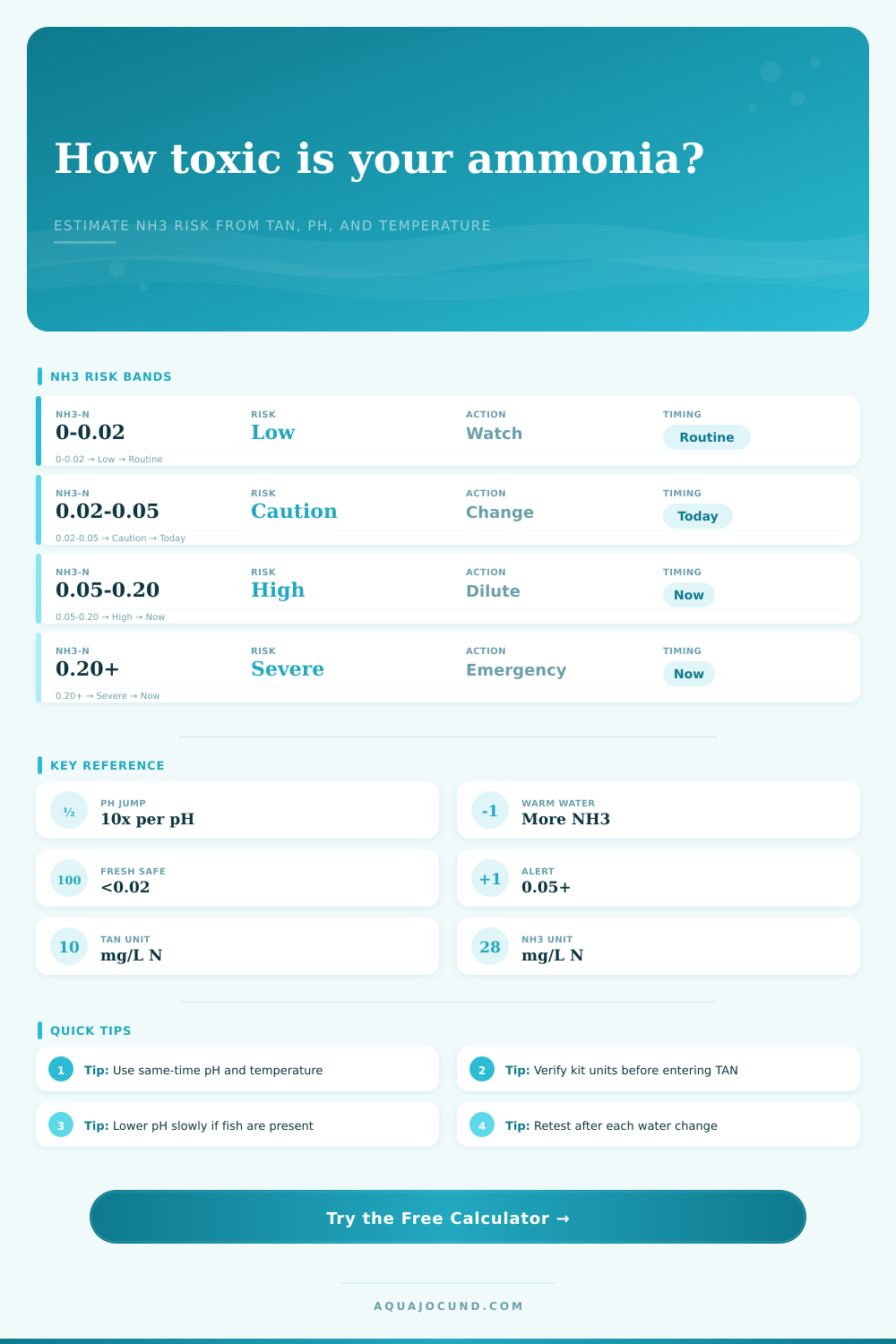
| 0.000-0.020 mg/L | Low | Mature tanks with zero or trace TAN | Monitor, retest if livestock act stressed |
| 0.020-0.050 mg/L | Caution | Fry, shrimp, quarantine, softwater species | Reduce feeding, dilute, confirm source |
| 0.050-0.200 mg/L | High | Most aquarium fish under active exposure | Water change, bind TAN, increase aeration |
| Above 0.200 mg/L | Severe | Cycle crash, shipping, overstocked holding | Immediate emergency dilution and retesting |
| Tank Name | Dimensions | Nominal Volume | Why It Matters |
|---|---|---|---|
| 10 gallon | 20 x 10 x 12 in | 38 L | Small TAN spikes concentrate quickly |
| 20 long | 30 x 12 x 12 in | 76 L | Good gas exchange but shallow volume |
| 40 breeder | 36 x 18 x 16 in | 151 L | Wide footprint helps dilution planning |
| 75 gallon | 48 x 18 x 21 in | 284 L | Marine pH makes low TAN more serious |
| 125 gallon | 72 x 18 x 21 in | 473 L | Large fish can produce TAN fast |
| Input | Calculator Treatment | Useful Range | Common Mistake |
|---|---|---|---|
| TAN | Converted to mg/L as nitrogen before NH3 fraction | 0-8 mg/L | Mixing NH3/NH4 and TAN-N units |
| pH | Raises NH3 fraction logarithmically | 6.0-9.5 | Using morning pH with evening TAN |
| Temperature | Converted to Kelvin for pKa | 50-90°F | Ignoring heat during summer or shipping |
| Salinity | Applies ionic strength pKa adjustment | 0-35 ppt | Leaving marine tanks at 0 ppt |
The water’s crystal clear. Everything look good. The fish swims around normaly. You are at your tank and use a test strip that reads no ammonia. Great! You breathe a sigh of relief.
But then you forget that you wanted some driftwood and overdose on some buffering agent, which cause an almost unnoticeable increase in pH (a mere half of one unit). Now that change you can’t see has converted harmless ammonium to deadly ammonia gas. Silent. Fast. It kill your livestock without any warning other than a sudden, unexplained collapse.
Why Ammonia Levels Can Be Dangerous
The calculator do all that complicated chemistry for you, so you don’t need to memorize the constants involved. However, knowing what the variables are is just as important then the result.
This all boils down to this, total ammonia nitrogen, alone, is a red herring. It show how much nitrogen waste is in your aquarium water. What it doesn’t reveal is potential danger level of that waste.
The latter relates directly to the proportion of un-ionized ammonia versus This refers to ionized ammonium. Ionized ammonium. Essentials, only former is dangerous, burning gill tissue and messing with osmoregulation.
This split is driven almost entirely by pH and temperature, though salinity also affects the math via ionic strength. Because the relationship are logarithmic, as pH increases, an increasing amount of total ammonia converts to un-ionized ammonia. Even small changes in pH, i.e., 0, have a significant impact on the toxic fraction.
That seem trivial if you aren’t familiar with chemistry, until you consider that a planted freshwater tank operate at a lower pH than a typical tropical reef tank. This baseline difference create a built-in disadvantage for marine aquarists even when both tanks exhibit same low levels of ammonia. Constant vigilance is required.
The second factor (though very important) is temperature. Ammonia becomes more and more toxic with warmer water and warm water also has less oxygen. So even if two tanks has the same pH, the goldfish bowl at 60 degrees will have fewer problems than the fish tank at 86 degrees.
Why? Because the percentage of ammonia (the most toxic form) is always going to be smaller in the cooler water. Ponds experience a lot of summer crashes for this exact reason. The fish’s metabolism rise as the water warms from the sun, and the chemistry change suddenly to become more and more toxic. You’re fighting a three-front battle now and it’s one you’re likely losing.
This is where the tool help by allowing you to enter your temperature. It will then adjust the pKa value used in its calculations to match. Otherwise, you’re just guessing.
The other thing that comes as a surprise are salinity. The fact is that higher salt levels in marine aquariums somewhat reduce the amount of toxic ammonia you get versus fresh water. This doesn’t mean it’s safe, but it shifts the math and the calculator takes into account the ionic strength. Most hobbyists don’t consider it because they think “ammonia is ammonia”. Not so. The form alters.
It doesn’t matter what it says if you don’t know what to do when it does. First thing, if the calculator indicates a high or caution band for the risk level, don’t reach for the chemical bottle to mask the ammonia. Masking agents like these temporarily bind the ammonia but DO NOT eliminate the nitrogen load. They only give the biofilter time to catch up. But if the biofilter can’t catch-up, the ammonia breaks free of the masking agent and kills your fish regardless.
Dilution is the solution. A twenty-five percent water change using dechlorinated tap water immediately reduces both the toxic fraction and total ammonia. This is the most reliable emergency intervention there is.
Tolerance for error depend on your livestock. A hardy goldfish can withstand more than a shrimp or fry. To change the risk assessment based off your livestock, use the calculator to choose your livestock profile. If you are keeping sensitive species, treat a caution reading as a high-risk situation. It is better to be safe than sorry when it comes to losing a breeding batch.
It is the biggest one. You’re testing at different times. Temperature changes during the day. PH does too. If you test pH in the evening, then ammonia in the morning, you have a false picture.
You must take all three at once from the same sample of water. Then use it to plug into the math that will tell you whether you’re waiting for a disaster, or whether your existing water change schedule is enough.