Shrimp KH Target Dose Calculator
Estimate the carbonate hardness dose, daily split, and equivalent alkalinity needed to move shrimp water from current KH to a safer target.
KH Dose Estimate
| Product category | Calculator strength | Unit | Best use |
|---|---|---|---|
| Dry shrimp KH+ label | 1.00 dKH per unit per 10 gal | g | Label-matched remineralizing |
| Sodium bicarbonate powder | 0.88 dKH per unit per 10 gal | g | Simple KH-only correction |
| Potassium bicarbonate powder | 0.74 dKH per unit per 10 gal | g | KH with potassium contribution |
| Concentrated KH+ liquid | 0.50 dKH per unit per 10 gal | ml | Small measured daily changes |
| Gentle liquid buffer | 0.25 dKH per unit per 10 gal | ml | Nano tanks and cautious dosing |
| Shrimp GH/KH+ mineral mix | 0.55 dKH per unit per 10 gal | g | RO water remineralizing |
| High strength alkalinity powder | 1.20 dKH per unit per 10 gal | g | Large systems with careful scale use |
| Shrimp type | Common KH range | Risk when too low | Risk when too high |
|---|---|---|---|
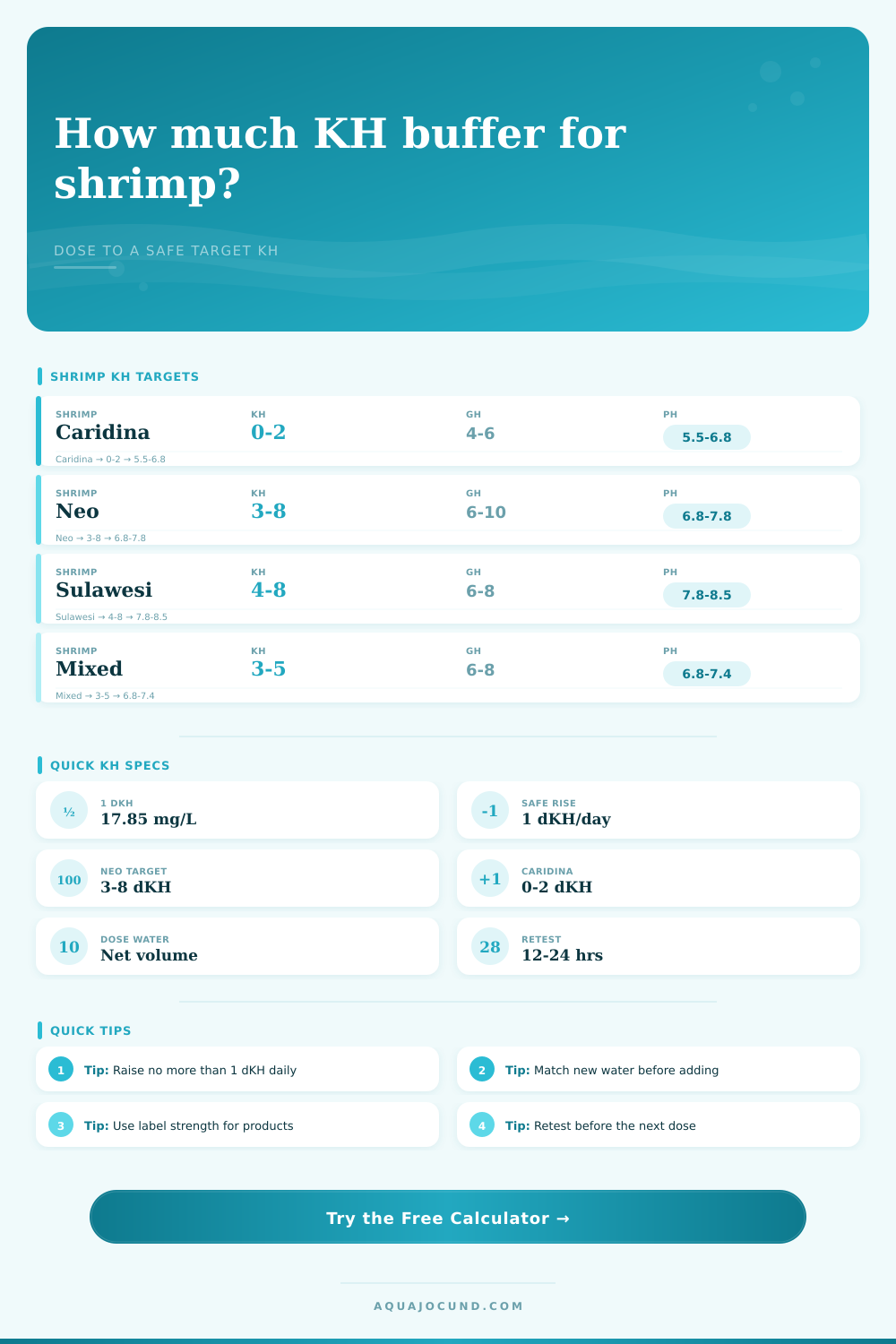
| Bee, crystal, Taiwan bee Caridina | 0 to 2 dKH | pH swings if buffering is exhausted | Reduced breeding in soft-water lines |
| Neocaridina cherry shrimp | 3 to 8 dKH | Weak pH reserve after water changes | Harder molts for some soft lines |
| Amano shrimp | 2 to 8 dKH | Stress during acidic dips | Usually tolerant, but avoid jumps |
| Sulawesi shrimp | 4 to 8 dKH | Unstable high-pH environment | Mineral imbalance if overdosed |
| Mixed community shrimp | 3 to 5 dKH | Low reserve for fish load | May miss Caridina preferences |
| Tank name | Typical dimensions | Net water | 1 dKH as NaHCO3 |
|---|---|---|---|
| 5 gal nano | 16 x 8 x 10 in | 4.2 gal / 16 L | 0.48 g |
| 10 gal colony | 20 x 10 x 12 in | 8.7 gal / 33 L | 0.99 g |
| 20 long rack | 30 x 12 x 12 in | 17 gal / 64 L | 1.93 g |
| 29 gal community | 30 x 12 x 18 in | 25 gal / 95 L | 2.84 g |
| 40 breeder | 36 x 18 x 16 in | 34 gal / 129 L | 3.86 g |
| 55 gal display | 48 x 13 x 21 in | 46 gal / 174 L | 5.22 g |
| 75 gal planted | 48 x 18 x 21 in | 64 gal / 242 L | 7.26 g |
Yes, you can have an awesome hardscape and cycle your bio-filter for a week…or two…but if the carbonate hardness (KH) decrease overnight, you could lose half your colony before realizing what happened. It’s happened to most anyone who begins keeping *Neocaridina* or *Caridina* shrimp. Your water appears clear and the shrimp is all out and about. You might ask, “what could possibly be wrong?”
But clear water does not mean your water are chemically stable. KH serves as your buffer against swings in pH due to changes in water chemistry (e.g., doing a water change; buildup of organics). When there is no buffer, you leave your shrimps exposed to chemical instability.
How to Change KH Safely for Shrimp
Enter the calculator above. You simply enter your target parameters and your tank dimensions, and it will run the math for you. No guesswork required on how much buffer you should of add.
Attempting to immediately increase KH is perhaps the single largest error beginner keepers commit. Let’s assume your tap water is soft and you want to end up at four degrees of German hardness. You might be tempted to add enough baking soda to get there all at once. Don’t.
Shrimp have a soft exoskeleton. They’re invertebrates and they depends on stable osmotic pressure. Just like a pH crash, a sudden rise in mineral content also shock their system.
That’s where the tool comes into play. Instead of dumping it all in at once, it splits total dose among days. At most, that’s about one degree per day, which is safe limit. Pacing it this way ensures gradual adjustment for the living things in the tank. What would otherwise be a deadly shock becomes an acclimation period that can be managed.
Knowledge of where you start is half the equation. Lots of folks think their tap water is completely unbuffered if it’s soft tasting. Unbuffered doesn’t mean soft water. Each tap supply will be very different based off its source and season. That’s why you must test with a liquid reagent kit every time before making any adjustments.
Strips aren’t accurate on the lower end (where we shrimp keepers dwell) and digital meters can drifts over time. Everything you calculate from this point forward will be based on sand if your initial read was incorrect.
The reference table chart also shows the range for each species. Note that *Neocaridina* varieties varies quite widely, with Crystal Reds requiring softer water than most.
The other somewhat sneaky variable is what’s in the tank, specifically, the substrate. For example, if you have some sort of active acidic substrate like many people use with *Caridina* shrimp, that substrate will soak up carbonate ions while releasing humic acids and resins into the water. So even though you may dose the water such that it reaches four degrees, the water can creep right back down to two within a week.
The soil helps keep the water low and stable, but it also soaks up KH which makes dosing harder. It’s a bit like having a sponge sucking up whatever you dose. You’d need to dose more frequently than initially calculated. Alternatively, maybe you don’t mind a lower steady state so long as the shrimp are breeding well.
The calculator lets you set a margin for such consumption. That way, you won’t accidently underdose just because the tank chemistry is alive and kicking.
Not surprisingly, products aren’t all created equally. Commercial remineralizers, sodium bicarbonate, and potassium bicarbonate varies in terms of their solubility and molecular weight. For example, a gram of a specially formulated shrimp buffer mix won’t increase KH to the same degree as a gram of baking soda.
The next step is entering the specific strength listed on the product label. This will turn what was once a rough estimate into an exact prescription. Think of this as precisely instructing the system how potent your ingredient is so it know how much mass to add.
Don’t be tempted to just dump the powder straight into the tank once you’ve figured out the dose. First, dissolve it into a bucket of ready-to-use replacement water. That will ensure even distribution and prevent any harsh, localized concentration that might damage shrimp hiding close to the surface. Stir well, allow the solution to reach a steady temperature, and introduce it gradually.
Re-test in 12-24 hrs and note where the number settles. The chemistry of a closed system isn’t static; it’s dynamic. You’re not aiming to nail down a number on a chart and forget about it. You want to establish a stable zone within which your shrimp can live comfortabley without feeling stressed.
Buffering isn’t a one-and-done deal; it’s a daily routine of gentle maintenance.