Fertilizer Weekly Dose Calculator
Plan aquarium fertilizer amounts for liquid bottles, dry salts, or stock solutions based on tank volume, plant demand, and weekly nutrient targets.
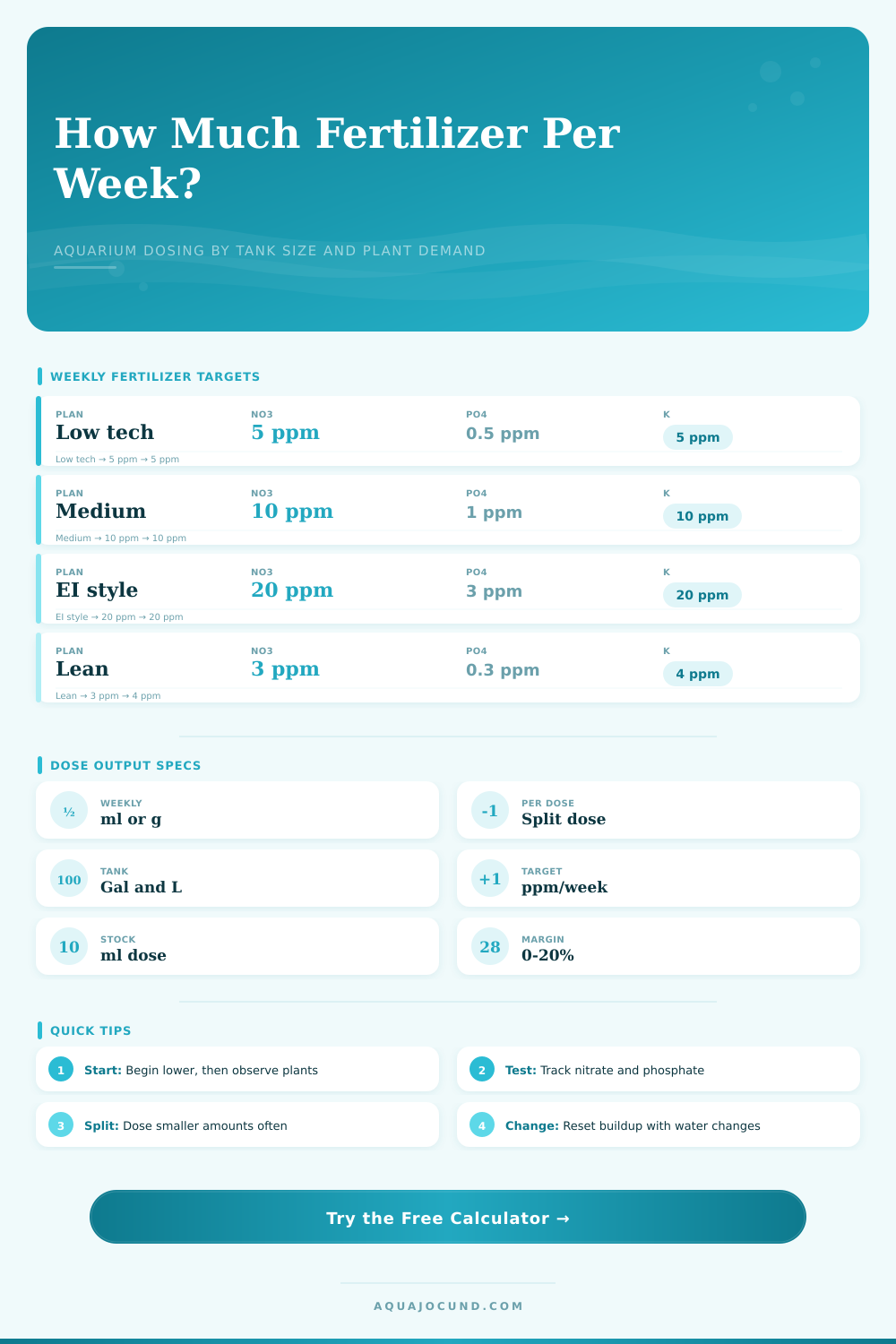
| Dosing style | NO3 target | PO4 target | K target | Fe/trace target |
|---|---|---|---|---|
| Lean maintenance | 3 ppm/week | 0.3 ppm/week | 4 ppm/week | 0.05 ppm Fe |
| Low tech planted | 5 ppm/week | 0.5 ppm/week | 5 ppm/week | 0.08 ppm Fe |
| Medium planted | 10 ppm/week | 1 ppm/week | 10 ppm/week | 0.15 ppm Fe |
| EI style high growth | 20 ppm/week | 3 ppm/week | 20 ppm/week | 0.5 ppm Fe |
| Dry fertilizer | Primary output | 1 g in 10 gal adds | Useful secondary nutrient | Best use |
|---|---|---|---|---|
| KNO3 | Nitrate | 16.2 ppm NO3 | 10.2 ppm K | Nitrogen for planted tanks |
| KH2PO4 | Phosphate | 18.4 ppm PO4 | 7.6 ppm K | Phosphate and potassium |
| K2SO4 | Potassium | 11.9 ppm K | Sulfate only | Potassium without nitrate |
| MgSO4.7H2O | Magnesium | 2.6 ppm Mg | General hardness support | Soft water magnesium |
| CSM+B trace | Iron estimate | 1.85 ppm Fe | Micronutrients | Trace dosing between water changes |
| Tank | Typical dimensions | Nominal volume | Medium weekly target | Suggested split |
|---|---|---|---|---|
| 5 gal betta | 16 x 8 x 10 in | 5 gal / 19 L | 5 ppm NO3 | 1-2 doses |
| 20 long | 30 x 12 x 12 in | 20 gal / 76 L | 8-10 ppm NO3 | 2-3 doses |
| 40 breeder | 36 x 18 x 16 in | 40 gal / 151 L | 10-20 ppm NO3 | 3 doses |
| 75 gal display | 48 x 18 x 21 in | 75 gal / 284 L | 15-20 ppm NO3 | 3-6 doses |
| Observation | Likely meaning | Calculator adjustment | Watch period |
|---|---|---|---|
| Pale new growth | Low macros or trace | Raise target one level | 10-14 days |
| Green dust algae | Light or excess imbalance | Use lower margin | 1-2 weeks |
| Bottoming nitrate | Plants consume weekly dose | Add 10-20% reserve | After tests |
| Shrimp sensitivity | Need gentler changes | Split into 3-7 doses | Each week |
The typical newbie makes same mistake. They read the label that says “fertilizer for beautiful plants” and buy some. And when they do their next water change, they add lots and lots. The water turns green and the plants fail to grow.
What happened? Fertilization is not about quantity but about chemistry. How much phosphate or nitrate did you put into how much water? To answer this question accuratly, you need to use a calculator; not because you’re a scientist, but because your fertilizer instructions are often vague. A calculator tells you exactly how many grams (or milliliters) per volume of water to add. That’s precision. That removes the guesswork.
Why You Need a Fertilizer Calculator
Each tank is different. That means each tank require customized math. For example, a five gallon betta bowl doesn’t hold much water. You can easily overdose with small amount of fertilizers and end up spiking aquarium’s nutrients into dangerous territory. On the other hand, a seventy-five gallon display tank will have plenty of volume to dilute the nutrients and allow you to safely dose at higher concentrations. To do that, simply enter your true tank dimensions (i.e., gallons) and let the tool do the math.
Why is it important? Labeled tank volumes aren’t always accurate. Take a twenty-nine gallon tank as an example. Once you add rocks, driftwood, and gravel, there isn’t quite as much water as stated volume suggests. Dosing based off stated volume will most likely cause you to under-dose your plants. Conversely, if you fail to consider the displacement caused by hardscape, you might dose regularly but still end up starving your plants. Measuring actual water column allows nutrients to get to your plants.
Lastly, decide what dosing strategy makes sense for you. There are several common methods in the hobby. For example, lean dosing maintain low nutrient concentrations that is best suited for tanks containing slow growing plants or shrimp. Stability is key. Moderate dosing is suitable for lower tech tanks. It targets low or moderate nitrate and PO4. This provides enough nutrition for plant growth without encouraging algae growth. The third method are the EI/Esterich method. It floods the tank with nutrients so plants outcompete algae and allow fast growing stems to thrive. Each of these can have different target ppm’s. By choosing this target, the calculator will adjust its output accordingly. A reference table show the different ppm targets for each type of dosing to show how they compare.
Salt is another variable in control. Lots of hobbyists makes their own fertilizer with monopotassium phosphate and potassium nitrate. Making your own is cheaper and more accurrate than purchasing premixed liquid solutions. Rather than having to lookup conversion charts, the calculator will tell you exactly how many grams of salt to add to increase either phosphate or nitrate by X amount each week. It factors in volume of the tank as well as the molecular weight of the salt. So all you have to do is select the salt type, enter your desired target, and get a number. This makes what used to be an advanced chemical exercise much simpler.
Give a steady dose instead of a large one. A steady but small amount of nutrients each day will sustain your plants while preventing water parameter swings that stress them out and cause algae to prefer spikes. Use the calculator to split your weekly total among daily doses to better align with your hectic schedule. Shrimp-keepers: Dosing consistency is extra critical since rapid water chemistry shifts can harm them.
That leaves testing. There’s no such thing as seeing into your tank. You don’t have a calculator looking at your tank for you. So use the calculated dose as a starting point, then test your water and adjust from there. Then once a week, test your water. By Friday, if there’s zero nitrates, increase your fertilizer. By Sunday, if it’s still elevated, decrease your fertilizer. Recalculate the dose based on those numbers and adjust to match.
Remember, this isn’t about following some formula. It’s about understanding how the formula works so you can make adjustments when necessary. When your numbers matches your plants, that’s when the water will clear up, growth will accelerate, and you’ll stop guessing. You should of used a calculator sooner to avoid these issues.