DIY Citric Acid CO2 Duration Calculator
Estimate how many days a citric acid and baking soda aquarium CO2 recipe can run from chemical amounts, bubble rate, duty cycle, and usable gas reserve.
⚗Quick presets
📏Tank and units
🧪Recipe and delivery
🧮Reaction reference
📊Chemistry comparison table
| Input | Molar basis | CO2 yield | Calculator use |
|---|---|---|---|
| Citric acid anhydrous | 192.12 g/mol acid | 3 mol CO2 per mol acid | Highest dry-acid yield by weight |
| Citric acid monohydrate | 210.14 g/mol acid | 3 mol CO2 per mol acid | Lower yield because crystal water adds weight |
| Baking soda | 84.01 g/mol sodium bicarbonate | 1 mol CO2 per mol soda | Often the limiting reagent if under-measured |
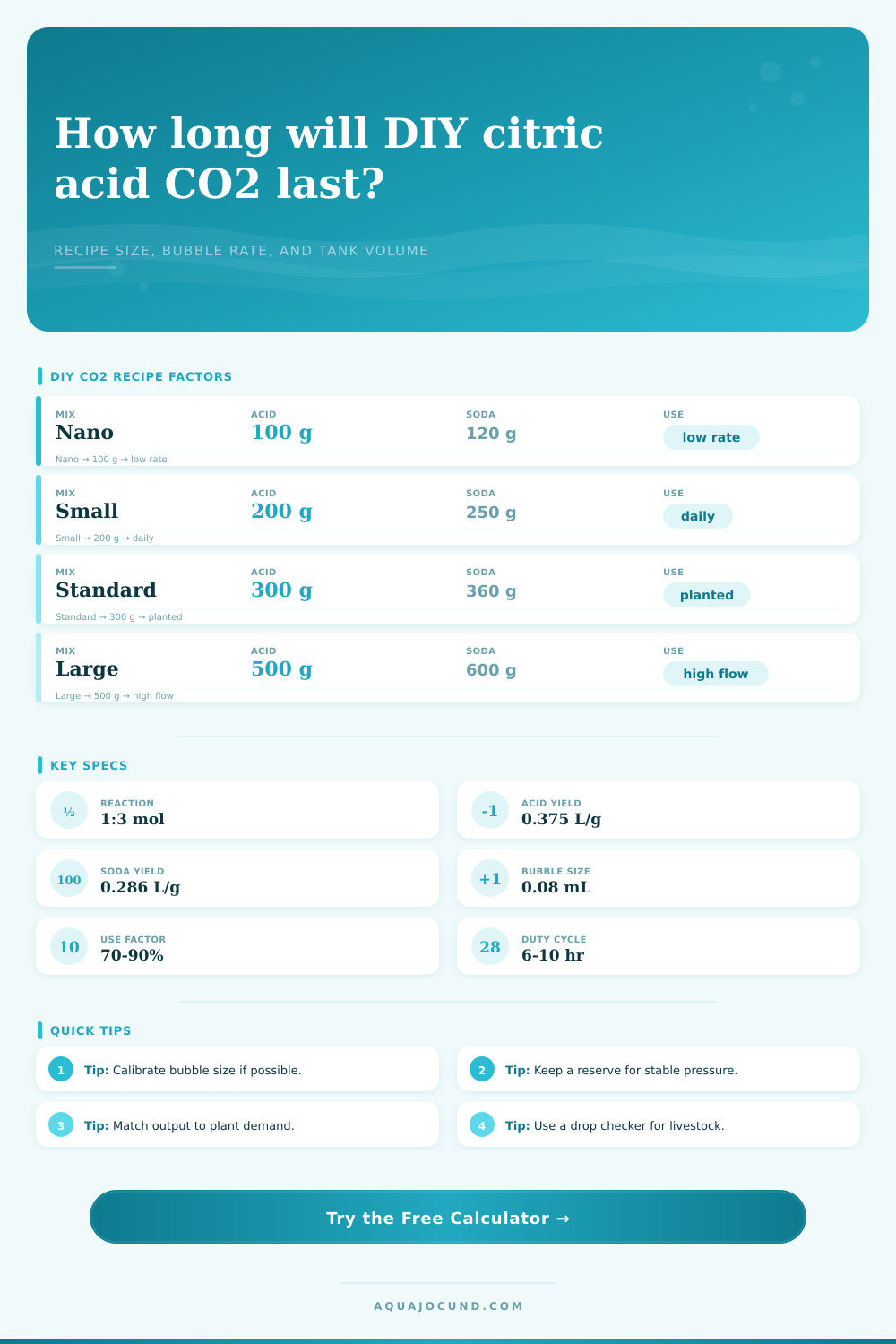
| Balanced dry ratio | About 1 g acid to 1.31 g soda | Uses both ingredients closely | Good starting point for dual-bottle systems |
| Usable gas factor | Usually 70% to 90% | Accounts for waste and tail pressure | Turns theoretical CO2 into practical runtime |
🌊Common aquarium scenarios
| Tank | Typical volume | Starting bubble rate | Common runtime driver |
|---|---|---|---|
| Nano shrimp tank | 5 gal / 19 L | 6 to 15 bubbles/min | Very small adjustments change intensity quickly |
| 10 gal planted | 10 gal / 38 L | 15 to 35 bubbles/min | Diffuser efficiency and surface agitation |
| 20 long aquascape | 20 gal / 76 L | 35 to 70 bubbles/min | Photoperiod length and plant mass |
| 40 breeder display | 40 gal / 151 L | 70 to 130 bubbles/min | Distribution across the broad footprint |
| 75 gal dense plants | 75 gal / 284 L | 130 to 230 bubbles/min | Large draw can shorten small DIY batches |
⏱Duration planning table
| Recipe | Theoretical CO2 | At 30 bubbles/min | At 90 bubbles/min |
|---|---|---|---|
| 100 g acid + 130 g soda | About 37 L | About 21 days at 8 hr/day | About 7 days at 8 hr/day |
| 200 g acid + 260 g soda | About 75 L | About 43 days at 8 hr/day | About 14 days at 8 hr/day |
| 300 g acid + 390 g soda | About 112 L | About 64 days at 8 hr/day | About 21 days at 8 hr/day |
| 500 g acid + 655 g soda | About 187 L | About 107 days at 8 hr/day | About 36 days at 8 hr/day |
💡Practical calculation notes
The sound of a steady bubble counter is oddly satisfying for any planted tank hobbyist. A constant bubble from a bubble counter provide that satisfaction. It’s as if your plants are receiving regular doses of plant food right at there root level. However, beneath this rhythmic tick-tick-tick is a variable you aren’t aware of… the bottle can be empty.
Do you really notice until your plants begin to fade or your shrimp stop reproducing? Knowing approximately how much time your homemade batch of baking soda and citric acid has left can transform it from a guessing game to a maintenance plan.
How to Calculate Your DIY CO2 Duration
It’s simple chemistry (though executed poorly by most folks), which is why estimating how long your DIY citric acid and baking soda mixture will last matter. It’s basically combining a base with an acid to produce carbon dioxide. It’s all about ratios. If you’ve got too much acid you waste the money… Though too much base will result in a stalled reaction (and a salty mess).
Luckily the calculator does the math for you; simply enter how much each ingredient you’re using weigh and it’ll tell you if you’ve made a balanced concoction, or if you’re just brewing a salty disaster. And no need to worry: the tool considers the difference between anhydrous and monohydrate citric acid, which sounds like a minor thing on the label but becomes enormous when estimating your run time.
The other thing that messes up those calculations is bubble size. A bubble is not a regular ol’ measure of volume. Its size depends on the tubing diameter, the counter mechanism, and the viscosity of the water. Tiny micro-bubbles spewing out of a small digital counter will give you a dramatic difference in run-time compared to fat sluggish bubbles coming out of a big manual counter.
You can set an estimate of volume per bubble into the calculator for this reason. Most folks gloss over this step, they’ll get caught up on bubbles per minute but don’t understand that one minute of ten big bubbles is chemically different then one minute of 60 little ones.
Secondly, let’s talk about pressure reserve. DIY systems use pressure within a soda bottle or something like it as their power source. When the gas is exhausted, that pressure reduces. Then it reaches the point where it can no longer push CO2 through your diffuser effectively. So although the bottle still contains gas, its pressure isn’t sufficient. Unless you account for this tail-off, you’ll believe you’ve got ten days left. In fact, you might have six.
You can specify an acceptable gas percentage which sets the usable gas level and provides a buffer against that low pressure situation. It grounds expectations.
Duration and intensity
While tank size matter more for duration, it’s definitely a factor in intensity as well. More so than anything else, you want to ensure that you’re dosing enough CO2 to saturate the water column yet not shock your livestock. While a small nano tank will tolerate significantly fewer mistakes than a large breeder display, the latter will require much more total gas.
What may be a minor case of over-dosing in a five-gallon tank could result in a rapid drop in pH, while the same dosage in a fifty-gallon tank might have little effect at all. The calculator shows how much you use each day compared to your tank size to help you visualize this. It’ll give you an idea as to if you’re drowning your plants or feeding them.
Consider this a guideline… Don’t make it the end all be all. There are variables that affect temperature, reaction rate, room humidity, etc. These will throw things off a little bit. Plan for your refilling based off the estimated results but then listen to what the drop checker says.
When does the water go yellow? Too much. When does the water stay blue? Not enough. Numbers put you on the right track. Watching out will keep you there.
The bottom line is consistency. Routines are good for plants. Knowing how often to make a fresh batch prevents those days when your carbon dioxide stops and your fish gets stressed.
You can stop guessing when the bottle runs dry. Instead of having a reaction to the chemistry you can plan for it. The tick tick tick of the counter isn’t so mysterious anymore. It’s just another piece of your well-oiled machine.
You should of used this sooner.