UV Wattage Per Gallon Calculator
Estimate aquarium UV sterilizer wattage, watt-per-gallon intensity, target flow, and turnover from tank size, water clarity, runtime, and lamp condition.
🐟Quick Presets
⚙Tank And UV Inputs
📊UV Goal Factors
📋Use Goal Comparison
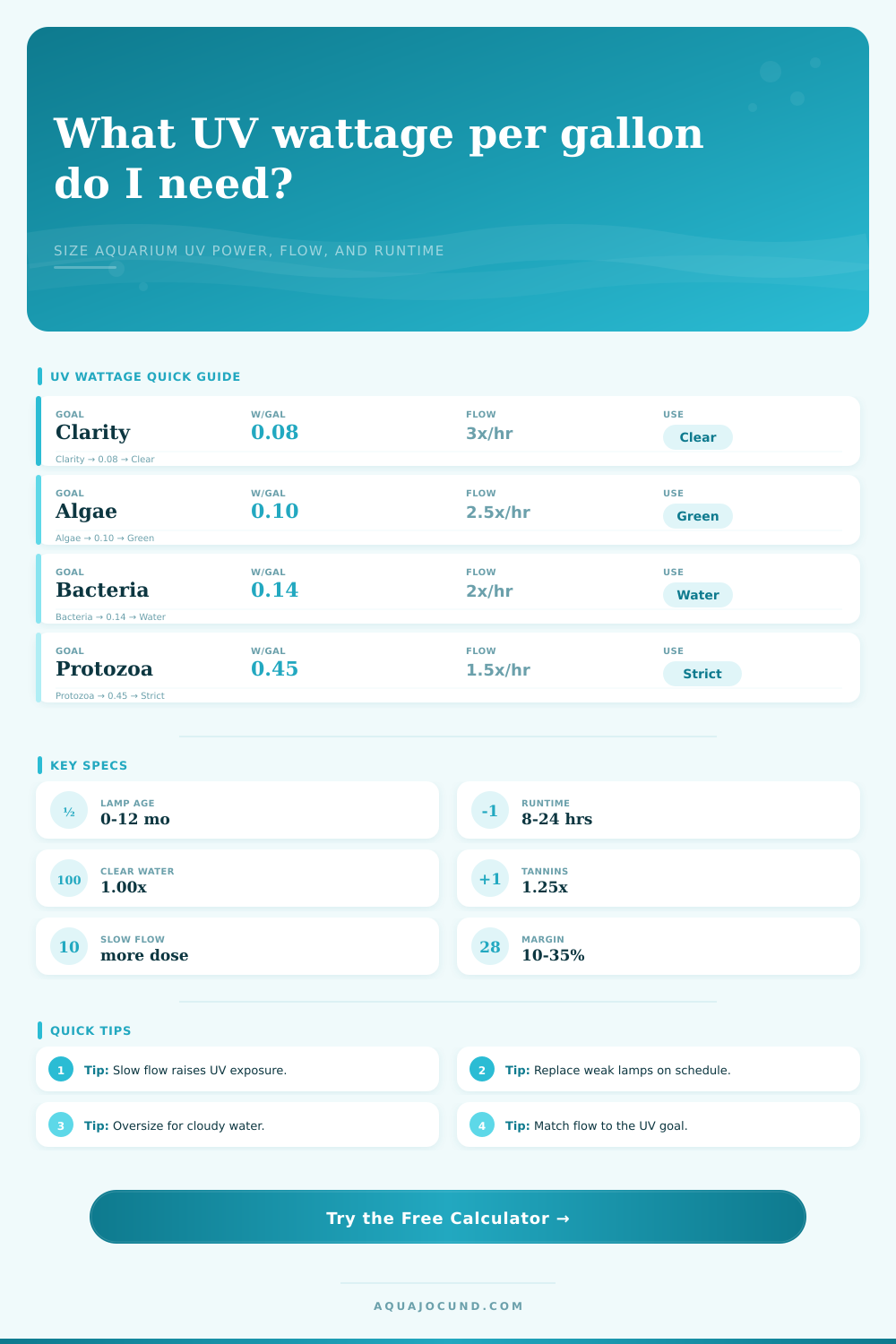
| UV Goal | Base W/Gal | Target Turnover | Best Use |
|---|---|---|---|
| Water clarity polish | 0.08 W per gal | About 3 tank volumes per hour | Clear water, minor haze, general polishing on established systems. |
| Green water algae control | 0.10 W per gal | About 2.5 tank volumes per hour | Suspended algae blooms where slower repeated passes matter. |
| Bacteria bloom reduction | 0.14 W per gal | About 2 tank volumes per hour | Milky water support after cycling changes or excess organics. |
| Reef-safe water polish | 0.25 W per gal | About 2 tank volumes per hour | Clear reef systems where flow control and heat are watched closely. |
| Quarantine support | 0.35 W per gal | About 1 tank volume per hour | Small holding tanks needing high exposure and calm flow. |
| Protozoa exposure target | 0.45 W per gal | About 1.5 tank volumes per hour | High exposure planning; verify against a UV maker flow chart. |
📐Common Tank Starting Points
| Tank | Typical Dimensions | Net Volume | Common UV Range |
|---|---|---|---|
| 5 gallon betta | 16 x 8 x 10 in | 4.5 gal / 17 L | 3-5 W for polish; control heat and flow. |
| 10 gallon planted | 20 x 10 x 12 in | 9 gal / 34 L | 5-9 W for clarity or green water control. |
| 20 long community | 30 x 12 x 12 in | 18 gal / 68 L | 9-15 W depending on goal and flow. |
| 40 breeder | 36 x 18 x 16 in | 36 gal / 136 L | 15-25 W for bloom reduction or polish. |
| 75 gallon cichlid | 48 x 18 x 21 in | 68 gal / 257 L | 25-40 W with measured canister flow. |
| 125 gallon display | 72 x 18 x 21 in | 112 gal / 424 L | 40-57 W for polish; higher for strict goals. |
🌊Flow And Exposure Reference
| Flow Situation | Calculator Adjustment | What It Means | Practical Check |
|---|---|---|---|
| Actual flow near target | 1.00x flow factor | Expected exposure is close to the goal selected. | Use measured outlet flow, not pump box flow. |
| Flow 25% above target | About 1.15x more wattage | Water moves faster through the chamber, so exposure drops. | Throttle or bypass if the UV unit allows it. |
| Flow 50% above target | About 1.35x more wattage | Clarification may still work, but strict exposure goals suffer. | Use a lower flow loop for disease-control planning. |
| Flow below target | No watt penalty | Exposure rises, but full-tank turnover takes longer. | Watch temperature, detritus buildup, and dead spots. |
💡Calculation Notes
If you got a UV sterilizer it was probably because your water was cloudy. That’s the standard entry point for most aquarium hobbyists. They want clear water.
The calculator uses age of lamp, runtime, flow rate, clarity and net water volume to estimate the lamp size needed to reach sterilization targets. This can help you compare how big of a sterilizer you might realistically need.
How to Use the UV Calculator
Clearing up the water depends on the balance between two opposing forces: (1) How much UV do I have? Do I have enough UV intensity to knock out the pathogens? And (2) How long do they sit in the chamber to get that dose? It’s both a power game but it’s also a timing game.
Wattage gets all of the attention from most folks. That’s the problem. Most grab largest bulb they can fit into their filter system. They have no concern about how fast water passes through it. If it streams through too fast, no matter what power the light has, it won’t be effective. Exposure time is decreased. Pathogens gets bounced right out without getting scratched up.
To account for this, you can enter your actual flow rate into the tool on this page. Pump ratings are often inflated. Real output is restricted significantly by head height and filter media. Maybe your pump claims to push a thousand gallons an hour but in your complex filter setup, it only pushes six hundred. That’s a complete change in UV exposure. The calculator takes that reality into consideration. Not idealized numbers on a pump box.
The condition of the lamp is another factor that will ruin UV performance. Even if the lamp appears completely lit, and even looks bright to you, its ultraviolet output diminishes long before it ceases to glow at all. What does that mean? A one year old lamp may appear fully illuminated but its germicidal output can be significantly diminished. There is an option on the calculator for lamp age which accounts for the decrease in output over time.
It also takes into account water clarity. Does your tank have a film on the quartz sleeve or driftwood leeching out tannins? That’s a barrier that the UV light must penetrate to reach the water. To get the same results with a heavily soiled sleeve compared to crystal clear water would take more power. It is a small thing, but it matters.
Intensity varies with purpose. For example, for clearing a green water algae bloom, you want more power. That’s an intense effort. If you just want to polish some water for a planted tank, you want less. This is because algae is harder. And they’re typically in denser clouds. Instead, it’s cloudier. Clouds require more watts per gallon to break apart.
This is where the page’s reference table comes into play. It outlines the wattage per gallon changes that occur when moving from clearing up the water to strictly controlling protozoa. Quarantine tanks requires heavy doses. You’re not preventing something minor, but treating what exists already. The math works here too. You’ll just choose the proper purpose for your application.
However, there’s one other variable you must take into account, how much water do you have in the tank? The calculator looks for net water volume. That includes everything except water in the tank such as decorations, rock and substrate. If you have dense hardscape, you might only be holding fifteen gallons of actual water in a 20g tank. If you size your UV for the entire 20 gallons, you’re under-dosing what’s really in the tank. That’s where displacement factor comes into play. It will ensure your wattage per gallon figure is calculated for the amount of water that the UV beam actualy hits.
Many keepers will have their UV light on 24 hours/day. Depending on your set up this may or may not be needed. You can turn it on just during light hours to ensure no algae growth. Or, you can have it running continuously and thereby maximize water quality. Adjust the runtime on the calculator. That will impact how much intensity is needed. The more time you run it the lower the light could be. If you run it less, you might need a stronger lamp to catch same number of pathogens in that shorter window. It’s a tradeoff of bulb life vs. Energy usage.
Finally, remember that a UV sterilizer is a maintenance tool. A UV sterilizer doesn’t make it all better. It helps manage particles and pathogens, but it cannot replace regular water changes or good filtration. If you don’t change the water regularly, you should of not expected to get away with it just by adding a UV sterilizer. It can only do so much.
What it does do is help control pathogens and other particles in the water. How many? Use those numbers as a starting point when shopping for equipment. How successful are you? That’s where your observations comes into play. Check the flow. Clean the sleeve. Change the bulb according to the schedule. Consistent attention to detail means clearer water. Clearer water means you’re doing something right. And if the water clears up; you’ll know you got it right.