Carbon Dosing Sugar Volume Calculator
Estimate a cautious reef sugar dose, spoon volume, carbon equivalent, and ramp limit from your tank volume and nutrient situation.
| Sugar source | Approx grams per tsp | Carbon fraction | Calculator use |
|---|---|---|---|
| White granulated sucrose | 4.2 g | 42.1% | Default dry dosing reference |
| Caster sugar | 4.5 g | 42.1% | Fine crystals pack slightly tighter |
| Raw cane sugar | 4.4 g | 41.5% | Similar carbon, slightly denser spoon |
| Light brown sugar | 4.6 g | 40.0% | Moisture lowers usable carbon fraction |
| Powdered sugar | 2.8 g | 39.5% | Lower density because of fine powder |
| Dextrose monohydrate | 3.6 g | 36.4% | Needs more grams for equal carbon |
| Glucose powder | 3.7 g | 40.0% | Simple sugar, fast bacterial response |
| Stock solution | Custom | By sugar selected | Best for micro doses below spoon accuracy |
| Stage | Vodka-equivalent basis | Sucrose estimate | Best use |
|---|---|---|---|
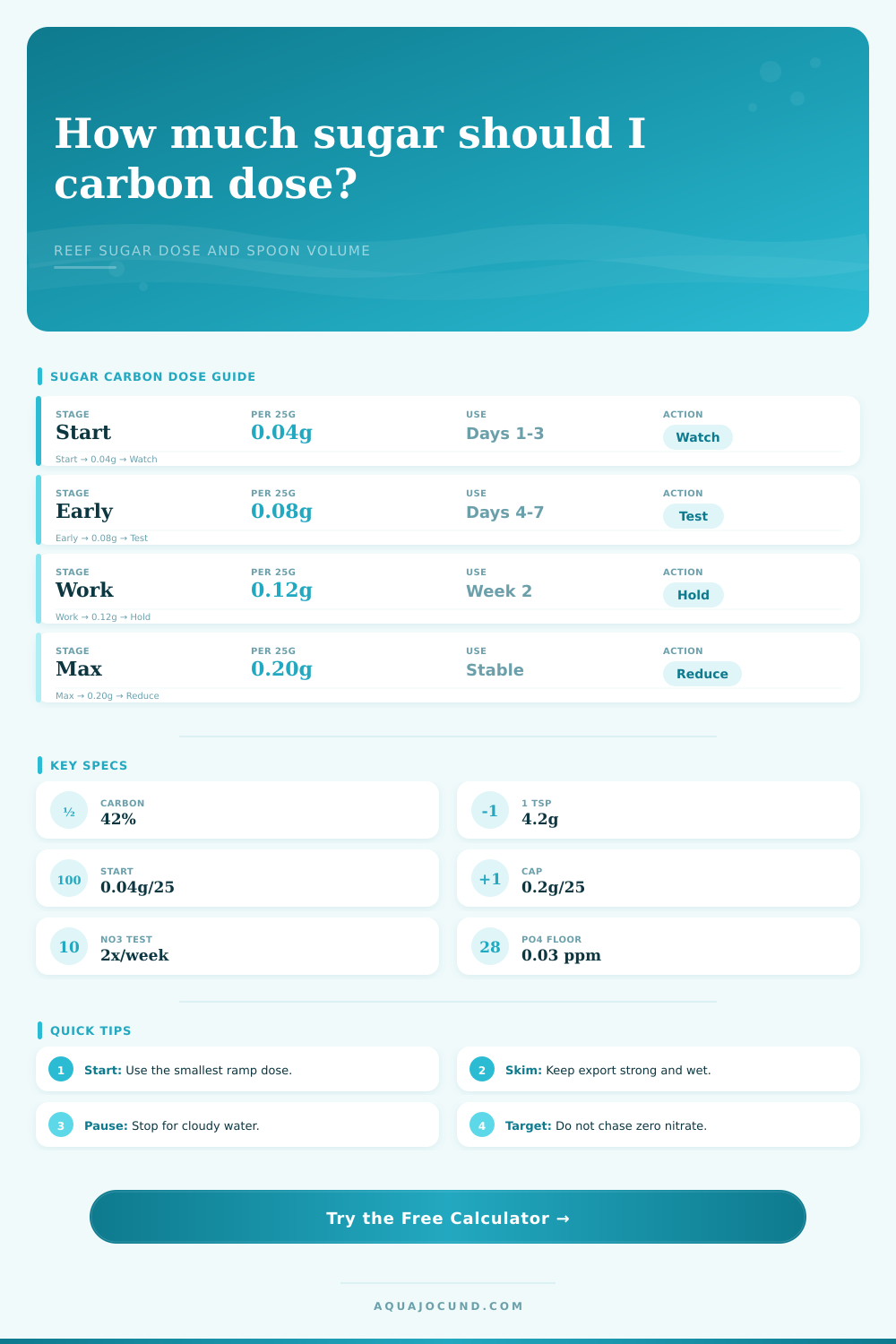
| Start dose | 0.1 mL per 25 gal | 0.04 g per 25 gal | First several days or restarted systems |
| Early dose | 0.2 mL per 25 gal | 0.08 g per 25 gal | After clear water and stable livestock |
| Controlled ramp | 0.3 mL per 25 gal | 0.12 g per 25 gal | When nitrate remains measurable |
| Working dose | 0.5 mL per 25 gal | 0.20 g per 25 gal | Mature skimmed reef with testing |
| Maintenance | About half working dose | 0.10 g per 25 gal | After nitrate and phosphate stabilize |
| System | Typical net water | Start sugar dose | Working soft cap |
|---|---|---|---|
| 10 gal nano reef | 8 to 9 gal | 0.01 to 0.02 g | 0.07 g |
| 20 long reef | 16 to 18 gal | 0.03 g | 0.14 g |
| 40 breeder reef | 32 to 38 gal | 0.05 to 0.06 g | 0.26 to 0.30 g |
| 75 gal mixed reef | 62 to 72 gal | 0.10 to 0.12 g | 0.50 to 0.58 g |
| 125 gal display reef | 105 to 120 gal | 0.17 to 0.19 g | 0.84 to 0.96 g |
| Check | Preferred range | Calculator response | Practical note |
|---|---|---|---|
| Phosphate | At least 0.03 ppm | Reduces dose if too low | Bacteria need nitrogen and phosphorus together |
| Nitrate | Measurable, not zero | Scales down near zero | Avoid stripping nutrients suddenly |
| Water clarity | Clear | Stops or halves dose for haze | Cloudiness can signal bacterial bloom |
| Export | Strong skimmer | Reduces for weak export | Carbon dosing works best when biomass is removed |
| Measurement | Scale or stock solution | Reports grams and mL | Tiny dry doses are hard to spoon accurately |
To dose or not to dose: That’s the question when considering adding sugar to your reef tank. Why would you add something that will feed bacteria? You set up a clean ecosystem. Why throw more junk into it?
But then again, using controlled dosing of carbon as a nutrient remover is one of the best options for getting rid of nutrients (without chemical additives). The bacteria gobble up the sugars and remove phosphate and nitrate from water. But how do you control it? You learn to manage the nutrient level along with oxygen levels.
How to Add Sugar Safely to Your Reef Tank
New dosers just guesstimate based off the total water capacity listed on tank label. That figure is a waste because it doesn’t account for displacement caused by equipment, corals, sand, and rocks. Your display may hold fifty-five gallons, but it might only have forty gallons of water in it. Plugging in your dimensions along with an estimate of your displacement percentage into the calculator does all the math for you.
Why? Underdosing is harder to do than overdosing. Having too much carbon causes bacteria to bloom which crashes oxygen levels. Precise dosing is what you want; hope-based estimation isn’t good enough.
That equation shifts substantialy depending on the type of sugar used. Sucrose (white granulated sugar) has a constant density and carbon count; it’s the standard by which everything else are compared. Other kinds of sugar like brown sugar have some moisture and molasses, making them heavier per teaspoon, and complicating things with extra variables we don’t want to worry about. Simpler sugars like glucose or dextrose will also dissolve quicker and spike the bacteria more quickly. Depending on the source of your sugar, you’ll see in the reference table below that different types of sugar requires different amounts of grams to provide the same level of carbon. For example, if you use dextrose, you’ll need more weight than you would with sucrose to achieve the same result.
Which is what everyone screws up when switching between different sugars. People switch from one to another without adjusting dosage. Assuming they’re the same thing.
This is Input #3; Ramp. This may be the most important input. There is no jumping in with both feet; you need to work up to the right amount (i.e., what will work). By starting slow, you give yourself time to develop a healthy colony of beneficial bacteria without overdoing it and killing them off quickly. That also means not letting the colony overwhelm the tank and use up all available oxygen. Start with very small doses during the initial few days. Use even as little as a single gram or less if your tank is medium size. Once the system stabilizes and the water stays clear, then bump up the dose. Because this process takes some time, the calculator bases its selection on the ramp stage, which is based on how long it will take you. In other words, you’re protecting your fish from any sudden changes in water parameters.
However, there is a safety brake on this mechanism: phosphate. Phosphates are required by bacteria to produce biomass, along with nitrogen. When you deplete phosphate too far below zero, you prevent effective processing of the nitrate by the bacteria. That means no export of nutrients and stressed corals. To avoid that scenario, the tool recommends reducing the dosage when your phosphate is close to zero. In other words, don’t let it strip the tank of necessary stuff. Nutrients are a tightrope. Walking it means paying attention not just to the upper limit but also to the lower one.
The flipside to this is skimmer strength. Dosing with carbon leads to increased bio-load (dead bacteria). That bio-load has to get exported or it just recirculates as nutrients. Aggressive dosing means higher levels of waste than a weak skimmer can manage. The calculator takes into account how well you are exporting the bioload, so if you have no skimmer or a very light skimmer, it reduces the dosage accordingly. It’s possible to dose carbon even without a skimmer in the tank, but it won’t work well and you run a significant risk of slimy algae.
It’s almost impossible to measure very small doses of sugar using your kitchen spoons. One teaspoon contains so much sugar that it would be too much for most nano tanks to safely hold in a 24 hour period. The only surefire method for delivering microdoses is via a precision scale or some type of stock solution. The device translates what you want (in grams) into either spoon fraction or milliliters (of solution), which allows you to actualy deliver the dose. No guessing required when it comes time to pour.
You don’t need no stinkin’ nitrates…or at least you shouldn’t chase zero. This is a road to chaos. Shoot for a low but detectable level. Let the bacteria handle it. Go slow. Monitor your water. Watch it clear up. Be as patient with this process as you were when you first created your reef.