🧪 DIY Two Part Recipe Calculator
Build alkalinity, calcium, and magnesium recipe jugs, check concentration per mL, and convert measured reef demand into balanced daily dosing.
Recipe Breakdown
| Dry Ingredient | Formula | Calculator Value | What It Controls |
|---|---|---|---|
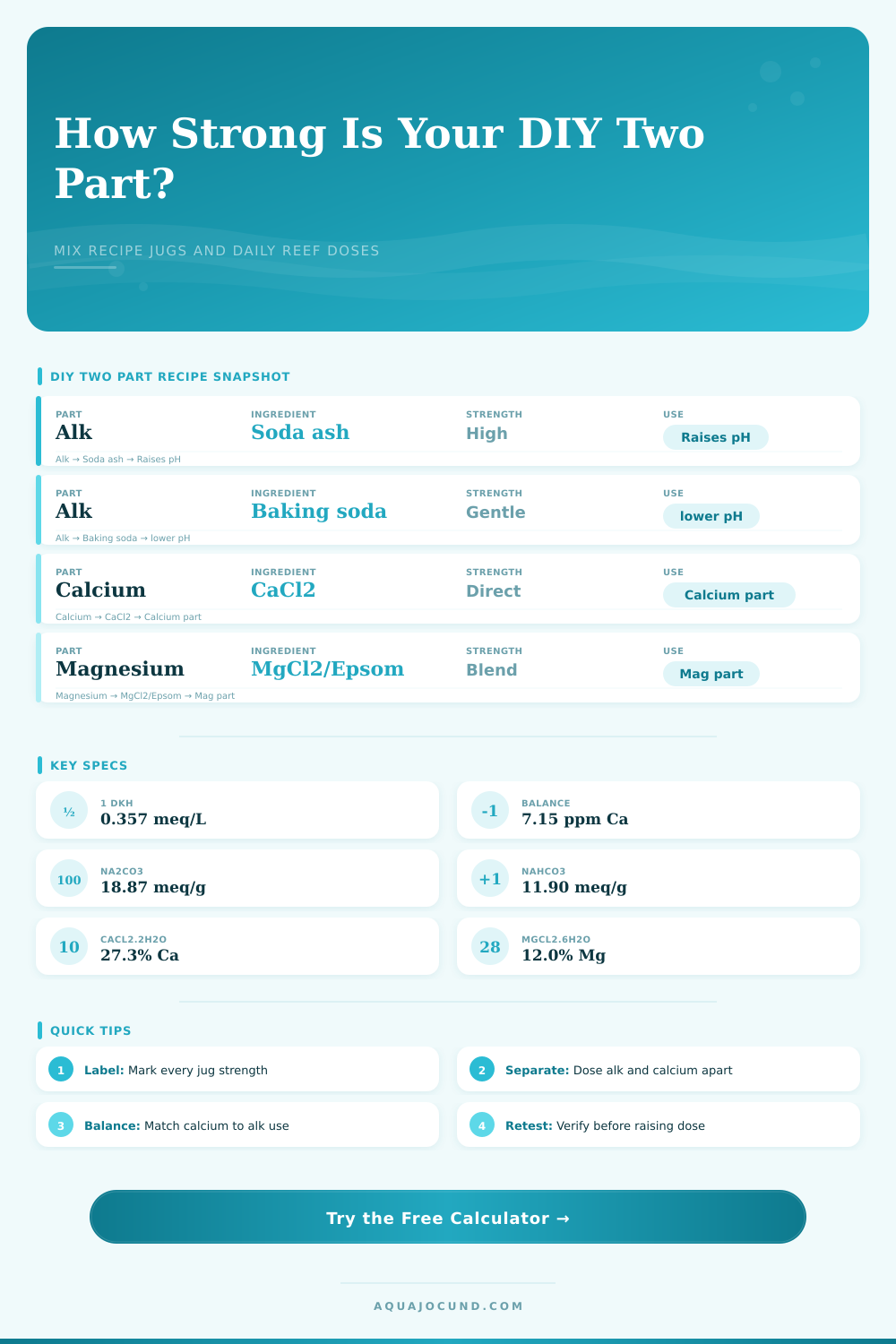
| Soda ash | Na2CO3 | 18.87 meq alkalinity per g | Higher-strength alkalinity part |
| Baking soda | NaHCO3 | 11.90 meq alkalinity per g | Lower-strength alkalinity part |
| Calcium chloride dihydrate | CaCl2.2H2O | 27.26% elemental calcium | Calcium part strength |
| Calcium chloride anhydrous | CaCl2 | 36.11% elemental calcium | Stronger calcium part per gram |
| Magnesium chloride hexahydrate | MgCl2.6H2O | 11.95% elemental magnesium | Magnesium chloride share |
| Magnesium sulfate heptahydrate | MgSO4.7H2O | 9.86% elemental magnesium | Sulfate share in magnesium blend |
| Final Jug | Soda Ash Alk | Baking Soda Alk | Calcium Dihydrate | Magnesium Blend |
|---|---|---|---|---|
| 1 L | 98 g | 158 g | 132 g | 161 g MgCl2 + 21 g Epsom |
| 2 L | 196 g | 316 g | 264 g | 322 g MgCl2 + 42 g Epsom |
| 1 US gal / 3.79 L | 371 g | 594 g | 500 g | 610 g MgCl2 + 80 g Epsom |
| 5 L | 490 g | 785 g | 660 g | 805 g MgCl2 + 106 g Epsom |
| 10 L | 980 g | 1570 g | 1320 g | 1610 g MgCl2 + 211 g Epsom |
| Reef System | Net Volume | Typical Alk Use | Balanced Ca Use | Recipe Watch Point |
|---|---|---|---|---|
| Soft coral nano | 15-25 gal / 57-95 L | 0.05-0.20 dKH/day | 0.4-1.4 ppm/day | Use smaller jugs if pump resolution is coarse. |
| LPS cube | 25-40 gal / 95-151 L | 0.15-0.40 dKH/day | 1.1-2.9 ppm/day | Retest alkalinity before changing both parts. |
| Mixed reef | 50-90 gal / 189-341 L | 0.30-0.75 dKH/day | 2.1-5.4 ppm/day | Balance calcium from alkalinity trend first. |
| SPS dominant | 80-180 gal / 303-681 L | 0.70-1.50 dKH/day | 5.0-10.7 ppm/day | Split doses through the light cycle. |
| Large mature system | 180+ gal / 681+ L | 1.00-2.00 dKH/day | 7.2-14.3 ppm/day | Concentrated jugs reduce daily pump runtime. |
| Blend Style | Mg Chloride Share | Epsom Share | Best Calculator Use |
|---|---|---|---|
| Chloride-heavy recipe | 85-90% | 10-15% | Default separate magnesium jug modeling. |
| Even contribution check | 50% | 50% | Compare sulfate influence by changing both gram fields. |
| Epsom-only emergency math | 0% | 100% | Set magnesium chloride to zero and use the sulfate field. |
| Chloride-only math | 100% | 0% | Set Epsom to zero for chloride-only strength. |
You nod confidently after your alkalinity test kit goes pink. Then two days later, your calcium drop and your pH crashes. Why? You don’t know what’s inside those white powder bag. You think they’re magic beans. You mix them with two-part dosing solution and then you expect it to work.
Guess what? It does. And it does for a reason. That reason is called chemistry, it is not hope.
Why You Should Use Math Instead of Guessing
Plugging in the amount of powder and your tank volume into calculator lets it do the math for you. No need for you to guess about units and stoichiometric coefficients.
Depending on where you get it from, DIY dosing can be realy strong or really weak. For example, each gram of sodium carbonate (also known as soda ash) has almost double (40%+) the alkalinity punch of each gram of baking soda. That’s because baking soda has a single alkalinity equivalent per mole whereas soda ash have two alkalinity equivalents per mole. Since dosage by weight is different than both materials, using one in place of the other will result in underdosing or overdosing your tank.
Underdosing starve your coral. Overdosing results in a dangerously high pH. Check out chart on page for the actual milliequivalent variation between the two popular alk sources. Knowing this ensures stable parameters over time (months).
On the other side, we have hydration causing confusion with water weight. Reefers know that they use calcium chloride with two water molecules since it’s safe and stable. However, each gram you weigh has a bunch of water molecule (H2O) bound up in the crystals themselves. So a lot of what you’re weighing is simply water. Anhydrous calcium chloride isn’t as heavy per gram of pure calcium. Thus, you can use less powder to achieve equal results.
Since this tool know the molecular weights of everything automatically, it takes your raw grams and changes them to actual ppm impact those grams would create in your chosen tank volume. You type in the dry weight, and it tells you how much to add in milliliters to stay balanced.
This is frequently an afterthought when folks read through the other two recipes. Magnesium acts as glue that keeps calcium and alkalinity separate. When magnesium falls too far, carbonate ions bonds with calcium forming those unwanted solids (aka chalk). This causes all the stuff you dose for days not to move the needle on any of your parameters.
By combining epsom salts and magnesium chloride in the calculator, you’ll be able to keep magnesium steady while finetuning the sulfate contribution. Pulling this lever right will ensure both your dosing is efficient and your water remain clear.
The amount to be added change day-to-day depending upon what lives in your tank. Soft coral tanks use very little of it. Tanks dominated by SPS burn calcium and alk up like a furnace. You enter the amounts you measure (daily or weekly) via the tool. The tool will then convert your measured consumption to a balanced dosing plan.
It will divide that overall number into several dose during the day. This is critical to keeping things stable. Adding a day’s worth of chemicals all-at-once dumps spikes into your sump. That stresses livestock and may settle out. If you split your dose, it smoothes the curve.
Always label your jugs. You can’t forget how many grams of soda ash were used in this gallon today, right? Nope. You’ll forget in three months. Label bottle with concentration and note the date.
Things change when you change your livestock, change your salt mix, or change your consumption. What worked last month won’t work next month if you change something. Dosing rates goes out of date. Test again before assuming that things haven’t changed.
This isn’t rocket science; it’s a small habit that saves thousands of hours of troubleshooting time. Consistency is as important as keeping the numbers within range. When you know what’s in the jug, you stop guessing and start managing. Knowing that would of been well worth the expense of the powder.