Magnesium Sulfate Dose Calculator
Calculate MgSO4 dose by hydrate type, target magnesium ppm, water volume, sulfate contribution, aquarium mode, and staged daily splits.
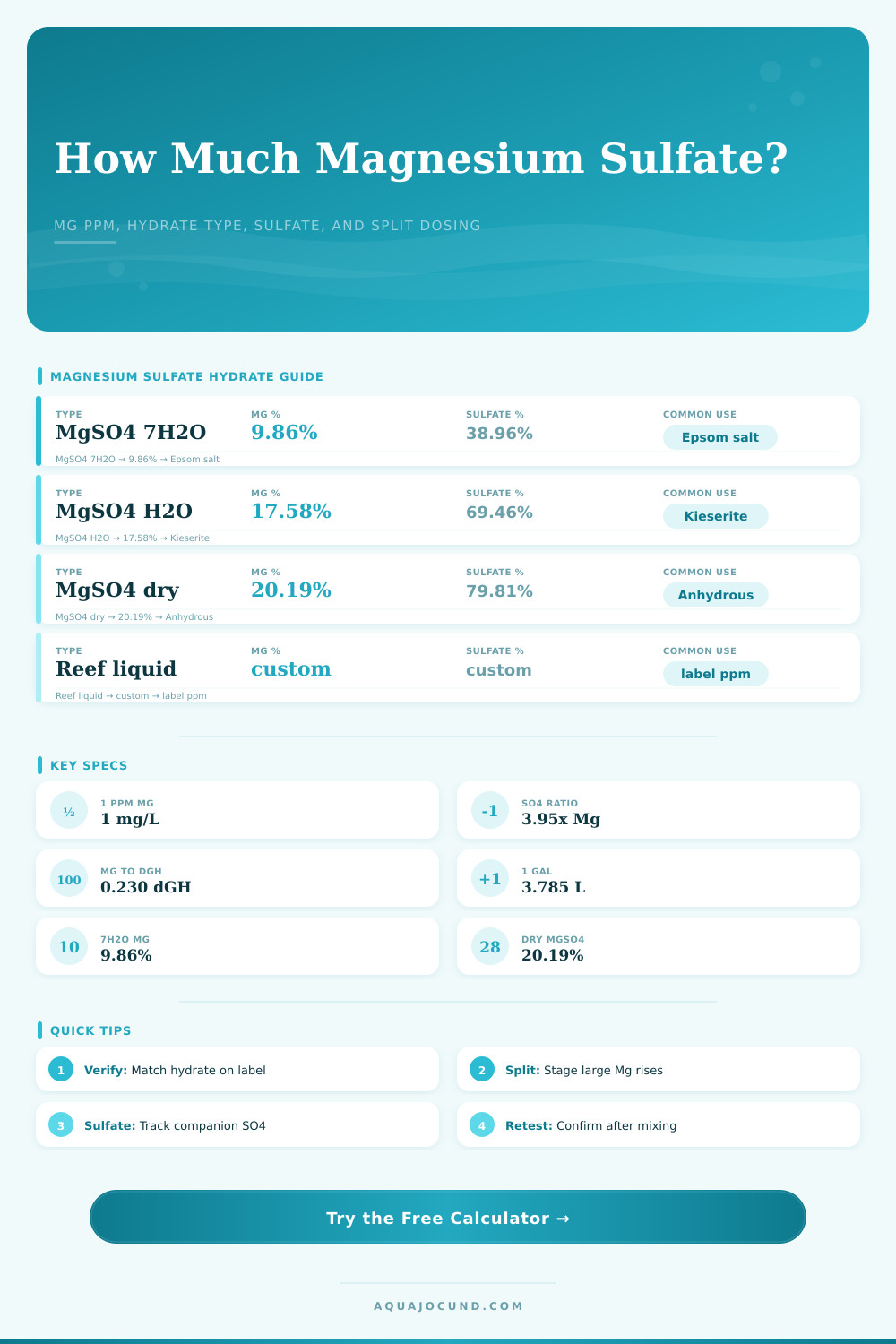
| Hydrate Type | Formula Weight | Elemental Mg | Sulfate | Dosing Note |
|---|---|---|---|---|
| Heptahydrate / Epsom salt | 246.47 g/mol | 9.86% | 38.96% | Most common aquarium dry MgSO4 source. |
| Monohydrate / kieserite | 138.38 g/mol | 17.56% | 69.42% | More concentrated than Epsom salt. |
| Tetrahydrate | 192.42 g/mol | 12.63% | 49.93% | Uncommon; verify the label before dosing. |
| Trihydrate | 174.40 g/mol | 13.94% | 55.09% | Use only if hydrate is clearly identified. |
| Anhydrous MgSO4 | 120.37 g/mol | 20.19% | 79.81% | Strong dry form; grams are about half heptahydrate. |
| Liquid or custom product | Label based | User entered | User entered | Use guaranteed analysis or prepared stock strength. |
| Water Volume | Metric Volume | MgSO4 7H2O For +5 ppm Mg | Sulfate Added | Mg-only GH |
|---|---|---|---|---|
| 10 gal | 37.9 L | 1.92 g | 19.8 ppm SO4 | 1.15 dGH |
| 20 gal | 75.7 L | 3.84 g | 19.8 ppm SO4 | 1.15 dGH |
| 40 gal | 151.4 L | 7.68 g | 19.8 ppm SO4 | 1.15 dGH |
| 75 gal | 283.9 L | 14.40 g | 19.8 ppm SO4 | 1.15 dGH |
| 125 gal | 473.2 L | 24.00 g | 19.8 ppm SO4 | 1.15 dGH |
| Mode | Typical Mg Context | Daily Split Trigger | Sulfate Watch Point |
|---|---|---|---|
| Freshwater planted | Often 3 to 15 ppm Mg, depending on source water | Split changes above 3 to 5 ppm | Repeated MgSO4 adds sulfate without calcium. |
| Shrimp freshwater | Usually managed through full GH and Ca:Mg balance | Use small staged corrections | Abrupt GH changes matter more than exact sulfate. |
| Reef maintenance | Common target around 1250 to 1350 ppm Mg | Split rises above 25 to 50 ppm | MgSO4 alone is not ideal for large corrections. |
| Water-change batch | Dose replacement water before adding it | Split usually unnecessary for small batches | Batch dosing keeps display changes gentler. |
| Mg Increase | Freshwater Split | Reef Split | Retest Point |
|---|---|---|---|
| 0 to 3 ppm | 1 dose | 1 dose | After full circulation. |
| 3 to 8 ppm | 2 to 3 doses | 1 dose | Before the final freshwater dose. |
| 8 to 20 ppm | 3 or more doses | 1 to 2 doses | Daily until stable. |
| 20 to 50 ppm | Not typical | 2 to 3 doses | Confirm salinity and test kit. |
| 50 ppm plus | Use water changes | Several daily additions | Consider balanced Mg chloride and sulfate blends. |
When I see a low reading on my test kit, I get this type of panic. A number is right in front of you. You grab that bag off the shelf. Then there’s some white powder. Now there’s an urgency, it is a crisis.
But the low reading isn’t the problem. The solution is the problem. The danger is a quick fix.
Why You Should Be Careful With Magnesium Dosing
Why do most aquarists know magnesium is important? How many really understand its chemistry, the chemistry of the salt? Adding magnesium blindly is like driving blind-folded. Yes, you may arrive at your destination, but you’ll hit something in the process.
It’s never simply a matter of magnesium. It’s always a matter of what attaches to it. Remember: Magnesium sulfate is not an element. It’s a compound. What does that mean? It means when you dose magnesium, you’re also dosing sulfate. And that’s where folks go off-track.
A little increase in magnesium may only show up as a tiny blip on your pH meter in a freshwater planted tank. But what about the sulfate? Well, that stuff adds up and alter the character of your water over time. The stakes are even higher in a reef tank due to the huge starting levels from which we operate.
So what’s the difference? The amount of magnesium in your salt depends on its hydrate state. But how do you know what percentage of the white powder you got from that LFS is magnesium? Because not all white powders is created equal.
The thing is, the stoichiometry is taken care of for you with the calculator on this page. It removes most of the mental math that inevitably results in costly errors. It converts a target ppm value into a gram weight for whichever salt happens to be in your hand. All that means is the hydrate state of the salt itself matters.
Magnesium sulfate heptahydrate, known as Epsom salt, contains seven water molecules per molecule of salt. That’s a lot of water molecules! Seven water molecules take up some of mass and space of the actual magnesium in each gram of Epsom salt. In contrast, anhydrous (no water) magnesium sulfate lacks those water molecules. So, it packs a bigger punch weight for weight. Two grams of anhydrous is twice the dose you would expect if you used it like Epsom salt. That can mean overdosing your tank (twice! To break that down further), the tool comes with a table showing the breakdowns of the percentage. From there, you’ll be able to get exact amounts of the elemental magnesium within the crystal structure. It is a little detail, but one that makes the difference between thriving corals and dissapearing shrimp.
The chemical formula matters but so does dosing strategy. It shocks the system by dumping a big dose all at once. Why? Fish (and invertebrates) has limits on their ability to balance their salt levels, and they get stressed out if their ion concentrations change too suddenly.
By splitting the dose, it lets the water chemistry stabilize gradually. When it’s suggesting a large correction, split it into small doses over time (typically daily). That way the increase in magnesium will be gradual and manageable. And it gives you an opportunity to retest prior to your next addition. What was a potential disaster becomes a controlled adjustment. You are no longer guessing. Now you’re managing.
The hidden factor in all of this is the sulfate management. For every mg/L added as magnesium (from sulfate), it’s like adding about 4x that much as sulfate ion. Sulfate accumulates in a closed system. You can control for it if you use reverse osmosis water, but then you need to be vigilant with that control. Otherwise, you’re battling whatever your municipal supply starts from if you’re on tap water. That companion load is what the calculator lets you keep an eye on. This keeps you from getting caught off guard when something suddenly doesn’t happen, like plant growth or water clarity. It forces you to consider the big picture instead of just the magnesium line on the graph.
The tool has several “real world” size presets that range from small shrimp tanks to large reef displays. That’s for demonstration purposes, so you can see how the math applies at all scales. If your tank is ten gallons then you’ll want just a pinch of salt. For a hundred gallon tank, it’s a careful measure. The same principle applies. Volume isn’t as important than precision. Better to add less now and do it again tomorrow than to overshoot and spend weeks trying to back off the excess. Water changes don’t cost money. New livestock does.
The idea is to get stable, but never perfect. Nothing in nature ever stays still. It’s always varying, but only in a small range. Make your dosing regimen follow this natural change. Plan with the tool, test to confirm, then tweak to hold. Remember the white stuff is nothing more than a tool. The trick is knowing how it works. Be kind to the change, watch the sulfate, and allow the chemistry to work itself out. This approach would of benefit the tank.