Soda Ash Alkalinity Dose Calculator
Estimate soda ash solution strength, alkalinity correction, max dose staging, pH caution, and dosing pump runtime.
🧪Soda Ash Presets
⚙Tank, Alkalinity, And Solution Inputs
📊Selected Dose Snapshot
⚖Soda Ash Comparison Grid
🧪Solution Strength Reference
| Solution strength | Dry soda ash | Approximate effect | Best use |
|---|---|---|---|
| 50 g/L | 50 g per final liter | 0.19 dKH per 10 mL in 10 gal | Small nano tanks |
| 100 g/L | 100 g per final liter | 0.37 dKH per 10 mL in 10 gal | Cautious manual dosing |
| 150 g/L | 150 g per final liter | 0.56 dKH per 10 mL in 10 gal | Common mixed reef stock |
| 190 g/L | 190 g per final liter | 0.71 dKH per 10 mL in 10 gal | Concentrated two-part style stock |
| 220 g/L | 220 g per final liter | 0.82 dKH per 10 mL in 10 gal | Large systems with pumps |
📏Common Tank Dose Examples
| System | Net volume | 1 dKH dry soda ash | At 190 g/L solution | Typical max dose |
|---|---|---|---|---|
| 10 gallon nano | 38 L / 10 gal | 0.72 g | 3.8 mL | 0.25-0.50 dKH |
| 20 gallon cube | 76 L / 20 gal | 1.43 g | 7.5 mL | 0.40-0.60 dKH |
| 40 breeder | 151 L / 40 gal | 2.86 g | 15.0 mL | 0.50-0.70 dKH |
| 75 gallon reef | 284 L / 75 gal | 5.37 g | 28.3 mL | 0.50-0.70 dKH |
| 120 gallon system | 454 L / 120 gal | 8.58 g | 45.2 mL | 0.50-0.80 dKH |
| 180 gallon system | 681 L / 180 gal | 12.87 g | 67.7 mL | 0.50-0.80 dKH |
⏱Dosing Pump Runtime Reference
| Pump rate | 10 mL runtime | 25 mL runtime | 50 mL runtime | Useful note |
|---|---|---|---|---|
| 0.5 mL/min | 20.0 min | 50.0 min | 100.0 min | Slow nano pump |
| 1.1 mL/min | 9.1 min | 22.7 min | 45.5 min | Common small peristaltic rate |
| 2.0 mL/min | 5.0 min | 12.5 min | 25.0 min | Shorter scheduled events |
| 5.0 mL/min | 2.0 min | 5.0 min | 10.0 min | Calibrate carefully |
⚠pH And Dose Staging Guide
| Situation | Modeled caution | Calculator response | Practical check |
|---|---|---|---|
| pH below 8.0 | Usually moderate temporary lift | Normal profile limits apply | Dose in high flow and retest alkalinity |
| pH 8.15 to 8.30 | Noticeable pH push possible | Use smaller max dKH per dose | Prefer early morning dosing |
| pH above 8.30 | Higher precipitation and pH risk | Split into more dose events | Watch clouding near the outlet |
| Manual cup pour | Localized high pH plume | Runtime is shown but caution rises | Add slowly to turbulent water |
💡Soda Ash Dosing Tips
One easy solution is soda ash (sodium carbonate); it’s cheap, it gets the job done, but don’t use it wrong and you’ll kill your tank. It is important to know how much to add so you don’t waste time, spike the pH, or put your livestock at risk. Alkalinity doesn’t affect pH; that change is temporary.
However, knowing how much alkalinity you have are the tricky part. It isn’t just simple math. It involves the rocks and water flow within a living system: your tank. Based off your set-up, the calculator (above) figure out the proper amount for you.
How to Use Soda Ash Safely in Your Tank
Simply enter total volume of water in your netted set-up. This includes all your sumps, sand, rocks, etc. These item displace water. Most hobbyists do this incorrecty. They use their stated tank size. For instance, a 40g breeder isn’t 40 gallons of water. That’s a grossly incorrect number since the decorations and substrate consume some of volume. In reality, it’s around thirty-eight or thirty-nine gallons. If you put in the wrong amount, then the remaining calculations is incorrect.
It also wants to know what your existing (and desired) alkalinity level are. It uses this value to calculate the total amount of correction required. Then it divide that total into “doses” of manageable size (which you specify as a maximum safe limit).
Why does it do that? Because that’s how it must be done with a reef tank. Jumping your alk by three dKH all at once produce a plume of increased pH where you poured the soda ash. That plume can blow around and harm delicate polyps. Or, worse yet, it could of cause calcium carbonate to instantly fall out of the water. Splitting up the dose allows the tanks circulatory system to blend the chemical over time.
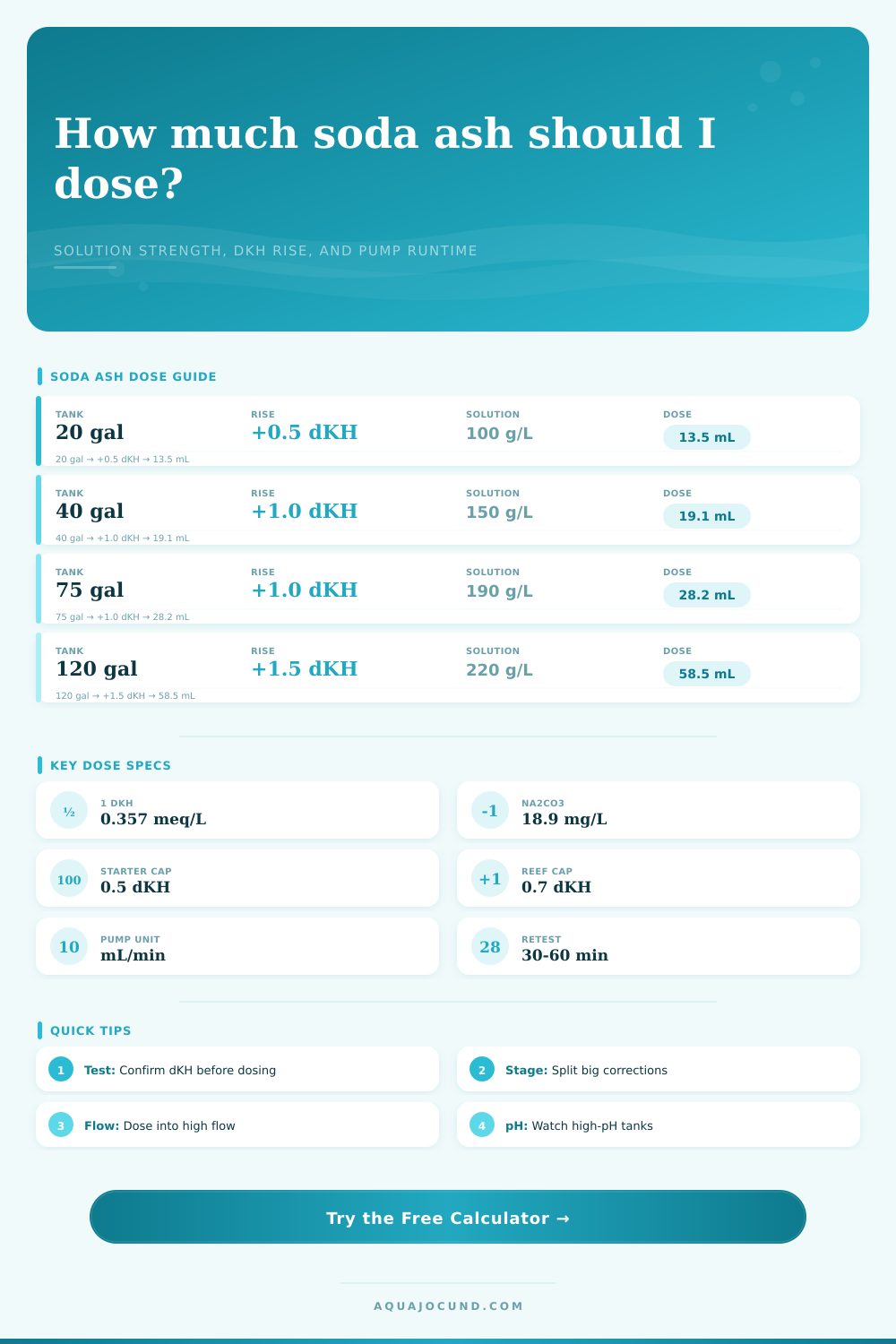
Another variable that impacts your dosing volume is solution strength. As seen in the reference table above, changing your solution strength will result in a different amount required for dosing. For manual dosing or a small tank, this is great since it results in a smaller volume of water needing to be dispensed (i.e., a stronger solution). If you’re calibrating with a dosing pump, a weaker solution may make calibration easier. That’s the trade-off of precision vs. Convenience.
Also, the calculator take into consideration the purity of your soda ash. Rarely does reef grade soda ash come at 100% purity. Taking this difference into account (i.e., ~9-10% variance) will prevent overdosing due to slight clumping or breakdown of your chemical.
The wildcard is the pH interaction with soda ash. As the soda ash dissolves, it also raise the pH. How much? That depends on your starting pH. If you have high pH (above 8.3) then you has to be even more careful. The tool will adjust itself according to how high or low your pH is. Meaning that the higher you enter, the higher the caution level.
When you dose, remember that timing can impact things. So if you dose during the day when plants are photosynthesizing, they will actualy increase the pH and compound the effect. Dosing at night or into a high-flow chamber such as a sump will help offset this concern.
This calculator recommends what run-time you should of set for your dosing pump. However, always double check the actual flow rate. Over time pumps drifts. Ten percent off on pump rate is ten percent off on your alkalinity, which compounds to big differences over time. You want something simple that you can count on, and you want it steady.
By keeping the level of alkalinity in a tight range you’re not asking your corals to work extra hard to keep their skeletons together. Use the numbers from the calculator but use the judgment yourself. Test before and after every dose. Retest at least half an hour (thirty to sixty minutes) after mixing the water.
If your water appears cloudy anywhere around where you’re doing the dosing, either reduce the rate or up the flow. Small incremental consistent actions build stability; don’t expect to do any heroic corrections to get there. Keep your doses small, your flow high, and your expectations realistic.