🧪 Target Calcium Dose Calculator
Calculate calcium chloride dosing from current calcium ppm to target ppm, including hydrate form, strength, split dosing, chloride impact, and alkalinity balance warnings.
| Source | Elemental Ca | Chloride Estimate | Calculator Note |
|---|---|---|---|
| Calcium chloride anhydrous, CaCl2 | 36.11% | 63.89% | Use only when the label confirms dry anhydrous CaCl2. |
| Calcium chloride dihydrate, CaCl2 2H2O | 27.26% | 48.23% | Common two-part calcium chloride form; store sealed. |
| Calcium chloride hexahydrate, CaCl2 6H2O | 18.29% | 32.36% | Weaker hydrate; requires more grams for the same Ca rise. |
| 77% calcium chloride flake | 27.81% effective CaCl2 basis | 49.20% effective chloride | Purity is built into the source, then strength field can fine tune. |
| 80% calcium chloride flake | 28.89% effective CaCl2 basis | 51.11% effective chloride | Useful for flake labels that state 80% CaCl2. |
| Liquid calcium solution | User entered | Depends on recipe | Enter label strength or stock ppm, then dose by mL estimate. |
| Tank Or Batch | Dimensions / Volume | CaCl2 2H2O For +20 ppm | Typical Use |
|---|---|---|---|
| 13.5 gallon nano | 22 × 12 × 13 in / 51 L | 3.8 g | Small reef correction |
| 20 gallon reef | 24 × 12 × 16 in / 76 L | 5.6 g | Soft coral or LPS tank |
| 40 breeder | 36 × 18 × 16 in / 151 L | 11.1 g | Moderate mixed reef |
| 75 gallon display | 48 × 18 × 21 in / 284 L | 20.8 g | Mixed reef correction |
| 120 gallon system | 48 × 24 × 24 in / 454 L | 33.3 g | SPS display, split larger rises |
| 25 gallon batch | Water-change container / 95 L | 6.9 g | Adjust new saltwater before exchange |
| Alkalinity | Practical Calcium Band | Balanced Cue | Warning Point |
|---|---|---|---|
| 6.5 to 7.5 dKH | 390 to 430 ppm | Lower nutrient or low-alk reef style | Avoid chasing calcium far above 450 ppm. |
| 7.5 to 8.5 dKH | 410 to 440 ppm | Common mixed reef target zone | Calcium chloride does not raise alkalinity. |
| 8.5 to 9.5 dKH | 420 to 455 ppm | Higher uptake systems | Watch precipitation if pH is high. |
| 9.5 to 11 dKH | 430 to 465 ppm | High alkalinity method | Stage calcium corrections and retest often. |
| Above 11 dKH | Confirm with testing | Not a simple calcium-only correction | High Ca plus high dKH can cloud or precipitate. |
| Calcium Rise | Typical Plan | Retest Cue | Calculator Handling |
|---|---|---|---|
| 0 to 15 ppm | Often one slow dose | After full circulation | Usually one stage unless max is lower. |
| 15 to 30 ppm | One or two additions | Same day or next day | Split by max daily rise input. |
| 30 to 60 ppm | Two to four days | Before final stage | Product dose divided evenly. |
| 60 ppm plus | Confirm test and recipe | Between every stage | Status warns and expands the split plan. |
Here you are with a bag of calcium chloride, a test kit and wondering if addition of another dose will help or hurt water chemistry. While calcium is critical for corals to build their skeleton, it’s tricky stuff to manage. It goes up fast, it can go down fast too. It reacts to many thing in the tank.
The calculator does all that work for you and tells you precisely how much to add. But what does it mean? What about biological aspects of these numbers? How do you know they won’t kill your livestock? More times than not, it’s not so much the math but what the material is that presents issue.
How to Add Calcium Chloride Safely
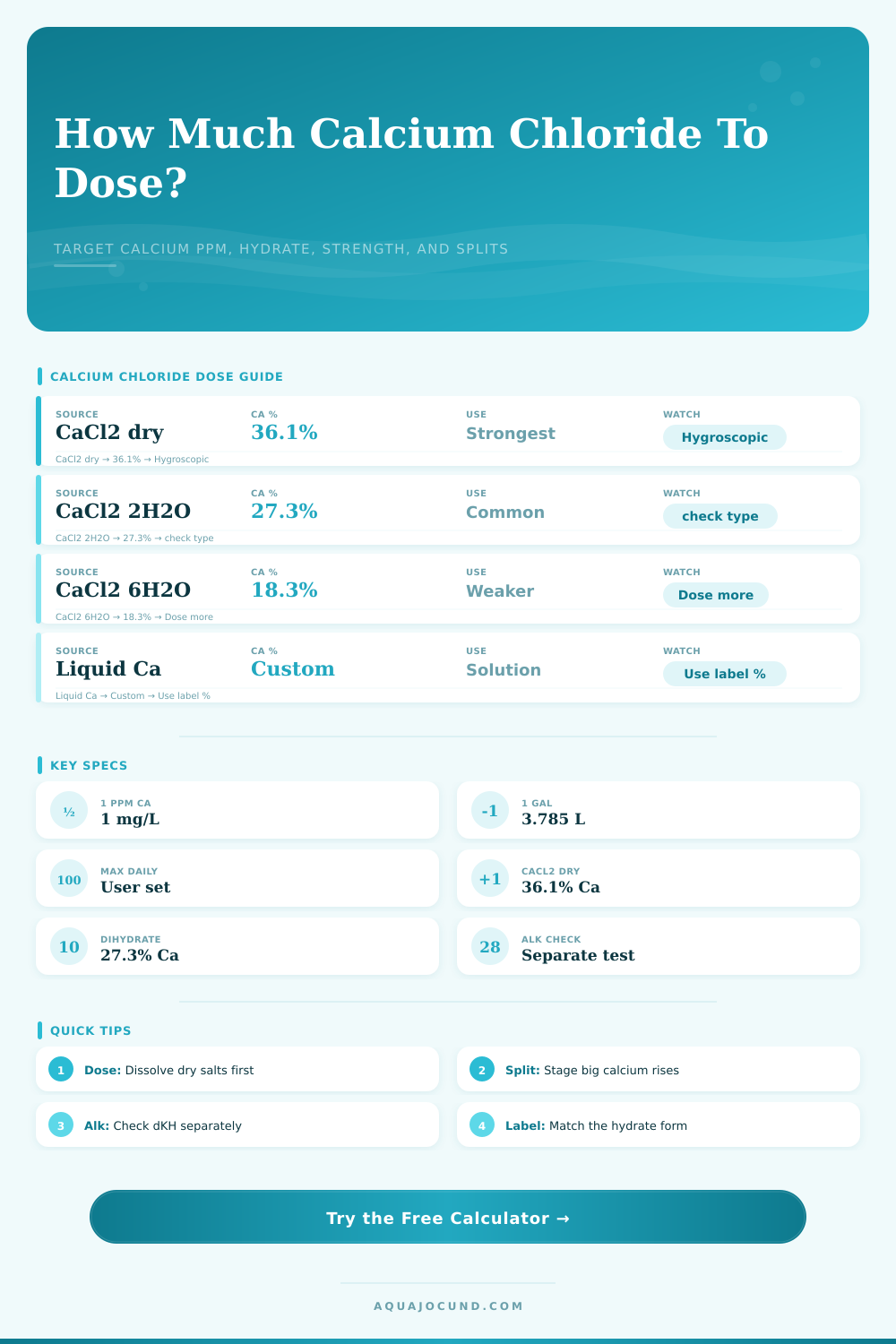
Calcium chloride isn’t one size fits all. There are two main types of calcium chloride. Anhydrous calcium chloride is pure, with about 36% elemental calcium by mass. Dihydrate calcium chloride contain water molecules within its chemical structure, which lowers amount of calcium to around 27%. Using either form interchangeably will result in underdosing your tank.
The calculator requires that you tell it which type you’re using and calculates the weight from there. A small entry avoids a big dosing mistake.
Speed of dosing matter as well. To account for this, the calculator includes split-dosing logic. Adding calcium too rapidly will fall out of solution (particualrly in hard water… I.e., high alkalinity). How fast your water can absorbs calcium depends on its capacity to dissolve that amount of calcium at any one time. When you add too much too fast the calcium reacts with carbonate to create solid calcium carbonate. Not only does this go to waste, but it’ll cloud up your water. Set the calculator to your max allowed daily dose. Typically, this is capped at 25 ppm. This means you have to spread out a big correction over multiple days. It’s slower, but it ensures the calcium stay dissolved and doesn’t shock your filtration system.
Magnesium, alkalinity, and calcium creates balance. Why? Because too much calcium can throw off pH if alkalinity is low. Too much calcium also can create white cloudiness if alkalinity is high. There’s a balance check in the calculator that alerts you to pay attention to your alkalinity levels. It won’t dose alkalinity for you (different chemical) but will alert you when the ratio isn’t correct.
Why? Because most newbies assume if they fix their calcium, everything about corals will be fixed. That is rarely true. Look at overall system. Not just one number.
The dose preparation is almost just as critical as dose calculation. Don’t dump a heap of dry salt into the tank. That will create a spot of highly concentrated salt. This can be toxic, killing sensitive fish, or caustic, burning corals. Instead, always dissolve the calcium chloride in a cup of fresh water. Stir well until all crystals are gone. Then drip/slowly add this solution to one corner of the tank where flow is highest. This allows for even distribution and avoids local buildup. Your technique determines whether that target is reached safely.
There’s a testing phase, it doesn’t account for everything. It predicts outcomes in perfect world situations. Biological ecosystems like your tank are complicated. Coral will grow differrently. Your live rock buffers things. It recommends retesting every time you do a split dose.
This isn’t about dumping chemicals into your tank. It’s about livig with an ecosystem. The numbers help you along, then observation verifies that it worked. Do the math, go with the split doses, allow it to work its way through the system and then add more if needed. Being patient aids your corals.