Target Alkalinity Dose Calculator
Calculate the alkalinity supplement amount, safe split schedule, and dosing pump runtime needed to reach a reef target dKH.
Soda Ash
Raises alkalinity and tends to lift pH, useful when the aquarium runs low pH and has strong gas exchange.
Bicarbonate
Raises alkalinity with less immediate pH lift, often chosen for gentler manual corrections.
Two-Part
Designed for routine paired calcium and alkalinity dosing after the tank demand is measured.
Kalkwasser
Adds alkalinity through evaporation replacement and needs extra caution because it has high pH.
| Reef Style | Common Target | Daily Rise Limit | Dosing Note |
|---|---|---|---|
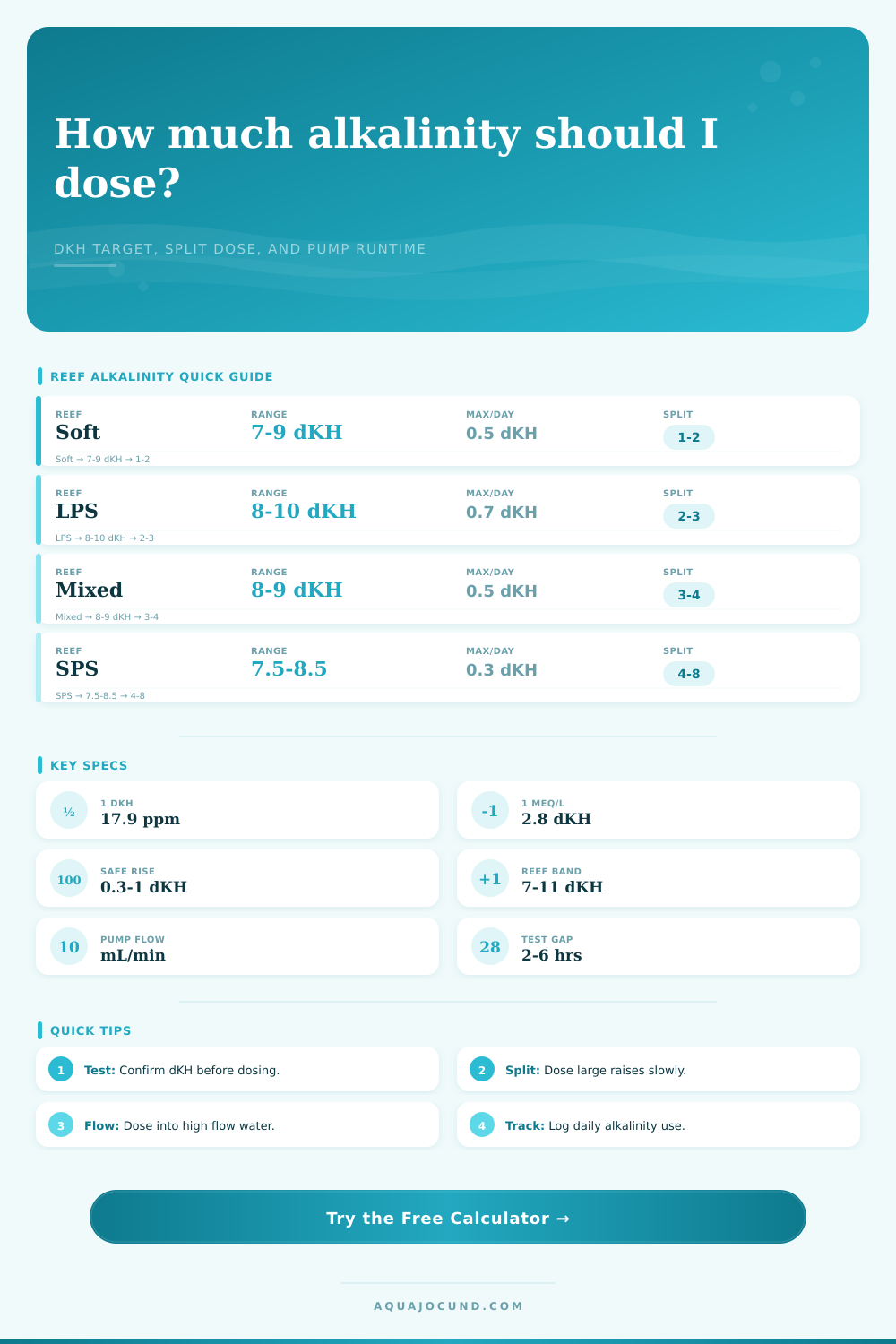
| Soft coral reef | 7.5-9 dKH | 0.5-0.8 dKH | Keep changes gradual when nutrients are low. |
| LPS reef | 8-10 dKH | 0.5-0.7 dKH | Split corrections around feeding and light cycle. |
| Mixed reef | 8-9 dKH | 0.4-0.6 dKH | Hold a narrow target once consumption is known. |
| SPS dominant | 7.5-8.5 dKH | 0.2-0.4 dKH | Avoid sharp rises, especially with very low nutrients. |
| Supplement Style | Typical Input | pH Effect | Best Use |
|---|---|---|---|
| Soda ash liquid | 15-20 mL | Raises pH | Daily dosing where pH trends low. |
| Sodium bicarbonate liquid | 18-25 mL | Mild change | Slower corrections and stable pH systems. |
| Balanced two-part alk | 12-22 mL | Varies | Automated maintenance after calcium is balanced. |
| Kalkwasser | Product based | High pH | Evaporation-linked supplementation only. |
| Splits/Day | Spacing | Correction Size | Use Case |
|---|---|---|---|
| 1 split | Manual | Tiny rises | Small nano adjustments under 0.2 dKH. |
| 2 splits | 12 hours | Low | Moderate correction in tolerant soft or LPS tanks. |
| 4 splits | 6 hours | Medium | Mixed reef corrections and routine automation. |
| 8+ splits | 3 hours | High care | SPS systems or any tank with sensitive alkalinity swings. |
| Display Size | Net Volume | 0.5 dKH Dose | Common Splits |
|---|---|---|---|
| 20 gal AIO | 16-18 gal | 6-8 mL | 1-2 |
| 40 breeder | 32-36 gal | 12-15 mL | 2-4 |
| 75 gal reef | 62-70 gal | 22-28 mL | 3-6 |
| 120 gal system | 100-115 gal | 36-46 mL | 4-8 |
The alarm goes off. You check your tank and notice your alk has dropped. You grab bottle of supplement, open the top, and dump some into the tank. You do this until your test kit register what you set as your target. Yay! It’s working! You feel like you’re controlling something, but in truth, you are panicking, and passing that panic off as keeping up with your tank.
The truth? Alk isn’t something you keep at a certain level; it’s something you adjust for as a buffer system. Adjusting it too far (up or down) will upset the overall chemical balance. Your corals depend on that buffer to protect them from extreme pH swings during the day and night cycle. Lights off). Dumping a bunch into your tank shocks your buffer right when they can least afford to have it knocked out from under them.
How to Manage Alkalinity Correctly
I’ve got a calculator that will do the math for you, and translate that complex chemistry into real milliliters (see above). But the true skill come from knowing what you’re putting into that calculator. You enter the volume of your system. But then the tool wants to know amount of displacement. What?
Displacement means water that isn’t there, the water displaced by canisters, sumps, rock, sand, etc. Your tank holds seventy-five gallons but only contains sixty-two gallon of seawater. You’re dosing for seventy-five. You’re overdosing. And yes, it’s a small error. But those additional milliliters adds up over time, forcing your alkalinity upward in search of a moving target that you generated yourself.
In addition, understand that different alkalinity supplements aren’t alike and some has higher concentrations than others (meaning they’re stronger). If you run your system low pH, raising both alkalinity and pH will be great. Unless you’re already at a stable pH. In that case, increasing your pH would be bad. A better choice for manual corrections are supplements containing bicarbonates, since they are gentler on the pH scale. That makes them a less risky bet when used for manual adjustment. The table at the top of the page explain this.
Bottom line: choose an alkalinity supplement appropriate for what your system actualy requires. Don’t just pick up whatever’s on sale. Since you can specify the product’s strength in the calculator, it will adjust the dose to match, so it won’t treat a milliliter of two-part solution the same as a milliliter of soda ash.
The second part of the equation are the splits. Increasing alkalinity by a full dKH all at once is dangerous, particularly if you keep an SPS or mixed reef. The dose size calculator figure out for you what number of splits (and how big) to apply each day to remain within the safety range for a given dKH rise. If total amount needed to reach your desired correction pushes above the safety band, the calculator informs you to split it up across a couple of days. It’s not slow per se. It’s steady.
While corals can acclimate to change, they don’t react well to shock. Breaking a large correction into four or eight smaller doses provides both corals and your biological filter time to handle it without any stress.
You should of time your testing to occur after mixing the full dose. Depending off your flow, this may take up to an hour or two. Testing before then will result in a false high which causes overdosing later. If consumption is fast, testing too late can result in missing the peak.
Consistency is key, when you do get a routine down, make sure to stick to it. Log what you use each day, look for trends, and change slowly. Managing alkalinity is not about having a perfect number everyday, but maintaining that number in a tight, stable range where life likes to stay. Start managing the buffer rather than chasing the number and you’ll find the tank easier to maintain.