Rimless Nano Volume Calculator
Estimate true display water after glass thickness, rimless freeboard, hardscape displacement, and water change marks.
📌Presets
📏Tank measurements
Volume breakdown
📊Rimless nano reference grid
⚖Displacement comparison
Minimal
About 3% for plants, small sponge filters, and light equipment in an open nano.
Planted
About 6% when substrate, plant mass, heater, and filter intake share the display.
Hardscape
About 12% when stones or wood occupy a visible part of the rimless layout.
Dense reef
About 18% for rock-heavy nano reefs where display water is noticeably reduced.
📋Common rimless nano sizes
| Nominal style | Outside size | Metric size | Typical true water | 25% change |
|---|---|---|---|---|
| 2 gal pico cube | 8 x 8 x 8 in | 20 x 20 x 20 cm | 1.4-1.6 gal | 0.35-0.40 gal |
| 5 gal cube | 12 x 12 x 10 in | 30 x 30 x 25 cm | 4.0-4.4 gal | 1.0-1.1 gal |
| 7 gal shallow | 18 x 11 x 9 in | 46 x 28 x 23 cm | 5.4-6.0 gal | 1.35-1.50 gal |
| 10 gal rimless | 18 x 12 x 12 in | 46 x 30 x 30 cm | 7.9-8.8 gal | 2.0-2.2 gal |
| 20 gal long | 24 x 15 x 13 in | 61 x 38 x 33 cm | 15.5-17.4 gal | 3.9-4.4 gal |
🧪Glass and freeboard guide
| Nano size | Common glass | Metric glass | Low freeboard | Safer freeboard |
|---|---|---|---|---|
| Under 5 gal | 0.16-0.20 in | 4-5 mm | 0.25 in | 0.5 in |
| 5-10 gal | 0.20-0.24 in | 5-6 mm | 0.5 in | 0.75 in |
| 10-20 gal | 0.24-0.31 in | 6-8 mm | 0.75 in | 1.0 in |
| 20-30 gal | 0.31-0.39 in | 8-10 mm | 1.0 in | 1.25-1.5 in |
💧Water change mark reference
| Change mark | Drop on 8 in fill | Drop on 10 in fill | Drop on 12 in fill | Use case |
|---|---|---|---|---|
| 10% | 0.8 in | 1.0 in | 1.2 in | Light weekly trim cleanup |
| 20% | 1.6 in | 2.0 in | 2.4 in | Routine planted nano change |
| 25% | 2.0 in | 2.5 in | 3.0 in | Common nano maintenance mark |
| 33% | 2.7 in | 3.3 in | 4.0 in | Larger reset without draining half |
| 50% | 4.0 in | 5.0 in | 6.0 in | Major service mark |
📝Calculation table
| Calculation | Formula | Imperial factor | Metric factor | Result meaning |
|---|---|---|---|---|
| Inside length | outside length - 2 glass | inches | cm | Water length between panes |
| Fill height | outside height - bottom glass - freeboard | inches | cm | Water column before scape |
| Display volume | L x W x fill height | 231 in3 per gal | 1000 cm3 per L | Water before displacement |
| Actual volume | display volume x (1 - displacement) | gal | L | Water available for dosing |
| Drop mark | fill height x change percent | inches | cm | Ruler mark below full line |
The label reads “twenty gallons” and your heart drops as you realize what’s in the box isnt even remotly close to twenty gallons. That’s okay, though; after all, you bought a twenty gallon long rimless aquarium that looks gorgeous on your shelf with its clean lines. But then you remember the open top, the thick glass, and how you plan to fill the tank with a ton of rocks.
Scam? Nah. This is simply the way the industry works. Companies know exactly how they’re misleading you. This is by design. They measure outside dimensions of the package (not the amount of water it holds) to meet the industry standard. To truly understand how much something will fit, you have to subtract the amount of physical material from the total available space. If only there were a tool that could do the math for you based off your own unique measurements… Well, there is now. Plug yours into the calculator above and let it take away the guesswork when it comes to conversions and coefficients.
How to Find the Real Size of Your Aquarium
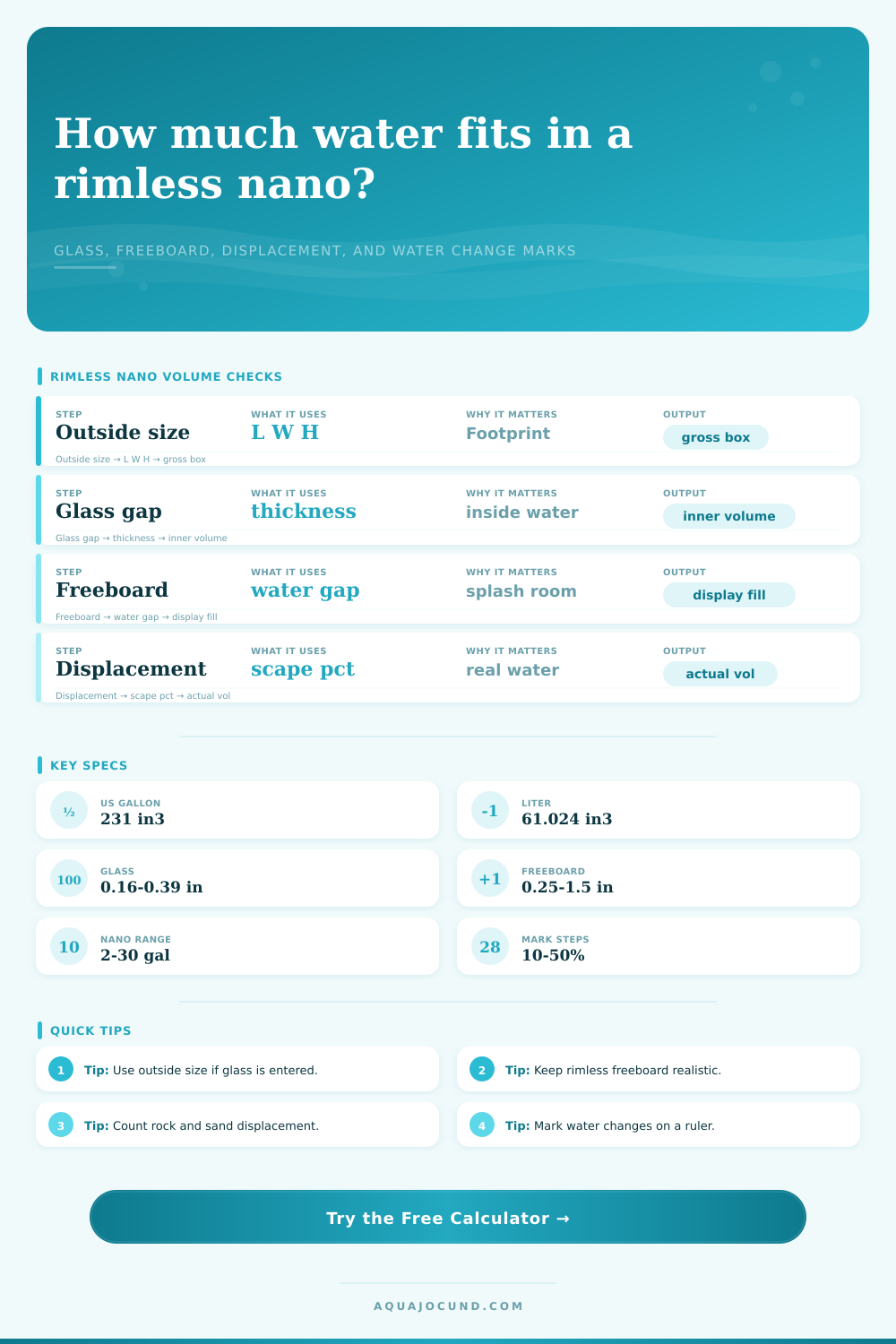
The first variable you have to wrestle with is the glass itself, which has nothing to do with substrate, plants, or decorations. Because in a rimless tank, those panes are exposed so every fraction of an inch counts. Aquarium glass come standard in sizes anywhere from six millimeter for smaller tanks to ten millimeters on large heavy duty tanks. Those numbers translate into fractions of an inch, which eat away at the interior height, width, and length of the tank. To calculate your tank’s usable volume, you need to measure its exterior and then subtract the glass thickness (twice) from both the width and the length and the height (once). That creates the inner void where water actually lives. And most folks fail to account for the fact that bottom pane consumes some of the vertical space as well. It rests below the gravel, raising the water level and thus reducing the usable column height. It is a small detail, but it matters when you’re trying to pack a certain number of fish into a given amount of space.
Next is freeboard, which is the space between the water’s surface and the tank’s rim. For an unbroken appearance, rimless tanks invite you to keep it full to the top, but that means one thing, flood city. Over time, evaporation will change your water level. Feeding makes things splash up onto the glass. A prudent freeboard is typically half an inch to an inch. It provides protection from spillage without sacrificing the beauty of open-tank looks. The chart on the page explains it all in a nutshell for various tank dimensions and it helps you know when to go with looks versus function.
After that there’s nothing sitting empty for very long. Now you start adding stones, driftwood, and substrate. That hardscape takes up some space, it displaces water! This reduce the amount of water available for your livestock. If you have a minimalist planted tank, you may only reduce the volume by five percent (plants + soil). If you have a super-dense iwagumi scape with lots of stone structures, you could easily knock off fifteen to twenty percent of the tank’s capacity. The amount displaced is the last piece in figuring out your real working volume. It’s not the volume the tank holds, but what remains once you put in your scenery.
How many gallons do I have? It’s important to know this to change water and add chemicals. You don’t want to add too little (and not get any benefit) or too much (and over treat). For example, if you have 20 gallons, you may be adding some medication for that amount but only have 16 gallons of water. That will cause overdosing. On the flip side, it can lead to underdosing because you’re not sure how much to add. The same is true for water changes. What looks like pulling out 25% doesn’t mean squat if you don’t know what the true gallons are. How do you measure the replacement water? You need to know that number. So put a tape across your water line on the tank so you can visualize what 25%, 50%, etc… means. In a tall tank, a ten inch drop could be ten percent. But in a shallow tank, it could be 30 percent.
This isn’t about filling a box; it’s about managing a biological system. Stable water parameters are the result of precision when calculating volume. Knowing precisely the contents of your tank transforms the hobby from chaos into science. It becomes a place where instead of guessing, you control. It changes your appreciation for the space from container to tuned environment. The numbers stop being abstract and become tools for maintenance. These are the small differences that make a big difference between a struggling nano and a thriving one.
In a small space, there’s competition for volume among the water, the stones, the freeboard, and the glass. Knowing where each of them takes away from the overall volume helps you plan ahead instead of reacting after-the-fact. What initially feels like the letdown of the “false” gallon number becomes a doable reality. The result is a beautiful-looking tank. It also operates reliably because you fully know what you’re dealing with, even though it should of been short of the sticker amount.