Aquarium Volume Per Inch of Height Calculator
Find gallons per inch, liters per centimeter, footprint area, fill marks, and water-change height from aquarium dimensions and displacement.
📌Tank Presets
📏Volume Per Height Inputs
Calculation Breakdown
📊Height Conversion Grid
🗂Correction Comparison
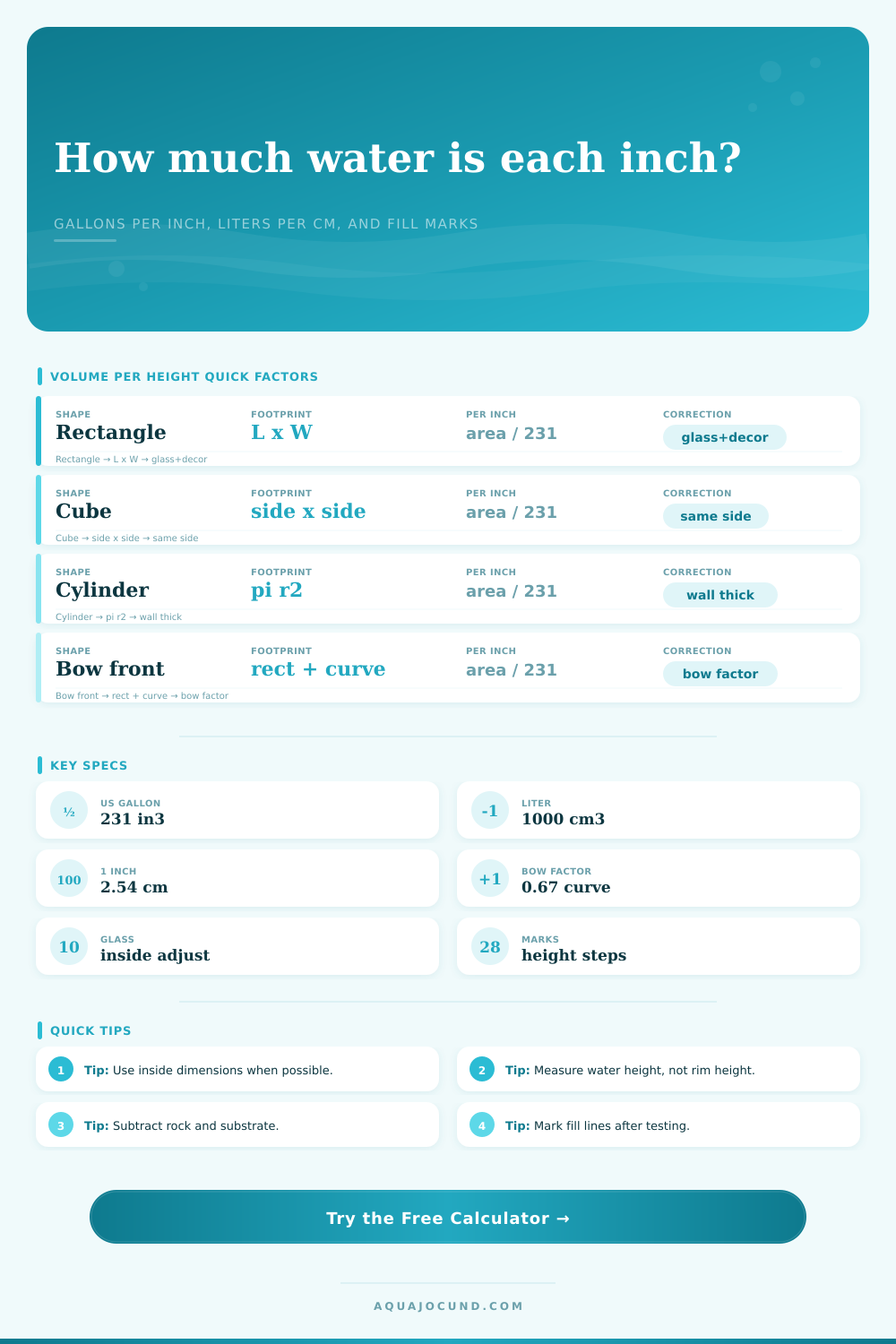
📐Shape Formula Table
| Tank shape | Footprint area formula | Volume per inch | Shape correction |
|---|---|---|---|
| Rectangle | inside length × inside width | area in² / 231 | Subtract two side panes when using outside dimensions |
| Cube | inside side × inside side | area in² / 231 | Length becomes both footprint sides |
| Cylinder | π × inside radius² | area in² / 231 | Subtract two wall thicknesses from diameter |
| Bow front | rectangle area + length × bow depth × 0.67 | corrected area / 231 | Curve factor estimates the rounded front segment |
| Custom | entered footprint area | entered area / 231 | Useful for L-shapes, sumps, or measured templates |
💧Common Tank Size Reference
| Common tank | Outside dimensions | Approx gallons per inch | Approx liters per cm |
|---|---|---|---|
| 10 gallon | 20 x 10 x 12 in / 51 x 25 x 30 cm | 0.85 gal/in | 1.27 L/cm |
| 20 long | 30 x 12 x 12 in / 76 x 30 x 30 cm | 1.53 gal/in | 2.28 L/cm |
| 29 gallon | 30 x 12 x 18 in / 76 x 30 x 46 cm | 1.50 gal/in | 2.24 L/cm |
| 40 breeder | 36 x 18 x 16 in / 91 x 46 x 41 cm | 2.73 gal/in | 4.06 L/cm |
| 55 gallon | 48 x 13 x 21 in / 122 x 33 x 53 cm | 2.62 gal/in | 3.90 L/cm |
| 75 gallon | 48 x 18 x 21 in / 122 x 46 x 53 cm | 3.67 gal/in | 5.46 L/cm |
📏Marked Fill Increment Guide
| Mark spacing | Best use | Example on 40 breeder | Note |
|---|---|---|---|
| 0.5 in / 1.3 cm | Small water changes or dosing checks | About 1.37 gal / 5.2 L | Good for nano and planted tanks |
| 1 in / 2.5 cm | General fill-line marks | About 2.73 gal / 10.3 L | Easy to read on most tanks |
| 2 in / 5.1 cm | Quick water-change planning | About 5.46 gal / 20.7 L | Useful for bucket matching |
| 5 cm / 2 in | Metric maintenance marks | About 20.3 L / 5.4 gal | Close to a 2 inch mark |
🧱Displacement Profile Table
| Profile | Typical displacement | Per-inch rate effect | When to use |
|---|---|---|---|
| Bare or quarantine | 0-2% | Nearly full footprint rate | Hospital, holding, or bare-bottom tanks |
| Light planted | 4-7% | Small net-volume reduction | Thin substrate and modest wood |
| Sand and driftwood | 6-10% | Moderate net-volume reduction | Community aquascapes |
| Rocky cichlid | 10-18% | Large lower-tank reduction | Stone piles or terrace layouts |
| Reef rock and sand | 12-20% | Large net-volume reduction | Live rock and reef structures |
| Measured displacement | User entered | Best for exact net volume | Bucket-test refill volume |
💡Practical Tips
You might have purchased the aquarium because of its inhabitants… The fish, but day in and day out it’s the water that you’re stuck with. The amount listed on the retail box is different than what fits within the limits of glass. That’s the space where most people makes their water maintenance errors. It’s the reason your water change feels like an exercise in guesswork, every single time. It’s also the reason you always feel like your bucket won’t quite reach manufacturer’s specifications.
Understanding which inches translate into how many gallons make for precise planning instead of vague estimation. A plan can mean knowing exactly how much ammonia you’ve removed; hope means hoping you got enough.
How to Calculate Your Tank’s Real Water Volume
The footprint is not what you normaly think it is. You’re going to need interior dimensions (not exterior) because glass is thick, and thicker glass mean less available interior room. A typical 1/4 inch pane on a 3 foot wide tank doesn’t sound like much but over the course of three feet of width, it adds up to a significant loss of space.
If the footprint is a rectangle, cylinder, or even some funky looking curvy one like a bow front (all cool, by the way), then our above calculator will handle math for you. It factors in both bottom and wall thickness so you can work off true water volume instead of shell volume. Just enter the numbers and boom, there’s your rate. It is your new best friend.
Now that you know gallons per inch, you can make water changes with real precision. You aren’t just guessing how high the water was. You also aren’t making wild guesses at what percentage you removed when siphoning. You can target an exact change in height. So if you wanted to drop the water five gallons in a tank that holds 2.5 gallons per inch, you’ll simply drop it two inches. No more wrestling with overflow and buckets. Quicker, cleaner, and much less stress on the livestock. Just use a strip of tape or a waterproof marker to draw right on the glass where those lines are. Makes the routine maintenance easy to see…and repeat.
Displacement is the silent volume thief. Substrate, driftwood, rocks, and coral all takes up space that water cannot occupy. Coral, rock, driftwood, substrate, these all displace water. You can fit much more water into a bare quarantine tank than one filled with heavy aquascaping. With this tool, you choose a displacement profile that most closely matches what’s in your tank (from a bare-bottom hospital tank to a very luxurius reef layout). It’s important to adjust this so you know how much net volume exists to dose chemicals and use as a filter. Dosing by the gross volume means you’re overdosing the fish. By doing so by net volume, you’re actualy treating what they swim in.
It’s easy to take a water height measurement, but it’s also easy to get lazy about it. Use a ruler and always measure the distance from the bottom of the tank (inside) to the top of the water line. Don’t measure from the outside rim because rims comes in all sizes and shapes. Make sure that when you start measuring, you have a constant reference point so that your math can stand the test of time.
You’ll be surprised how often you discover your “twenty-gallon” tank is really more like seventeen gallons of water after glass and other decor are considered. It’s not the manufacturer’s fault; it’s simply geometry. Understanding this makes managing your expectations easier, which means you won’t go overboard with stocking furnitures.
It’s laid out well on the page; there’s a handy reference table for the different common shapes (and their correction factor) that will help if you have an odd sump or are setting one up. But where it really comes into play is the day to day. Knowing your per-inch rate means you know how fast your tank will go down when changing water and rise when refilling. No more anxiety about it. No more wondering. Just knowing.
But ultimately, this isn’t about filling a box with water. This is about creating an environment where all those factors is consistent. You can dose with precision because you know precisely how much water is in there. Making it a controlled process rather than a chaotic chore. The next time you grab your siphon, consider that small line you drew directly on the glass to designate an inch. That line is more than just water level. It’s accuracy, it’s control, it’s a tank running exactly as you want it to.
You should of used this earlier.