Bowfront Tank Volume Estimator
Estimate curved-front aquarium capacity from rear width, bow depth, fill height, and displacement.
📌Bowfront Presets
📏Tank Measurements
Bowfront Volume Results
🧮Displacement Comparison Grid
📊Bowfront Formula Reference
| Step | Formula | Imperial Factor | Metric Factor |
|---|---|---|---|
| Rectangle footprint | Length × rear width | sq in | sq cm |
| Segment radius | L² / (8s) + s / 2 | L and s in inches | L and s in cm |
| Bow area | R² acos((R-s)/R) - (R-s) sqrt(2Rs-s²) | sq in | sq cm |
| Filled volume | (rectangle + bow) × fill height | divide by 231 | divide by 1000 |
| Usable volume | filled volume - displacement | US gallons | liters |
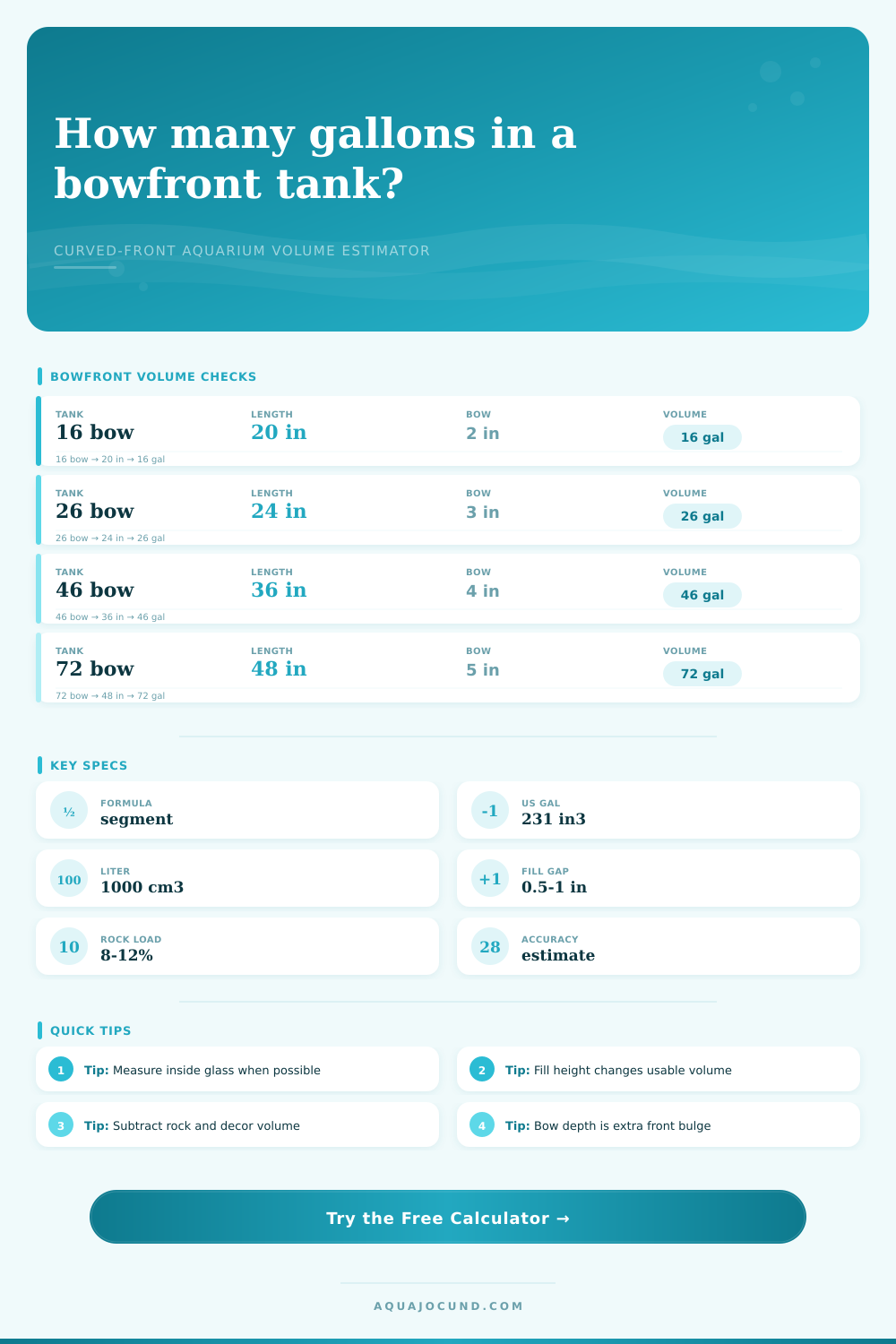
📐Common Bowfront Size Checks
| Nominal Tank | Typical Inside Dimensions | Metric Dimensions | Estimated Filled Volume |
|---|---|---|---|
| 5 mini bow | 16 × 7.5 + 1.1 bow × 9.5 in | 41 × 19 + 3 bow × 24 cm | 4.7-5.3 gal |
| 10 desktop bow | 18 × 9 + 1.6 bow × 11.5 in | 46 × 23 + 4 bow × 29 cm | 9-11 gal |
| 16 tall bow | 20 × 10 + 2.2 bow × 18 in | 51 × 25 + 6 bow × 46 cm | 15-17 gal |
| 26 bow | 24 × 12 + 3 bow × 20 in | 61 × 30 + 8 bow × 51 cm | 24-28 gal |
| 36 bow | 30 × 12 + 3.5 bow × 20 in | 76 × 30 + 9 bow × 51 cm | 34-38 gal |
| 46 bow | 36 × 12 + 4 bow × 19 in | 91 × 30 + 10 bow × 48 cm | 43-48 gal |
| 72 bow | 48 × 15 + 5 bow × 21 in | 122 × 38 + 13 bow × 53 cm | 68-75 gal |
| 155 bow | 72 × 18 + 6 bow × 23 in | 183 × 46 + 15 bow × 58 cm | 145-160 gal |
🌊Fill Height and Displacement Effects
| Adjustment | What It Changes | Typical Range | Volume Impact |
|---|---|---|---|
| Rim air gap | Reduces water depth | 0.5-1.5 in | 2-8% less |
| Substrate slope | Raises decor displacement | 1-3 in bed | 3-9% less |
| Rock hardscape | Displaces open water | Light to dense | 5-12% less |
| External filter | Adds water outside tank | Canister or sump | Tank calc excludes it |
🔍Bow Depth Measurement Guide
| Measurement | Use In Calculator | Best Method | Common Mistake |
|---|---|---|---|
| Length | Chord of curve | Measure straight left to right | Following the curved glass |
| Rear width | Rectangle depth | Back glass to straight front chord | Using full center depth |
| Bow depth | Segment sagitta | Extra center bulge only | Entering total front depth |
| Fill height | Actual water column | Substrate top to waterline if estimating water | Using outside tank height |
For normal rectangular aquariums, it’s easy. Just multiply length x width x height to get the gallon capacity. To convert to gallons, simply divide the answer by 231.
But for more complicated shapes like a bowfront aquarium, it gets tricky. A bowfront aquarium has curved glass, which makes geometry different than a regular rectangle. This mean the straightforward math doesn’t work anymore.
How to Calculate Water Volume in Bowfront Aquariums
The bowfront tank volume estimator do all this complicated math for you. Simply input exact curvature of your tank and it will give you an accurate estimate of how much water the tank holds.
Bowfront tanks have an advertised size but the available water capacity is less then the stated volume. For example, knowing a 46-gallon bowfront is full of water doesn’t help you dose or maintain it. What you want to know is how much water is in the water column? How much volume do the rock, substrate, and air space above take up? With the calculator you can set the fill level of the tank then subtract out the displacement from substrate, rock, etc.
Overdosing medications using the stated size are a very common error. For the calculator to work correctly, you have to know what you are inputting. What I call the rear width is a measurement of how far back the glass goes in a straight line to the point at which it curves outward again. Then there’s bow depth, the additional space the front glass extend past that mark.
On small tanks, this may be a slight curve, so measuring it precisely isn’t always easy. It depends on size of tank. You’ll get an overage if you measure the total depth and put it into the “rear width”. The calculator avoids that mistake by maintaining those entries separately, it makes you think about the shape. It forces you to look beyond the overall size.
Finally, many folks don’t consider displacement. For example, if you have lots of rock and other decor in your tank, it will reduce the effective volume of your tank (i.e., how much usable water it contains) by up to 10% or more. This calculator has some built-in presets based off decoration type. They’re approximations, but give you a nice margin of error.
Also be aware that if you have a sump or canister filter, the calculator only accounts for water inside the glass. While more water contained within your equipment does contribute to the amount of biological filtration available, it doesn’t get factored into the primary result.
A baseline provides an exact point from which to work so it’s easier to know what water should be changed and by how much. How much should of go out for a 20% water change? Exactly! No guessing required. Fill the bucket(s) precisely; do not take out too much, which stresses the fish, but do not take out too little, which causes a buildup of nutrients.
As shown in the reference tables included in the tool, even a half-inch difference in fill height can shift the volume by several gallons in your large tanks. That may not seem like much but it makes all the difference for the health of the tank.
Accurate volume estimation is about respecting the chemistry of your aquarium. Dissolved nutrients and waste products remains in the water until they are removed. The shape of the tank is not just a box; it’s also a complicated environment. If you factor in the water level, the displacement, and the bow, then you has a more accurate volume estimate.
More accurate volume estimates = healthier fish. More accurate volume estimates = better maintenance habits. More accurate volume estimates = a clearer picture of the aquarium’s ecosystem.
The curve of the glass improves the view, but understanding the space behind the glass help keep the ecosystem stable.