Aquarium Tank Gallons From Dimensions Calculator
Estimate gross capacity, usable fill, glass-thickness allowance, displacement, gallons, and liters from aquarium dimensions.
🐟Tank Presets
📏Dimension Inputs
Calculation Breakdown
📊Volume Conversion Grid
🗂Tank Shape Comparison
| Shape mode | Main formula | Glass allowance | Best use |
|---|---|---|---|
| Rectangle | length × width × fill height | Subtract two side panes and bottom pane | Most standard aquariums |
| Cube | side × side × fill height | Uses length as both inside sides | Nano cubes and reef cubes |
| Cylinder | π × radius² × fill height | Subtract wall thickness from diameter | Column and round tanks |
| Bowfront | rectangle + curved front segment | Subtract glass, then add bow curve volume | Curved front display tanks |
📐Common Tank Size Reference
| Common tank | Nominal outside dimensions | Nameplate volume | Typical net water |
|---|---|---|---|
| 5 gallon cube | 16 x 8 x 10 in / 41 x 20 x 25 cm | 5 gal / 19 L | 3.8-4.6 gal |
| 10 gallon | 20 x 10 x 12 in / 51 x 25 x 30 cm | 10 gal / 38 L | 8-9.5 gal |
| 20 long | 30 x 12 x 12 in / 76 x 30 x 30 cm | 20 gal / 76 L | 16-18.5 gal |
| 29 gallon | 30 x 12 x 18 in / 76 x 30 x 46 cm | 29 gal / 110 L | 23-27 gal |
| 40 breeder | 36 x 18 x 16 in / 91 x 46 x 41 cm | 40 gal / 151 L | 32-37 gal |
| 55 gallon | 48 x 13 x 21 in / 122 x 33 x 53 cm | 55 gal / 208 L | 44-51 gal |
| 75 gallon | 48 x 18 x 21 in / 122 x 46 x 53 cm | 75 gal / 284 L | 61-70 gal |
| 125 gallon | 72 x 18 x 21 in / 183 x 46 x 53 cm | 125 gal / 473 L | 103-117 gal |
⚙Glass Thickness Reference
| Profile | Typical wall | Typical bottom | Waterline habit |
|---|---|---|---|
| Rimmed glass tank | 0.125-0.375 in / 3-10 mm | Same or slightly thicker | Fill below inside trim |
| Rimless glass tank | 0.25-0.75 in / 6-19 mm | Often thicker than walls | Leave visible top gap |
| Low-iron display tank | 0.375-0.75 in / 10-19 mm | Usually reinforced bottom | Use exact inside fill height |
| Acrylic aquarium | 0.25-1 in / 6-25 mm | Bonded acrylic base | Measure inside if possible |
| Bowfront glass tank | 0.25-0.5 in / 6-13 mm | Profile varies by model | Use bow depth carefully |
🧮Displacement Planning Table
| Aquascape load | Typical displacement | What to enter | Why it matters |
|---|---|---|---|
| Bare tank or quarantine | 0-3% | 0 to 1 gal per 40 gal | Near-gross water volume |
| Light planted layout | 4-8% | 1.5 to 3 gal per 40 gal | Substrate and wood reduce water |
| Rocky cichlid tank | 8-18% | 4 to 9 gal per 55 gal | Stone piles displace a lot of water |
| Reef display with rock | 10-20% | 5 to 15 gal per 75 gal | Rock and sand affect dosing volume |
| Heavy aquascape | 15-25% | Measure by refill if possible | Net volume can be far below label |
💡Practical Tips
I’m sure many people think that their new tank contains exactly the number of gallons it was rated for on the label. Not so! That is container’s size, not the actual amount of water you are treating or filling it with. New aquarists are frequently burned by this difference, whether they’re calculating medication doses or mixing saltwater; resulting in costly mistakes. Overdosing your fish, or not adding enough salt to a reef tank, is stressful for animals and frustrating for you.
So what’s the problem? It has to do with real world vs geometric calculations. On the outside, a typical five gallon tank is maybe 16 inches long, 8 inches wide, and 10 inches tall (outside dimensions). That’s not how much water it holds because the outside dimensions also contain thickness of the glass, width of plastic rim, air gap above the water, etc. You are measuring the exterior size of something that includes empty space which won’t be filled with water. If you want to know how many gallons of liquid fit into a certain size container, you need to remove the allowance for the glass and account for where your water level sit inside the tank.
Why Your Tank Holds Less Water Than It Says
The calculator does that math for you. Taking the glass allowance out and factoring in your fill level. So if you want to know how much water can fits in your tank different than how big your tank is, then you have the number you’re looking for. Take care to measure inside dimensions and use a tape measure. Newer rimless aquariums has much thicker glass than older rimmed tanks. You must account for this change when getting the glass thickness from the tool.
Most importantly, remember it’s the inside space that counts. Don’t include the casing in your measurement unless you have inside/outside dimensions. Enter your full tank height but don’t fill it all the way to the top, reserve some “headspace” since most people like an inch or two between the top of the water and the rim of the tank. This air gap allows for gas exchange as well as prevents your fish from leaping out of the tank. Your volume will be overestimated if you simply plug in the full tank height without accounting for the air gap, resulting in unstable water parameters and diluted treatments.
The second thing that reduces volume is displacement. The volume of water in a bare tank can be expected to be exactly that… Whatever the nameplate says. However, once you start filling it with rock, substrate, and wood, those materials begin to reduce your water volume considerabley. Sand and rock displace water at a ratio of 1:1. So, if you have a gallon of sand in your tank, you now have a gallon less water in the tank. For someone doing dosing, this is important as adding chemicals at the listed dose rate when half of the tank contains rock amounts to twice the dose.
Displacement can represents 10-20% of the tank’s volume, which is not uncommon for heavily landscaped or cichlid tanks. This results in a noticeable change in water chemistry, not a rounding error.
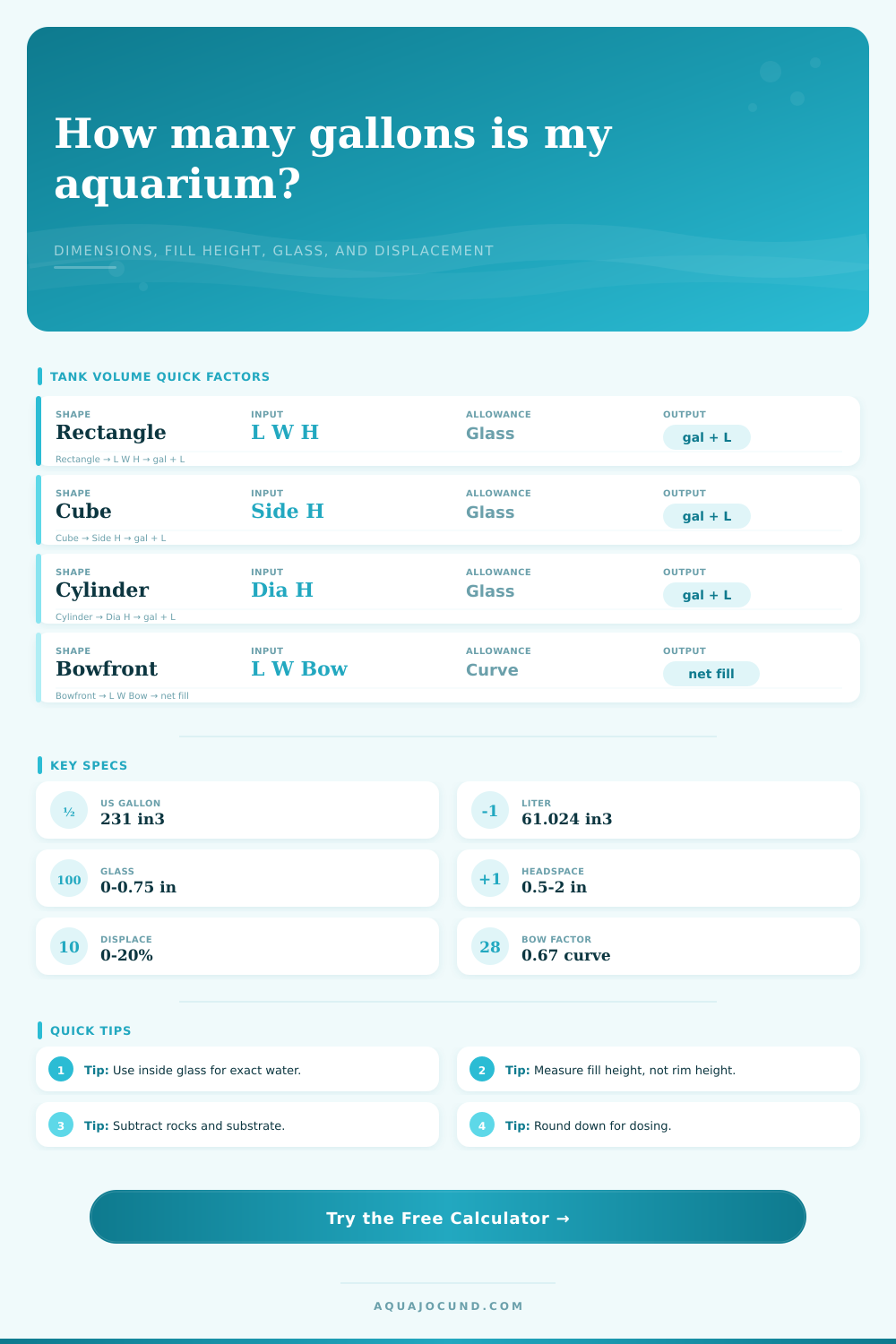
It also adjusts for variation in shape. Cylindrical tanks require calculating radii different than just width x length. The same goes for curved front (bowfront) tanks. Those rounded sides provides extra volume over a plain rectangle, yet they don’t fit your mind’s quick “it’s rectangular” mental shortcut. It may look cool but it doesn’t compute like a normal box does! The web page has a reference table demonstrating what formula to use based off the tank shape.
This ensures you can trust the result because you know the calculations accounts for the tank’s curves or the glass thickness. For example, if mixing aquarium salt or dosing meds, knowing the calculation is compensating for curve factor gives you confidence in the result.
Volume accuracy is the basis for quality husbandry. This means going from guess work to precision. You still begin with a box but you now maintain a precise chemical environment because the water isn’t the glass. The water matters.